• Skip to primary navigation
  • Skip to main content
  • Skip to primary sidebar

Carnegie Museum of Natural History

One of the Four Carnegie Museums of Pittsburgh

  • Visit
    • Buy Tickets
    • Visitor Information
    • Exhibitions
    • Events
    • Dining at the Museum
    • Celebrate at the Museum
    • Powdermill Nature Reserve
    • Event Venue Rental
  • Learn
    • Field Trips
    • Educator Information
    • Programs at the Museum
    • Bring the Museum to You
    • Guided Programs FAQ
    • Programs Online
    • Climate and Rural Systems Partnership
  • Research
    • Scientific Sections
    • Science Stories
    • Science Videos
    • Senior Science & Research Staff
    • Museum Library
    • Science Seminars
    • Scientific Publications
    • Specimen and Artifact Identification
  • About
    • Mission & Commitments
    • Directors Team
    • Museum History
  • Tickets
  • Give
  • Shop

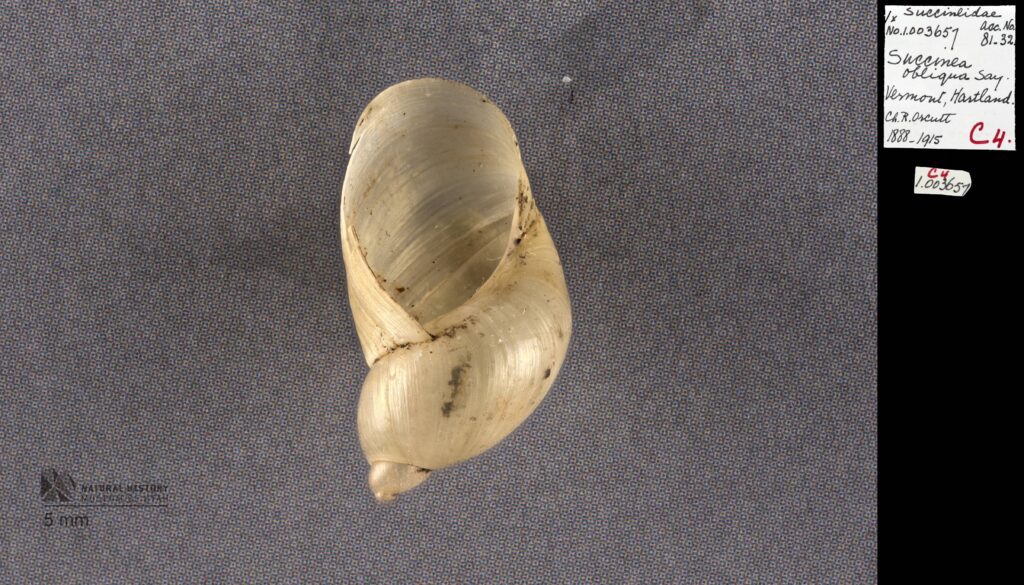
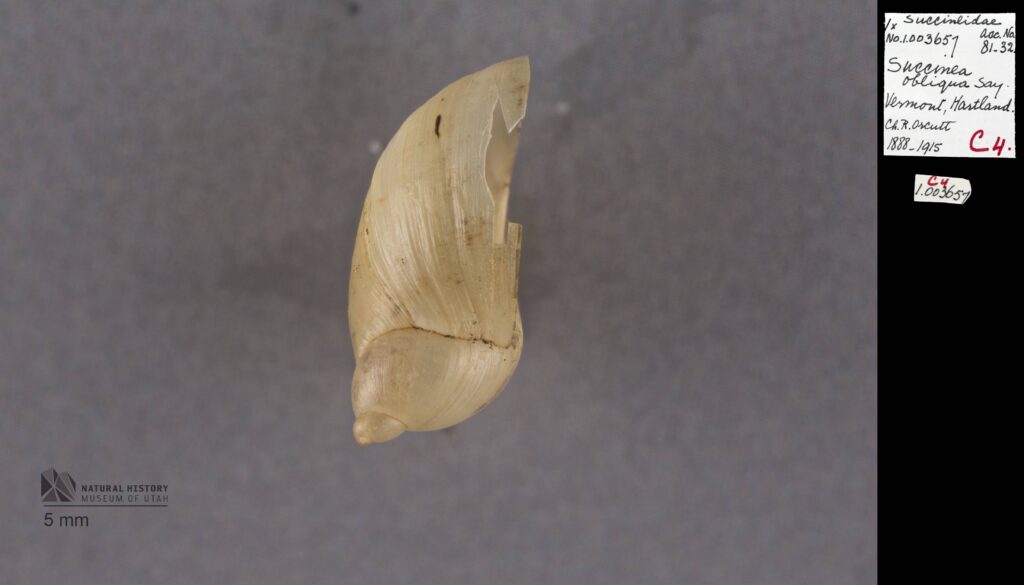
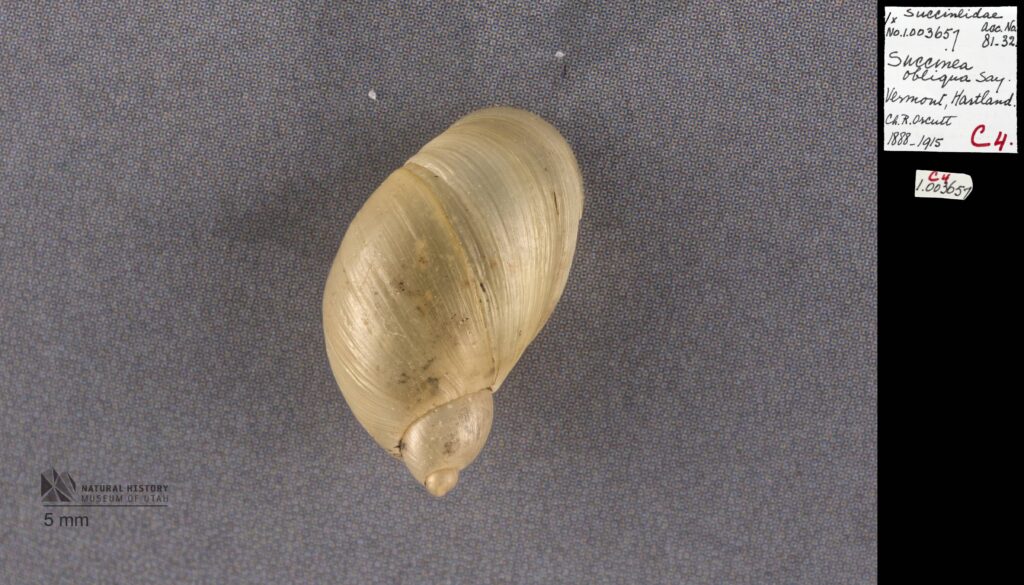
Novisuccinea ovalis

Image Usage Information

  • Natural History Museum of Utah
  • Public Domain
  • For additional information about this specimen: Christy Bills (cbills@nhmu.utah.edu)

Family: Succineidae

Common name: Oval Ambersnail

Discovery: Say, 1817

Identification

Height: 14.2-16.5 mm
Width: 9-11 mm
Whorls: 2+

Novisuccinea ovalis is a medium-sized snail with a transparent, glossy yellow shell. The fragile shell has a rela­tively low spire and an oval aperture about two-thirds the height of the entire shell. The animal is pale with dark upper antennae. There are several look-alike members of its family, but it tends to be large and has more rounded whorls than its congeners.

Ecology

Novisuccinea ovalis can be found among herbaceous plants along ditches, streams or rivers, but also in hillside woods, sometimes hundreds of meters from water. It typi­cally occurs in moderate to low numbers. It is the most upland-dwelling species in the Family Succineidae.

Taxonomy

Novisuccinea ovalis has also been known as: Helix (Cochlohydra) ovalis, H. (C.) putris, Succinea campestris, S. obliqua, S. totteniana, S. ovalis, and S. ovatis.

Distribution

This species is found throughout the eastern and Midwestern states and provinces, but also a bit further south along the Mississippi and Appalachian Mountains. It is found in the western Virginia mountains.

Conservation

NatureServe Global Rank: G5, Secure

sidebar

About

  • Mission & Commitments
  • Directors Team
  • Museum History

Get Involved

  • Volunteer
  • Membership
  • Carnegie Discoverers
  • Donate
  • Employment
  • Events

Bring a Group

  • Groups of 10 or More
  • Birthday Parties at the Museum
  • Field Trips

Powdermill

  • Powdermill Nature Reserve
  • Powdermill Field Trips
  • Powdermill Staff
  • Research at Powdermill

More Information

  • Image Permission Requests
  • Science Stories
  • Accessibility
  • Shopping Cart
  • Contact
  • Visitor Policies
One of the Four Carnegie Museums | © Carnegie Institute | Privacy Policy | Terms of Use | Accessibility
Rad works here logo