• Skip to primary navigation
  • Skip to main content
  • Skip to primary sidebar

Carnegie Museum of Natural History

One of the Four Carnegie Museums of Pittsburgh

  • Visit
    • Buy Tickets
    • Visitor Information
    • Exhibitions
    • Events
    • Dining at the Museum
    • Celebrate at the Museum
    • Powdermill Nature Reserve
    • Event Venue Rental
  • Learn
    • Field Trips
    • Educator Information
    • Programs at the Museum
    • Bring the Museum to You
    • Guided Programs FAQ
    • Programs Online
    • Climate and Rural Systems Partnership
  • Research
    • Scientific Sections
    • Science Stories
    • Science Videos
    • Senior Science & Research Staff
    • Museum Library
    • Science Seminars
    • Scientific Publications
    • Specimen and Artifact Identification
  • About
    • Mission & Commitments
    • Directors Team
    • Museum History
  • Tickets
  • Give
  • Shop

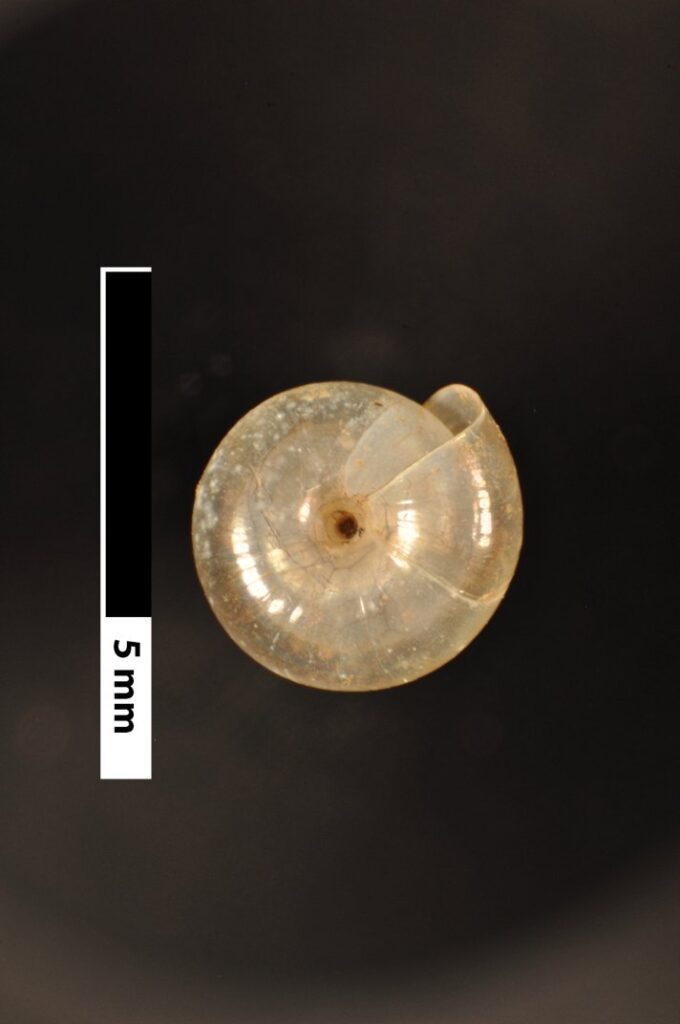
Paravitrea tridens

Image Usage Information

  • The Academy of Natural Sciences of Philadelphia
  • CC BY-NC 4.0 DEED
  • For additional information about this specimen: Gary Rosenberg (rosenberg.ansp@drexel.edu)

Family: Pristilomatidae

Common name:  White-foot Supercoil

Discovery: Pilsbry, 1946

Identification

Width: 5.5-6.5 mm
Height: 2.5-3.5 mm
Whorls: 6+

The spire of Paravitrea tridens is low but distinctively dome-shaped and somewhat pointed. The shell is lined with radial growth wrinkles and the periphery appears a bit oblong. The aperture is larger than in other Paravitrea species. As a juvenile, the shell may have between one and three sets of three teeth each, radially-aligned inside the final whorl. These disappear with age, however, and the adult shell is toothless.

Ecology

This animal may be found in moist leaf litter on mountain hillsides (Hubricht, 1985).

Taxonomy

Paravitrea tridens has also been known as Paravitrea capsella tridens.

Distribution

Paravitrea tridens is only known from a few counties in the easternmost Appalachian Mountains of Tennessee (Hubricht, 1985). It might be found in nearby western Virginia, perhaps Washington, Grayson, or Smyth Counties. The species is not yet reported.

Conservation

NatureServe Global Rank: G2
NatureServe State Rank: SNR

sidebar

About

  • Mission & Commitments
  • Directors Team
  • Museum History

Get Involved

  • Volunteer
  • Membership
  • Carnegie Discoverers
  • Donate
  • Employment
  • Events

Bring a Group

  • Groups of 10 or More
  • Birthday Parties at the Museum
  • Field Trips

Powdermill

  • Powdermill Nature Reserve
  • Powdermill Field Trips
  • Powdermill Staff
  • Research at Powdermill

More Information

  • Image Permission Requests
  • Science Stories
  • Accessibility
  • Shopping Cart
  • Contact
  • Visitor Policies
One of the Four Carnegie Museums | © Carnegie Institute | Privacy Policy | Terms of Use | Accessibility
Rad works here logo