

Image Usage Information
Family: Polygyridae
Common name: Proud Globelet
Discovery: Greene, 1827
Identification
Width: 15-20 mm
Height: 10.2-15 mm
Whorls: 5.5-6
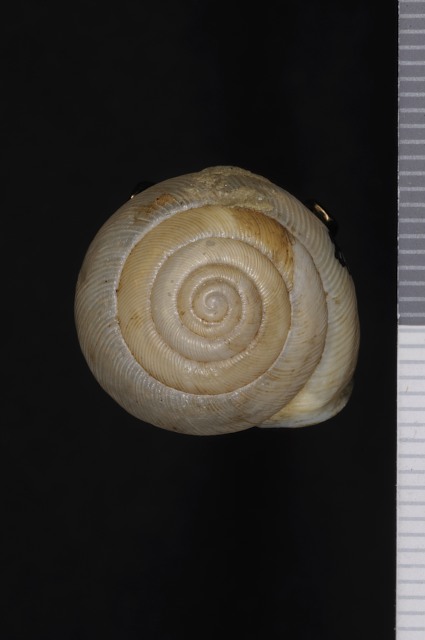
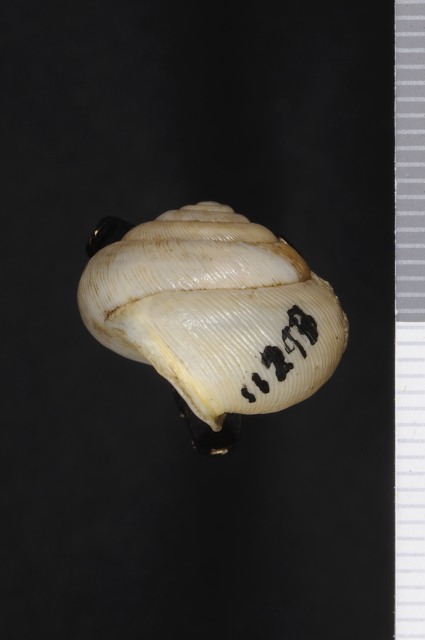
The shell of Patera pennsylvanica is nearly round, only a bit depressed heliciform. The top edge of the aperture points abruptly downward and is only slightly reflected. The right side of aperture is angular, not as rounded as in other Patera species. The shell is imperforate with no teeth, its whorls are tightly coiled, and the color is light tan to yellowish-olive. Transverse striae are well-developed and spiral striae is always present and a strong feature. This species is similar to Patera appressa but lacks a parietal denticle, has a higher spire, and the last whorl strongly descends at the aperture (Grimm et al., 2009).
Ecology
Patera pennsylvanica is usually found on wooded hillsides or in ravines, under leaf litter, or under rocks as well as grassy hillsides (Hubricht, 1985). In West Virginia it has been found on limestone slopes and can be fairly common in mature stands of sugar maple. It is also found in open road cuts and grassy areas along abandoned railroad beds, suggesting that it may have “hitchhiked” to those locations on railroad cars or automobiles.
Taxonomy
The true phylogenic position of Patera pennsylvanica is unclear. It could be a member of the Patera clade, or a unique relict of an isolated, look-alike genus within the Mesodontini tribe (Emberton, 1991). Synonyms include Mesodon pennsylvanicus, Helix pennsylvanicus, Helix pennsylvanica, and Polygyra pennsylvanica.
Distribution
This is a native snail of the central-eastern United States including Illinois, Indiana, Kentucky, Missouri, Michigan, and Ohio, as well as Ontario, Canada. In the Northeast it is known only from Pennsylvania and West Virginia.
Conservation
NatureServe Rank: G3. NatureServe State Ranks: Pennsylvania (S1), West Virginia (S2). This species is uncommon in the Northeast states in which it occurs.
