• Skip to primary navigation
  • Skip to main content
  • Skip to primary sidebar

Carnegie Museum of Natural History

One of the Four Carnegie Museums of Pittsburgh

  • Visit
    • Buy Tickets
    • Visitor Information
    • Exhibitions
    • Events
    • Dining at the Museum
    • Celebrate at the Museum
    • Powdermill Nature Reserve
    • Event Venue Rental
  • Learn
    • Field Trips
    • Educator Information
    • Programs at the Museum
    • Bring the Museum to You
    • Guided Programs FAQ
    • Programs Online
    • Climate and Rural Systems Partnership
  • Research
    • Scientific Sections
    • Science Stories
    • Science Videos
    • Senior Science & Research Staff
    • Museum Library
    • Science Seminars
    • Scientific Publications
    • Specimen and Artifact Identification
  • About
    • Mission & Commitments
    • Directors Team
    • Museum History
  • Tickets
  • Give
  • Shop

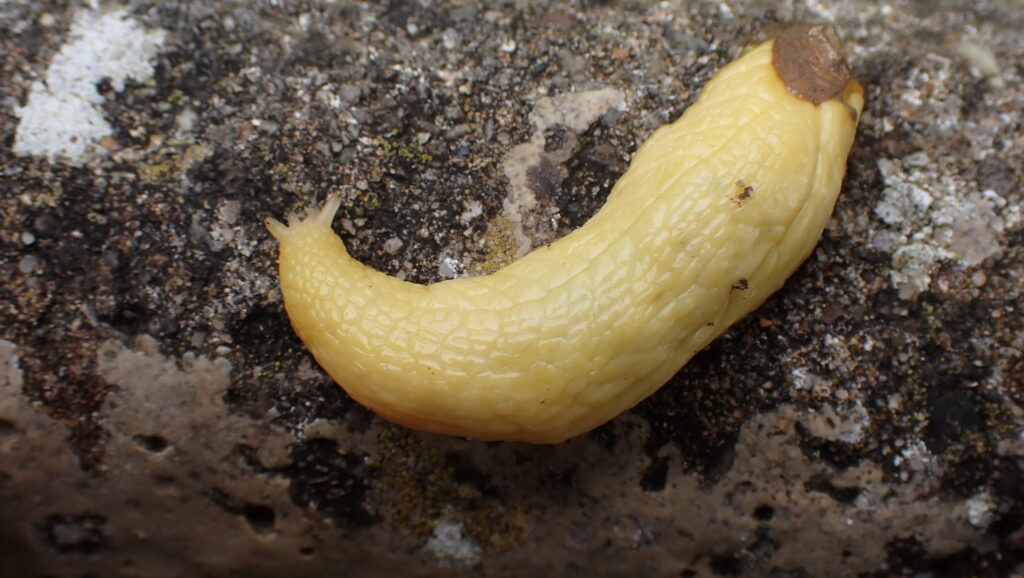
Testacella haliotidea

Image Usage Information

  • Julien Tchilinguirian
  • CC BY-NC 4.0 DEED
  • Additional information about this specimen

Family: Testacellidae

Common name: Shelled slug, Earshell slug

Discovery: Draparnaud, 1801

Identification

Length: 80-120 mm

Testacella haliotidea is cream-colored or yellow above, whitish on its foot. It has a small shell upon the dorsal posterior surface of the tail, and this shell barely covers the junction of two pronounced lateral grooves.

Ecology

Found in gardens, parks, fields, and vineyards (Kerney and Cameron, 1979), T. haliotidea is a predator of earthworms and other snails. Laboratory work showed that T. haliotidea may take from 40 minutes to three days to eat a worm (Stokes and Hirst, 1958). The slug’s eggs are laid under the soil in clutches of up to 40 and turn from white to brown soon after laying. Some eggs in the laboratory took nearly two years to hatch. Some of the slugs aestivated sporadically in a coating of mucus and soil (Stokes and Hirst, 1958).

Taxonomy

Testacella europaea is a synonym.

Distribution

Western Europe and the western Mediterranean (Kerney and Cameron, 1979)

Conservation

NatureServe Global Rank: G5, Apparently secure.

sidebar

About

  • Mission & Commitments
  • Directors Team
  • Museum History

Get Involved

  • Volunteer
  • Membership
  • Carnegie Discoverers
  • Donate
  • Employment
  • Events

Bring a Group

  • Groups of 10 or More
  • Birthday Parties at the Museum
  • Field Trips

Powdermill

  • Powdermill Nature Reserve
  • Powdermill Field Trips
  • Powdermill Staff
  • Research at Powdermill

More Information

  • Image Permission Requests
  • Science Stories
  • Accessibility
  • Shopping Cart
  • Contact
  • Visitor Policies
One of the Four Carnegie Museums | © Carnegie Institute | Privacy Policy | Terms of Use | Accessibility
Rad works here logo