• Skip to primary navigation
  • Skip to main content
  • Skip to primary sidebar

Carnegie Museum of Natural History

One of the Four Carnegie Museums of Pittsburgh

  • Visit
    • Buy Tickets
    • Visitor Information
    • Exhibitions
    • Events
    • Dining at the Museum
    • Celebrate at the Museum
    • Powdermill Nature Reserve
    • Event Venue Rental
  • Learn
    • Field Trips
    • Educator Information
    • Programs at the Museum
    • Bring the Museum to You
    • Guided Programs FAQ
    • Programs Online
    • Climate and Rural Systems Partnership
  • Research
    • Scientific Sections
    • Science Stories
    • Science Videos
    • Senior Science & Research Staff
    • Museum Library
    • Science Seminars
    • Scientific Publications
    • Specimen and Artifact Identification
  • About
    • Mission & Commitments
    • Directors Team
    • Museum History
  • Tickets
  • Give
  • Shop

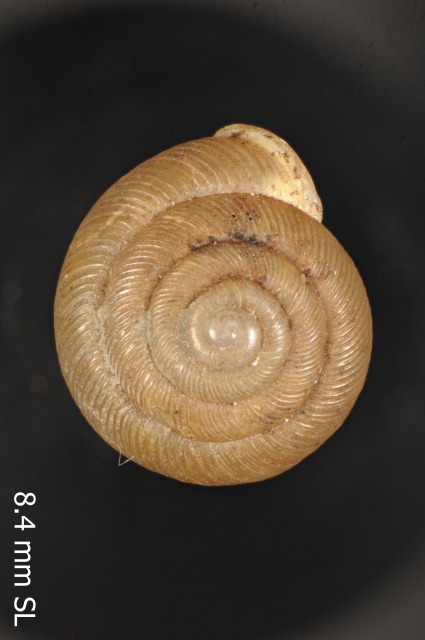
Triodopsis hopetonensis

Image Usage Information

  • The Academy of Natural Sciences of Philadelphia
  • CC BY-NC 4.0 DEED
  • For additional information about this specimen: Gary Rosenberg (rosenberg.ansp@drexel.edu)

Family: Polygyridae

Common name: Magnolia Threetooth

Discovery: Shuttleworth, 1852

Identification

Width: 11-13 mm
Height: 5.5-6.5 mm
Whorls: 5+

The three-toothed Triodopsis hopetonensis has a medium-sized, tongue-shaped parietal denticle, a thick, rounded tooth on the peristome, and a small basal tooth upon a buttress. Compared with T. fallax, the narrow umbilicus is not deep and the teeth are more widely spaced. The depressed-globose outer shell has close radial striae. Its central spire is somewhat pronounced.

Ecology

This snail prefers moderately damp habitats, and often occurs in large numbers. It may be found in woodland, in open grassy areas, and very commonly in urban settings (Hubricht, 1985). It can also be seen near salt or brackish water (Pilsbry, 1940).

Taxonomy

Other names for T. hopetonensis include Helix hopetonensis, H. tridentata, H. t. var. ephabus, Polygyra hopetonensis, P. h. var. charlestonensis, and Triodopsis fallax hopetonensis.

Distribution

Triodopsis hopetonensis is widespread throughout the southeastern United States, stretching as far north as Maryland and west to Louisiana, especially along the coast. In Virginia it lives on the southeastern shore and Piedmont.

Conservation

NatureServe Global Rank: G4G5
NatureServe State Rank: S3S4

sidebar

About

  • Mission & Commitments
  • Directors Team
  • Museum History

Get Involved

  • Volunteer
  • Membership
  • Carnegie Discoverers
  • Donate
  • Employment
  • Events

Bring a Group

  • Groups of 10 or More
  • Birthday Parties at the Museum
  • Field Trips

Powdermill

  • Powdermill Nature Reserve
  • Powdermill Field Trips
  • Powdermill Staff
  • Research at Powdermill

More Information

  • Image Permission Requests
  • Science Stories
  • Accessibility
  • Shopping Cart
  • Contact
  • Visitor Policies
One of the Four Carnegie Museums | © Carnegie Institute | Privacy Policy | Terms of Use | Accessibility
Rad works here logo