Image Usage Information
Family: Polygyridae
Common name: Brush Creek Threetooth
Discovery: Hotopp, 2015
Identification
Width: 13.1-17.6 mm
Height: 7-9 mm
Whorls: 4.76-5.5
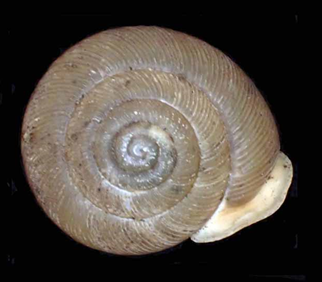
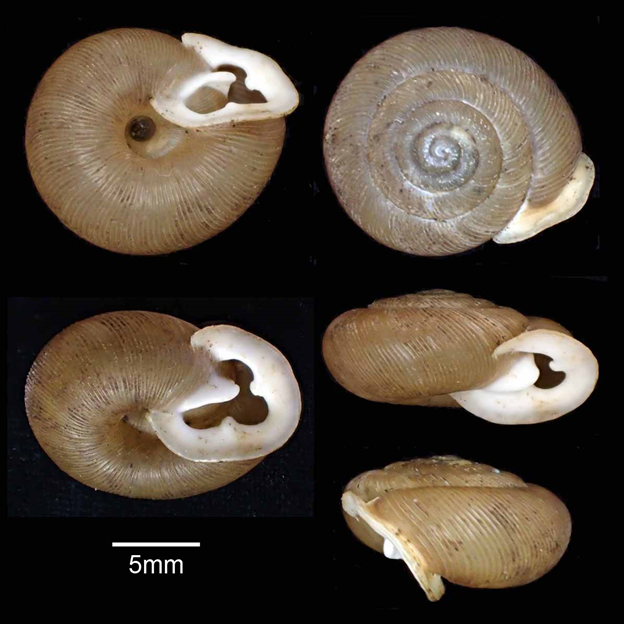
As with Triodopsis juxtidens juxtidens, this snail possesses a typical threetooth shell, with three tooth-like barriers in the aperture and the shell has a microsculpture of fine ridges and an open umbilicus on a depressed heliciform shell. Both T.j. juxtidens and T.j. robinae differ from the similar T. tridentata by having a parietal tooth that points at or above its palatal tooth, when viewed perpendicular to the aperture plane. T.j. robinae differs from T.j. juxtidens in having a more triangular aperture, a basal denticle sitting on a buttress, with an exceptionally wide lip especially near the base, and from the upper lip attachment, the lip initially extends upwards more strongly in T.j. robinae. The basal denticle is deeper than wide, set perpendicular to the aperture upon a horizontal buttress, the buttress usually taller to the palatal side of the tooth. No other Triodopsis has a triangular aperture along with a parietal lamella pointing at the palatal denticle and a basal denticle upon a buttress (Hotopp 2015).
Ecology
Triodopsis juxtidens robinae occurs on and in leaf litter on steep, rocky, mesic forested slopes, among cliffs, upon sandstone talus; forest of mixed eastern hemlock (Tsuga canadensis L.(Carr.) )-hardwood forest.
Taxonomy
No synonyms.
Distribution
Triodopsis juxtidens robinae occurs on forested slopes of the Bluestone River Valley and tributaries in Mercer and Summers Counties, West Virginia, U.S.A. (Hotopp 2015).
Conservation
NatureServe Global Rank: T1, Critically Imperiled — At very high risk of extinction
NatureServe State Rank: S1, Critically Imperiled — At very high risk of extirpation
