

Image Usage Information
Family: Polygyridae
Common name: Cheat Threetooth
Discovery: Brooks, 1933
Identification
Width: 18-25 mm
Height: 8 mm
Whorls: 5-5.5
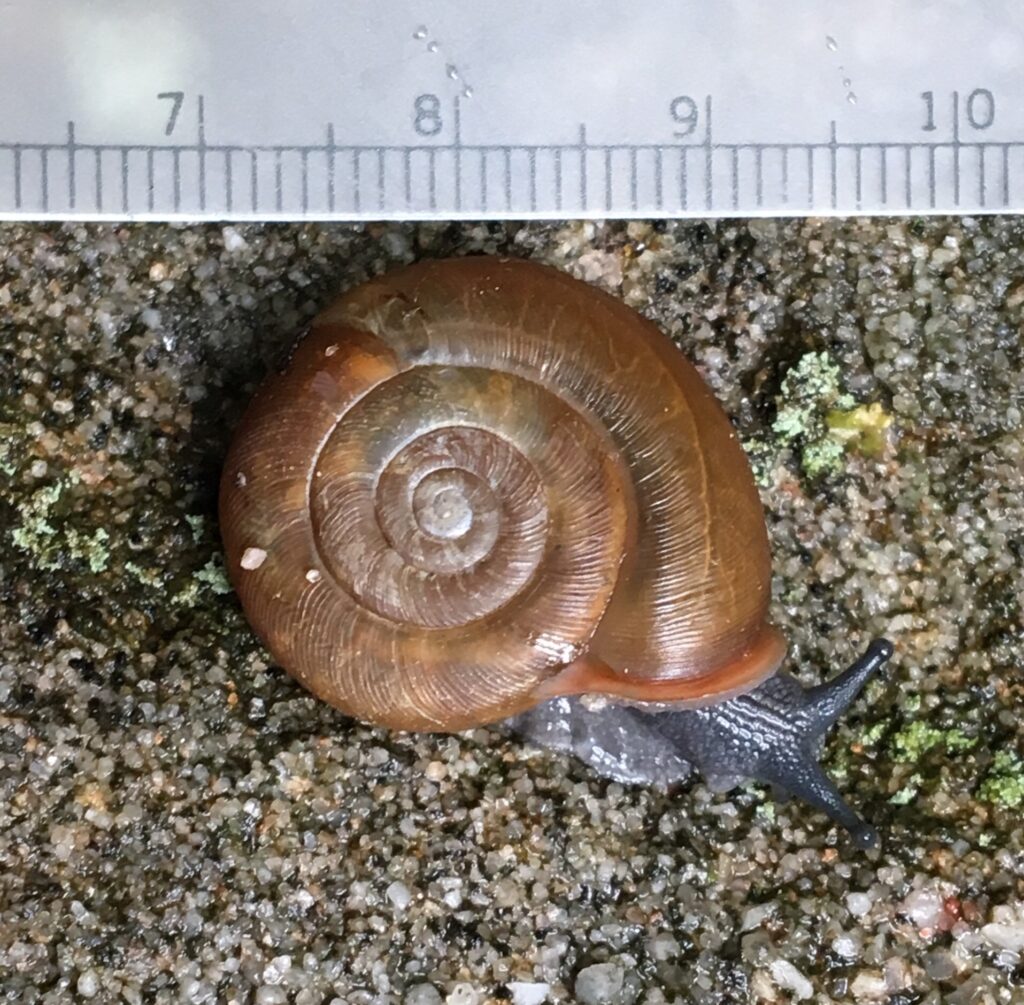
The shell of Triodopsis platysayoides is depressed heliciform or discoidal. The five whorls are flattened and only slightly convex, the base is flattened and slightly inflated at the aperture. The shell is thin, translucent but not fragile, and umbilicate. A moderately-sized parietal denticle is found, but basal and palatal denticles are absent or scarcely detectable. Transverse striae are present but not as well-developed as in other species of Triodopsis. The live animal is grayish to light brown above, paler below.
Ecology
Triodopsis platysayoides is a highly specialized land snail, found almost entirely among massive rock features within the Cheat River Canyon in West Virginia. These include sandstone cliffline outcrops and talus as well as limestone caves and outcrops (e.g. Hotopp, 2000). It is often found several meters within crevices well below the ground surface. Talus depth and cool temperatures are critical components of this snail’s habitat (Dourson, unpublished data).
Triodopsis platysayoides consumes a wide variety of foods including decaying rhododendron blossoms, a variety of fungi, dead cave crickets, crustose lichen growing on sandstone, decaying fern fronds, fresh Allegheny Woodrat scat, and mold filaments growing from woodrat scat (Dourson, 2008). The snail is relatively long-lived, reaching adulthood in 2-3 years.
Taxonomy
Polygyra platysayoides is the only known synonym. The snail’s unique identity is confirmed by its reproductive anatomy and allozymes (Emberton, 1988).
Distribution
This species is only known from the two counties in West Virginia on the Cheat River Canyon.
Conservation
NatureServe Rank: G1. NatureServe State Rank: West Virginia, S1. Listed as federally Threatened. Large parts of the Cheat River Canyon are in public or conservation ownership. Habitat fragmentation, non-native species, pesticides, and climate change are possible threats.
