
Image Usage Information
Family: Polygyridae
Common name: Buttressed threetooth
Discovery: Brooks & MacMillan, 1940
Identification
Width: 18-25 mm
Height: 8 mm
Whorls: 5-5.5
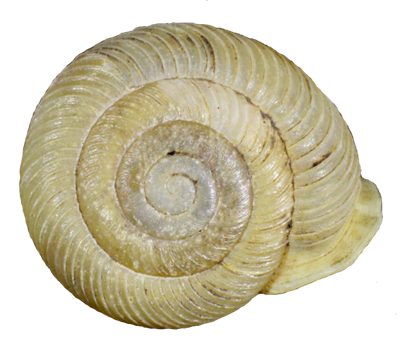
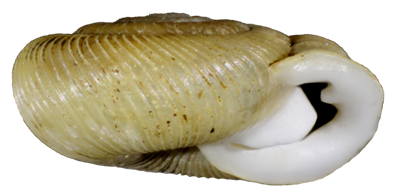
Triodopsis rugosa’s shell is depressed heliciform, its lip is reflected and thickened within, and the shell is umbilicate. With three denticles in the aperture, the large parietal denticle points above the palatal denticle, which on a wide sloping buttress produced from the thickened outer lip. The equally-sized basal and palatal denticles are substantially smaller than the parietal denticle. The sloping buttress, and the well-developed and widely-spaced transverse striae on the top that continue strongly to the base are the best diagnostic features of this species. Scattered papillae are also found on the shell. The periphery is rounded to shouldered. Its close relative Tridopsis anteridon has a larger shell with a slightly wider umbilicus and finer, more closely-spaced transverse striae.
Ecology
Found particularly in ravines and valleys that are narrow and damp. Also found on cliffs, hillsides, and sandstone bluffs.
Taxonomy
Triodopsis tridentata rugosa is the only known synonym. Originally described as a subspecies, this animal was elevated to species apparently by Pilsbry (1940).
Distribution
An endemic of West Virginia, there is some confusion about the known localities of Triodopsis rugosa. This globally-rare snail is currently confirmed only from Logan County in West Virginia (Dourson, 2015). MacMillan (1948) states the snail was found in Logan County, Nicholas County and Putnam County in West Virginia. However, specimens examined from the Carnegie Museum of Natural History labeled as this species refer to Triodopsis anteridon, and possible specimens from Kentucky are also Triodopsis anteridon.
Conservation
NatureServe Rank: G1.
NatureServe State Rank: West Virginia, S1.
This species is a narrow Appalachian Mountain endemic that is poorly known and may be vulnerable.
