• Skip to primary navigation
  • Skip to main content
  • Skip to primary sidebar

Carnegie Museum of Natural History

One of the Four Carnegie Museums of Pittsburgh

  • Visit
    • Buy Tickets
    • Visitor Information
    • Exhibitions
    • Events
    • Dining at the Museum
    • Celebrate at the Museum
    • Powdermill Nature Reserve
    • Event Venue Rental
    • Gift Cards
  • Learn
    • Field Trips
    • Educator Information
    • Programs at the Museum
    • Bring the Museum to You
    • Guided Programs FAQ
    • Programs Online
    • Climate and Rural Systems Partnership
  • Research
    • Scientific Sections
    • Science Stories
    • Science Videos
    • Senior Science & Research Staff
    • Museum Library
    • Science Seminars
    • Scientific Publications
    • Specimen and Artifact Identification
  • About
    • Mission & Commitments
    • Directors Team
    • Museum History
  • Tickets
  • Give
  • Shop

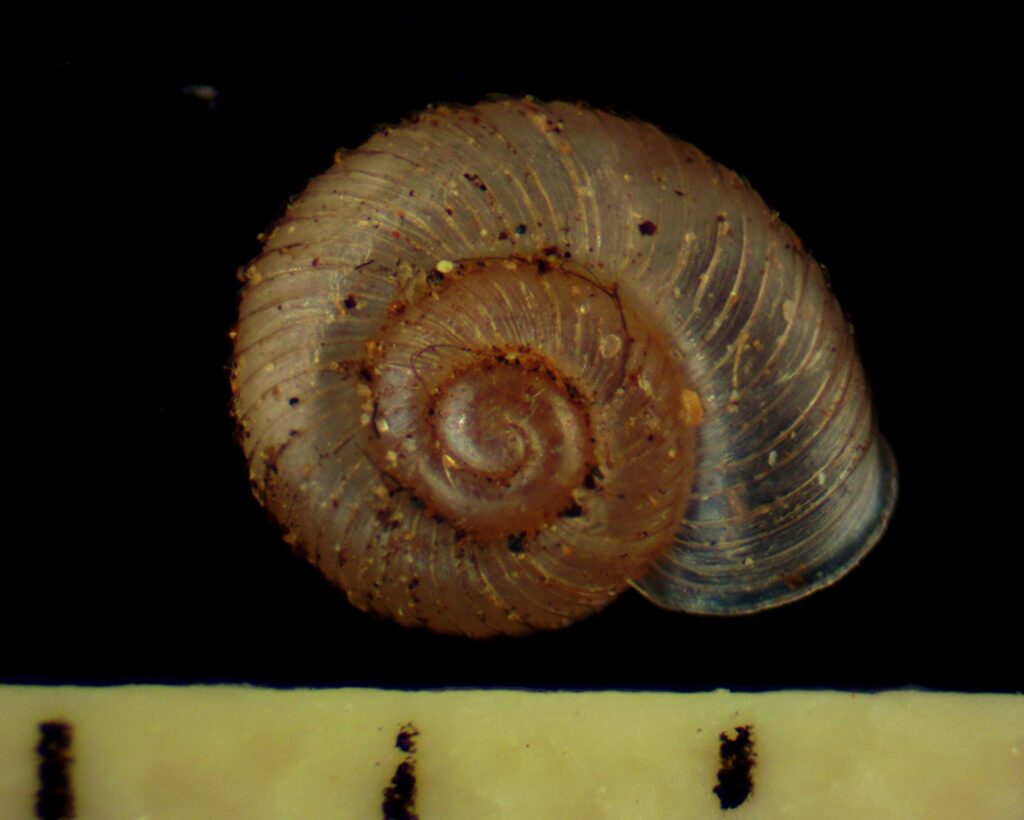
Vallonia perspectiva

Image Usage Information

  • Ben Hutchins
  • CC BY-NC 4.0 DEED
  • Additional information about this specimen

Family: Valloniidae

Common name: Thin-lip Vallonia

Discovery: Sterki, 1893

Identification

Width: 2 mm
Height: 0.7 mm
Whorls: 3.5

The shell for this species has a similar shape to others in its family, with large whorls and a very low apex. The umbilicus is very wide, allowing for a view, or perspective, of interior whorls. The radial ribs are moderately pronounced though somewhat delicate. The shell itself is thin and pale. The rounded aperture has a flared lip that, in contrast to V. parvula, is not particularly thick. Though smaller, this species resembles V. cyclophorella.

Ecology

Vallonia perspectiva is a calciphile that likes habitats with broken rock – railroad tracks for example, or talus slopes in the woods (Hubricht, 1985). Some authors suggest that most Vallonia species are introduced in eastern North America (e.g. Nekola, 2008).

Taxonomy

There are no synonyms.

Distribution

This species’ range seems to be wide but also somewhat sparse, having been identified in twenty-one states from the Dakotas south to Arizona and mountains in Mexico, and east through the mid-Atlantic states, in several of these only in one or two counties. Records are somewhat more concentrated in Virginia, appearing in the northern tip of the state as well as at a few points along the southern border.

Conservation

NatureServe Global Rank: G4/G5
NatureServe State Rank: S3

sidebar

About

  • Mission & Commitments
  • Directors Team
  • Museum History

Get Involved

  • Volunteer
  • Membership
  • Carnegie Discoverers
  • Donate
  • Employment
  • Events

Bring a Group

  • Groups of 10 or More
  • Birthday Parties at the Museum
  • Field Trips

Powdermill

  • Powdermill Nature Reserve
  • Powdermill Field Trips
  • Powdermill Staff
  • Research at Powdermill

More Information

  • Image Permission Requests
  • Science Stories
  • Accessibility
  • Shopping Cart
  • Contact
  • Visitor Policies
One of the Four Carnegie Museums | © Carnegie Institute | Privacy Policy | Terms of Use | Accessibility
Rad works here logo