
Image Usage Information
Family: Valloniidae
Common name: Lovely Vallonia
Discovery: Müller, 1774
Identification
Width: 2.4 mm
Height: 1.2 mm
Whorls: 3+
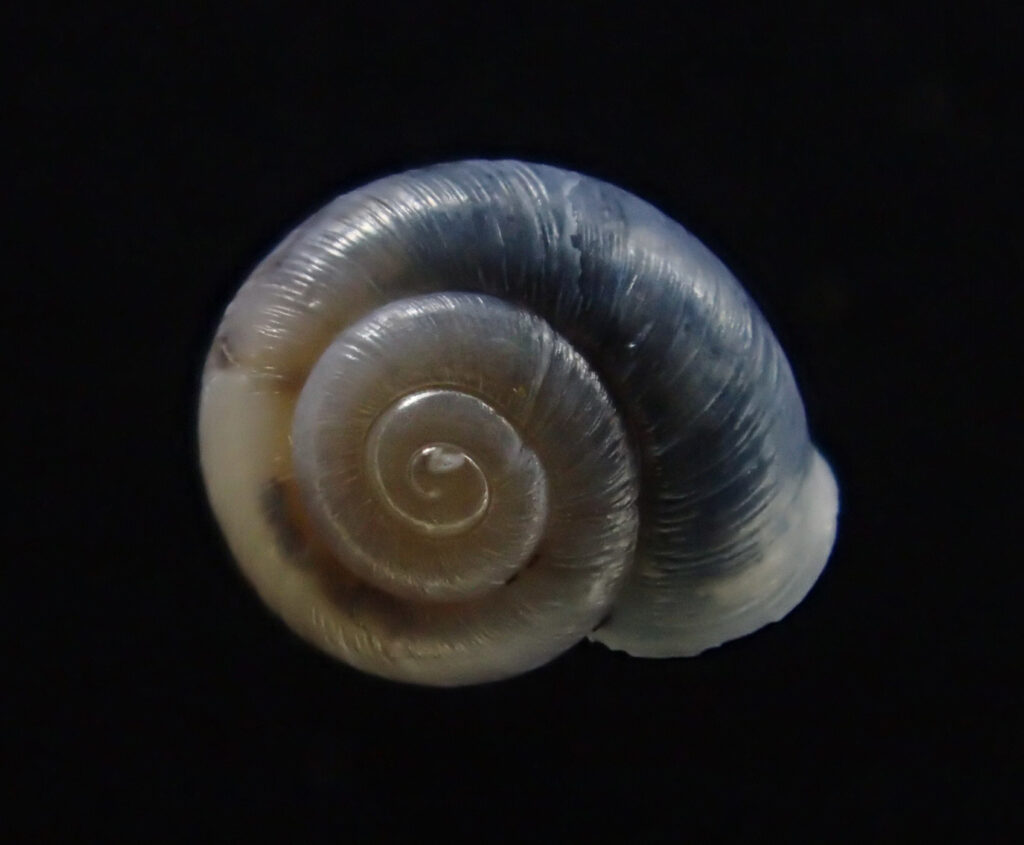
The shell of this animal has a similar shape to others in its family, with large whorls and a very low apex. It is smooth or very finely striate, with a lip that is reflected toward the outside of the shell. The umbilicus is open.
Ecology
Vallonia pulchella is found often in grassy places like meadows or along roadsides and lawns (Hubricht, 1985). However, in Europe it is reported from wetter habitats such as wet meadows and marshes, as well as dry dunes and grasslands (Kerney & Cameron, 1979). This species is holarctic, found around the world at high latitudes. Unlike several other Vallonia species that may be introduced in North America, V. pulchella is likely to be a native – found in Pleistocene sediments and native grasslands (Nekola, 2008).
Whitney (1938) examined the reproductive cycle of this animal in the laboratory and found that eggs are laid singly over several days. These eggs hatched in 12 days, and reached maturity in two months. Isolated individuals were able to reproduce, suggesting parthenogenesis or self-fertilization in this species.
Taxonomy
Synonyms for V. pulchella are: Helix minuta, H. pulchella, and Vallonia minuta.
Distribution
This species is found in twenty six states, most significantly in the northeastern quarter of the continental US, though it has appeared in California and Texas. It has a similar distribution in Canada, being found most in the southeastern part with appearances in British Colombia. In Virginia it has been found in counties along the coast, the north, and west, with a “gap” in the center of the state.
Conservation
NatureServe Global Rank: G5
NatureServe State Rank: S3S4
