• Skip to primary navigation
  • Skip to main content
  • Skip to primary sidebar

Carnegie Museum of Natural History

One of the Four Carnegie Museums of Pittsburgh

  • Visit
    • Buy Tickets
    • Visitor Information
    • Exhibitions
    • Events
    • Dining at the Museum
    • Celebrate at the Museum
    • Powdermill Nature Reserve
    • Event Venue Rental
  • Learn
    • Field Trips
    • Educator Information
    • Programs at the Museum
    • Bring the Museum to You
    • Guided Programs FAQ
    • Programs Online
    • Climate and Rural Systems Partnership
  • Research
    • Scientific Sections
    • Science Stories
    • Science Videos
    • Senior Science & Research Staff
    • Museum Library
    • Science Seminars
    • Scientific Publications
    • Specimen and Artifact Identification
  • About
    • Mission & Commitments
    • Directors Team
    • Museum History
  • Tickets
  • Give
  • Shop

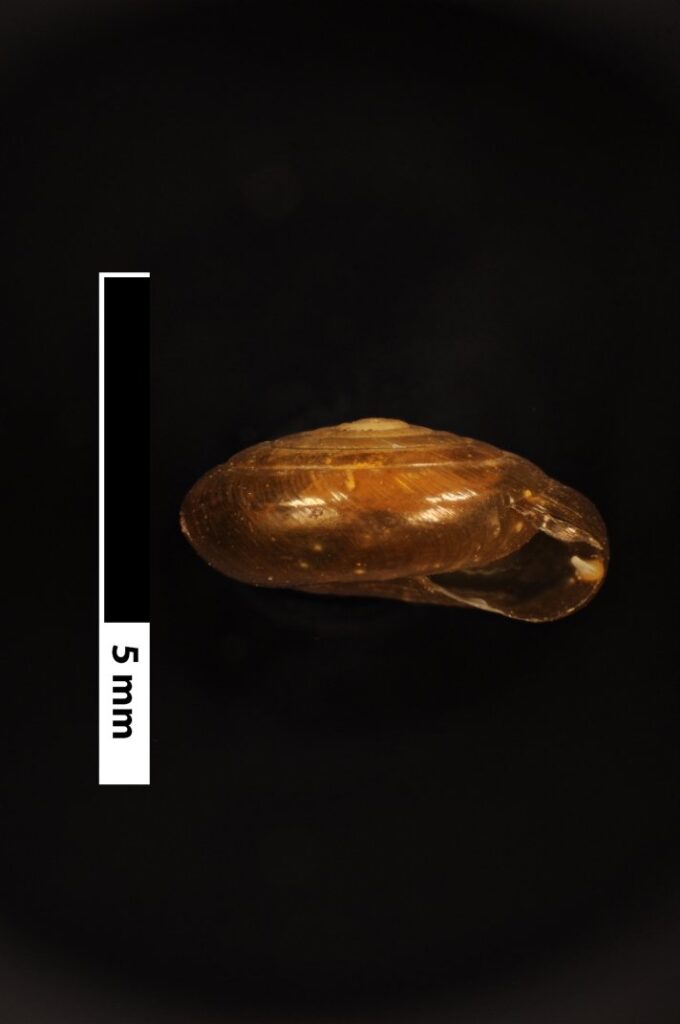
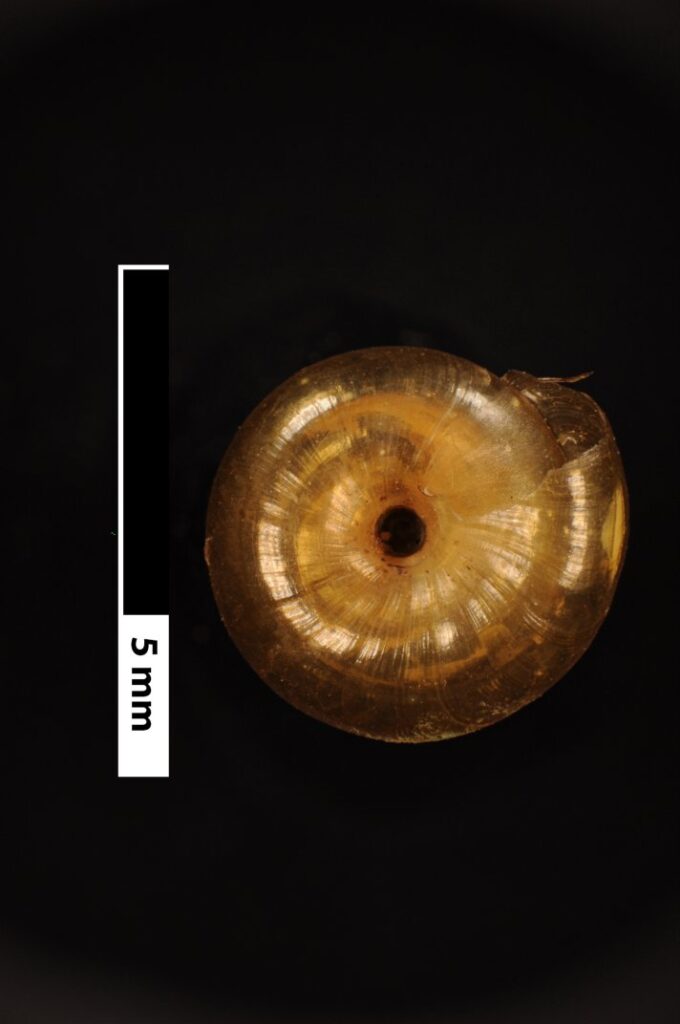
Ventridens coelaxis

Image Usage Information

  • The Academy of Natural Sciences of Philadelphia
  • CC BY-NC 4.0 DEED
  • For additional information about this specimen: Gary Rosenberg (rosenberg.ansp@drexel.edu)

Family: Gastrodontidae

Common name: Bidentate Dome

Discovery: Pilsbry, 1899

Identification

Width: 6.6 mm
Height: 3 mm
Whorls: 6.75

The shell of this animal is flatter in shape than many of its cousins’, with a lower apex. Its umbilicus is notably wide, narrower only than V. lasmodon. The shell material itself is yellow, glossy, thin, a bit fragile, and somewhat transparent. The shell surface is not deeply sculpted. The aperture is oblique and relatively small. There are two lamellae within, one in the floor of the aperture and the other on the palatal wall. According to Pilsbry (1946-48) these teeth are sometimes absent.

Ecology

This species is found in leaf litter, at higher elevations on mountain slopes (Hubricht, 1985).

Taxonomy

Synonyms for V. coelaxis are Gastrodonta coelaxis and Zonitoides coelaxis.

Distribution

The range of this Appalachian Mountain endemic is quite restricted. It is found in a handful of counties around the convergence of Virginia, Tennessee, and North Carolina.

Conservation

Global Rank: G3
State Rank: S2
Virginia’s wildlife action plan: Tier III

sidebar

About

  • Mission & Commitments
  • Directors Team
  • Museum History

Get Involved

  • Volunteer
  • Membership
  • Carnegie Discoverers
  • Donate
  • Employment
  • Events

Bring a Group

  • Groups of 10 or More
  • Birthday Parties at the Museum
  • Field Trips

Powdermill

  • Powdermill Nature Reserve
  • Powdermill Field Trips
  • Powdermill Staff
  • Research at Powdermill

More Information

  • Image Permission Requests
  • Science Stories
  • Accessibility
  • Shopping Cart
  • Contact
  • Visitor Policies
One of the Four Carnegie Museums | © Carnegie Institute | Privacy Policy | Terms of Use | Accessibility
Rad works here logo