• Skip to primary navigation
  • Skip to main content
  • Skip to primary sidebar

Carnegie Museum of Natural History

One of the Four Carnegie Museums of Pittsburgh

  • Visit
    • Buy Tickets
    • Visitor Information
    • Exhibitions
    • Events
    • Dining at the Museum
    • Celebrate at the Museum
    • Powdermill Nature Reserve
    • Event Venue Rental
  • Learn
    • Field Trips
    • Educator Information
    • Programs at the Museum
    • Bring the Museum to You
    • Guided Programs FAQ
    • Programs Online
    • Climate and Rural Systems Partnership
  • Research
    • Scientific Sections
    • Science Stories
    • Science Videos
    • Senior Science & Research Staff
    • Museum Library
    • Science Seminars
    • Scientific Publications
    • Specimen and Artifact Identification
  • About
    • Mission & Commitments
    • Directors Team
    • Museum History
  • Tickets
  • Give
  • Shop

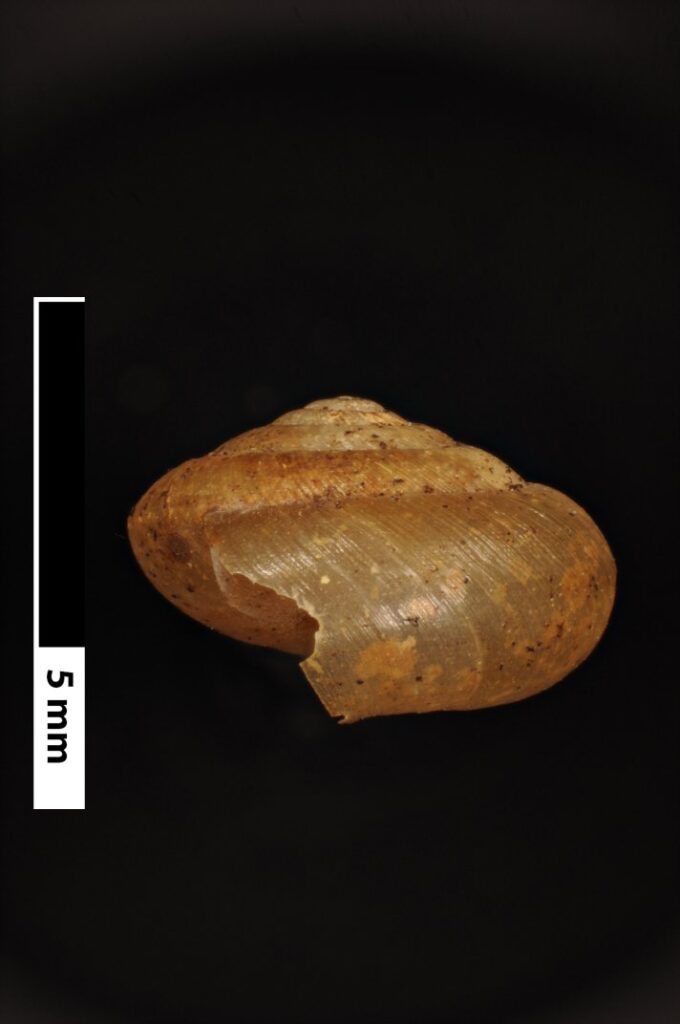
Ventridens intertextus

Image Usage Information

  • The Academy of Natural Sciences of Philadelphia
  • CC BY-NC 4.0 DEED
  • For additional information about this specimen: Gary Rosenberg (rosenberg.ansp@drexel.edu)

Family: Gastrodontidae

Common name: Pyramid Dome

Discovery: A. Binney, 1841

Identification

Width: 12.0 – 18.5 mm
Height: 7.3 – 13.3 mm
Whorls: 6+

The apex of this species’ shell is relatively high and spire acute. The final whorl may be slightly angular, often with a light-colored band at the periphery. The shell texture of Ventridens intertextus consists of very fine oblique and spiral striae intersecting each other. The aperture is rounded with a thin lip with a callus lining within, and is a bit reflected close to where it meets the previous whorl. The umbilicus is tiny. This species can be differentiated from V. ligera by looking at the base, which has spiral striae and lacks the gloss present on V. ligera.

Ecology

This species is found in woods with acid soils, in the leaf litter. In Kentucky it is found in hardwood forest ravines, hillsides, and acidic ridgetops (Dourson, 2010). However, in Tennessee, V. intertextus has been reported in young forests where dolomite is predominant (Coney et al, 1982).

Taxonomy

Synonyms for V. intertextus are Gastrodonta intertexta, Helix intertexta, Zonites intertextus, and Zonitoides (Ventricallus) intertextus.

Distribution

Ventridens intertextus is found across much of the East, from southern Ontario, New York and Michigan, south to east Texas and northern Florida. It has been reported from south central and western Virginia.

Conservation

NatureServe Global Rank: G5
NatureServe State Rank: S3

sidebar

About

  • Mission & Commitments
  • Directors Team
  • Museum History

Get Involved

  • Volunteer
  • Membership
  • Carnegie Discoverers
  • Donate
  • Employment
  • Events

Bring a Group

  • Groups of 10 or More
  • Birthday Parties at the Museum
  • Field Trips

Powdermill

  • Powdermill Nature Reserve
  • Powdermill Field Trips
  • Powdermill Staff
  • Research at Powdermill

More Information

  • Image Permission Requests
  • Science Stories
  • Accessibility
  • Shopping Cart
  • Contact
  • Visitor Policies
One of the Four Carnegie Museums | © Carnegie Institute | Privacy Policy | Terms of Use | Accessibility
Rad works here logo