Image Usage Information
Family: Vertiginidae
Common name: none
Discovery: Martens, 1882
Identification
Height: 1.6-1.8 mm
Width: 0.7-0.9 mm
Whorls: 5
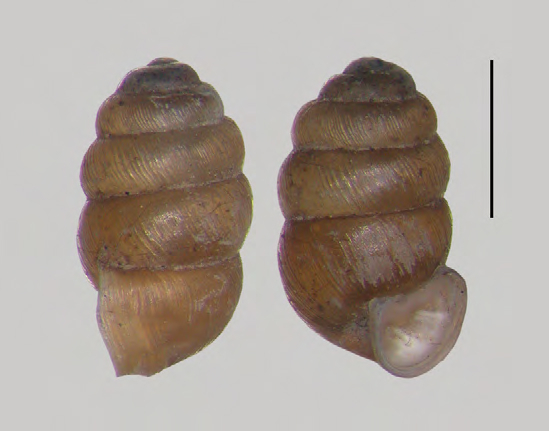
Vertigo arthuri shares with V. nylanderi a more deeply inserted lower as compared to upper palatal lamella, a feature unique in the subgenus Vertigo to these two species. Outside of the subgenus, only one other North American species – V. (Vertilla) hinkleyi from sky island oak forest of the desert southwest – shares this trait. Vertigo arthuri differs from V. nylanderi by its weak to absent sinulus, peg-shaped columellar lamella, less deeply inserted and shorter lower palatal lamella, and weaker (to absent) angular lamella.
Ecology
Vertigo arthuri is primarily a species of upland forest, taiga, and rock outcrops. In the Northeast, it is particularly abundant in upland northern white cedar stands (especially on bedrock outcrops) and strays into the drier parts of adjacent wetlands (Nekola and Coles, 2010). It has also been rarely seen in upland aspen groves. Along the shore of the St. Lawrence in Atlantic Maritime Canada it can be found in calcareous maritime turf. In the Upper Mississippi Valley, this species is limited to algific talus and other cool talus slopes and rock outcrops.
Taxonomy
Apertural callus and crest strength, and the presence or absence of a basal and angular lamella have been historically used to split V. arthuri into seven additional taxa. However, these traits show continual variation across not only across the geographic and ecological range of this species, but also within single populations – especially in southeastern Ontario where up to four shell forms may co-occur within the same site with all possible forms of intergradation (Nekola et al., in press).
DNA sequence data shows these various shell forms to exist within the same highly supported species-level clade with no inter-clade genetic structuring (Nekola et al., in press). As a result, V. briarensis, V. gouldii basidens, V. hubrichti, V. hubrichti variabilis, V. iowaensis, V. occulta and V. paradoxa represent at best only shell forms of V. arthuri. While occurring throughout the range of the species, in New England and adjacent Maritime Canada only the shell form paradoxa is present. It is demarcated from other V. arthuri forms by its lack of basal and angular lamellae, lack of an apertural callus, and a less deeply inserted lower palatal lamella. Type Locality: Little Missouri, North Dakota, U.S.A. (V. arthuri); Woodland, Aroostook County, Maine, U.S.A. (V. arthuri form paradoxa).
Distribution
This species possesses one of the largest ranges of any North American land snail species, extending across the northern taiga from Newfoundland to the Alaskan interior, south to upstate New York, northeastern Iowa, northwestern Minnesota, the Black Hills of South Dakota, the Jemez Mountains of northern New Mexico, and the Selkirk Mountains of southeastern British Columbia.
Conservation
NatureServe Global Rank: G5. Apparently secure. The various named shell forms of V. arthuri have been given ranks ranging from G1-G4.
