Image Usage Information
Family: Vertiginidae
Common name: none
Discovery: E.S. Morse, 1865
Identification
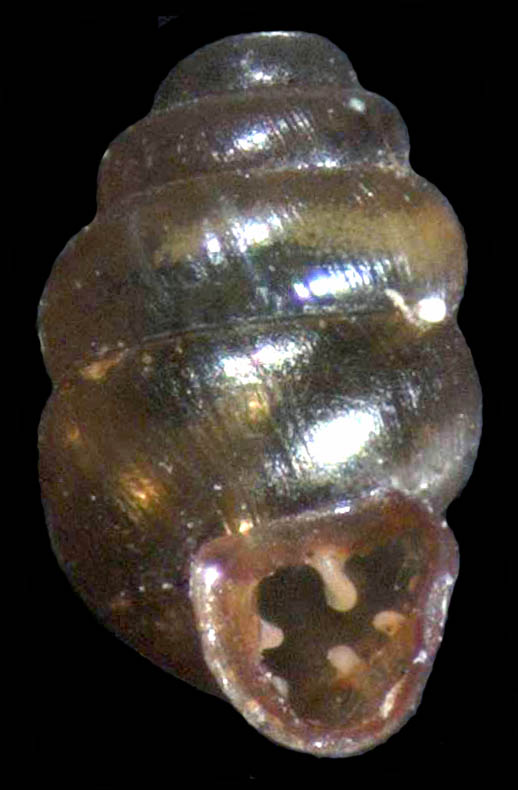
Height: ~1.7 mm
Width: ~0.9 mm
Whorls: 5
This species is quite similar in appearance to Vertigo gouldii, from which it can be distinguished by its much weaker shell striation, and by the presence of a deep depression on the outside of the shell under both palatal lamellae. It has been commonly confused with V. gouldii, and all purported southern Appalachian specimens likely represent small V. gouldii shells (Nekola & Coles, 2010). As a result, records of V. bollesiana south of Pennsylvania should be considered questionable.
Ecology
Vertigo bollesiana is found in leaf litter often under shrubs, on cliff-face ledges and boulder tops in mesic upland forest, and damp microsites in northern white cedar wetlands (Nekola & Coles, 2010).
Vertigo bollesiana ranges across the Great Lakes region from northeastern Iowa and northwestern Minnesota east through Wisconsin, Michigan, and southern Ontario through the New England states. Although it is also reported from isolated sites in the Appalachians of West Virginia, Kentucky, and Tennessee (Hubricht, 1985), as mentioned above, these reports almost certainly represent misidentified examples of a small southern Appalachians morph of V. gouldii.
Taxonomy
A synonym for this animal’s name is Isthimia bollesiana.
Distribution
This species has not yet been reported from Virginia. Because of the likelihood that reports from surrounding states are misidentified V. gouldii, it seems unlikely that populations will be eventually found here. However, there is a small possibility that it may occur in forests with significant cold air drainage in the northern mountains.
Conservation
NatureServe Global Rank: G5
NatureServe State Rank: S1S3
Virginia’s wildlife action plan: Tier II
