Image Usage Information
Family: Vertiginidae
Common name: Crested Vertigo
Discovery: Sterki, 1919
Identification
Height: ~1.9 mm
Width: ~0.9 mm
Whorls: 5
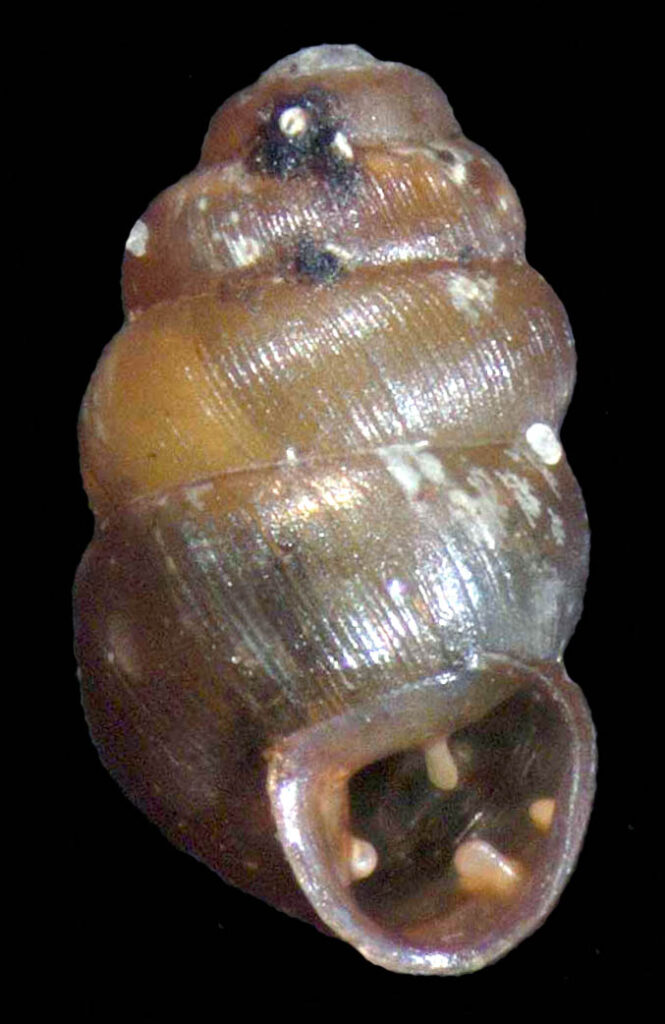
This species is characterized, like Vertigo gouldii, by a shell with pronounced striations. It differs from that species, however, by having finer and more regular striae, a pronounced crest in back of the aperture, no basal lamella, and by a cross-shaped pattern among the four lamellae.
Two sizes of V. cristata are present throughout its range: one with mature shells less than 1.9mm tall, and a second size with heights from 2 to 2.25mm (Nekola, 2001). Both morphs often co-occur without intermediates. However, DNA sequence analyses do not show these to be genetically distinct (Nekola, et al., 2009). Shells of the large morph are similar in size to small Vertigo modesta, from which they are most readily distinguished by their strong striation and sharper crest. All prior records for Vertigo modesta from the New England states (e.g. Pilsbry, 1948) are probably the large form of Vertigo cristata (Nekola & Coles, 2010).
Ecology
Vertigo cristata lives in well-decomposed leaf litter in a wide variety of northern forest habitats, ranging from wetlands to dry upland rock outcrops. It is particularly common in acidic base-poor sites such as pine and spruce forest, heaths, and Sphagnum-dominated peatlands (Nekola, 2010).
Taxonomy
A synonym for this animal’s name is Vertigo gouldii cristata.
Distribution
Vertigo cristata ranges across the eastern North American taiga from Newfoundland and the Laurentian shield, west through Ontario. It ranges south to northern Minnesota, central Wisconsin, Massachusetts, the Catskills of southeastern New York, and Ice Mountain in northeastern West Virginia.
The western range limit for this species is not yet defined – although Vertigo coloradensis of the western mountains possess a highly distinct DNA sequence (Nekola et al., 2009), its shells are essentially indistinguishable from V. cristata. Because genetic analyses have not yet been conducted on material from western Ontario to British Columbia, it is not known how far east V. coloradensis or how far west V. cristata penetrate into the central Canadian taiga.
This species has not yet been reported from Virginia. However, because of its presence in adjacent West Virginia, it may occur in the state, especially in acidic, high-elevation conifer forests in the northern mountains.
Conservation
NatureServe Global Rank: G5
NatureServe State Rank: none
