

Image Usage Information
Family: Vertiginidae
Common name: Variable Vertigo
Discovery: A. Binney, 1843
Identification
Height: ~1.9 mm
Width: ~1.0 mm
Whorls: 5
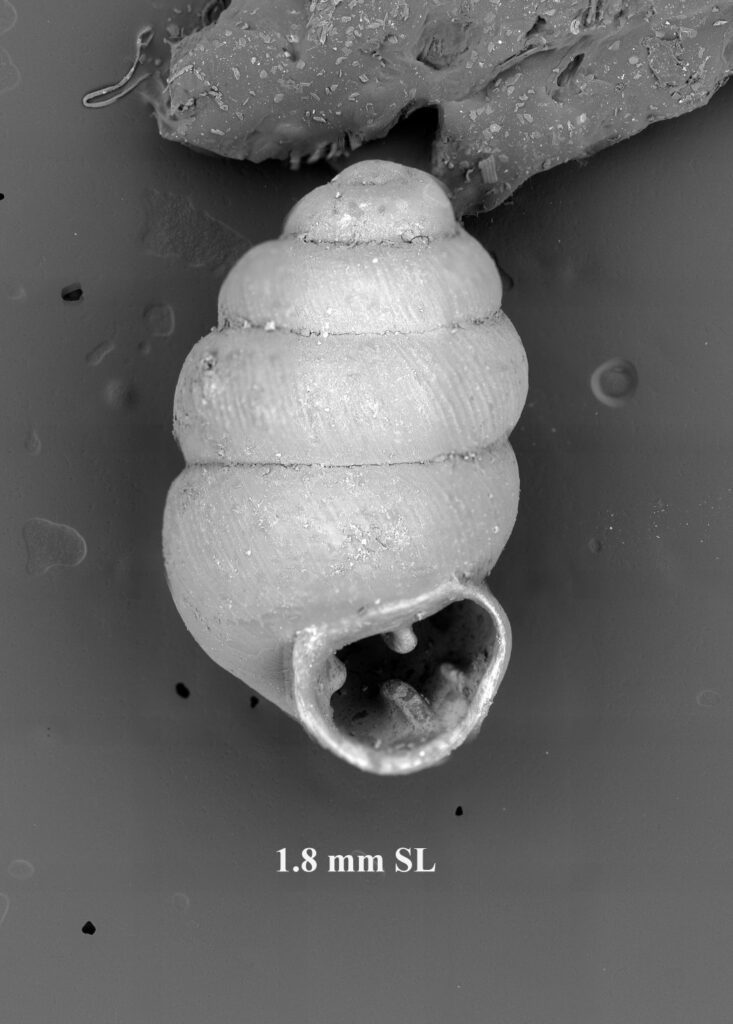
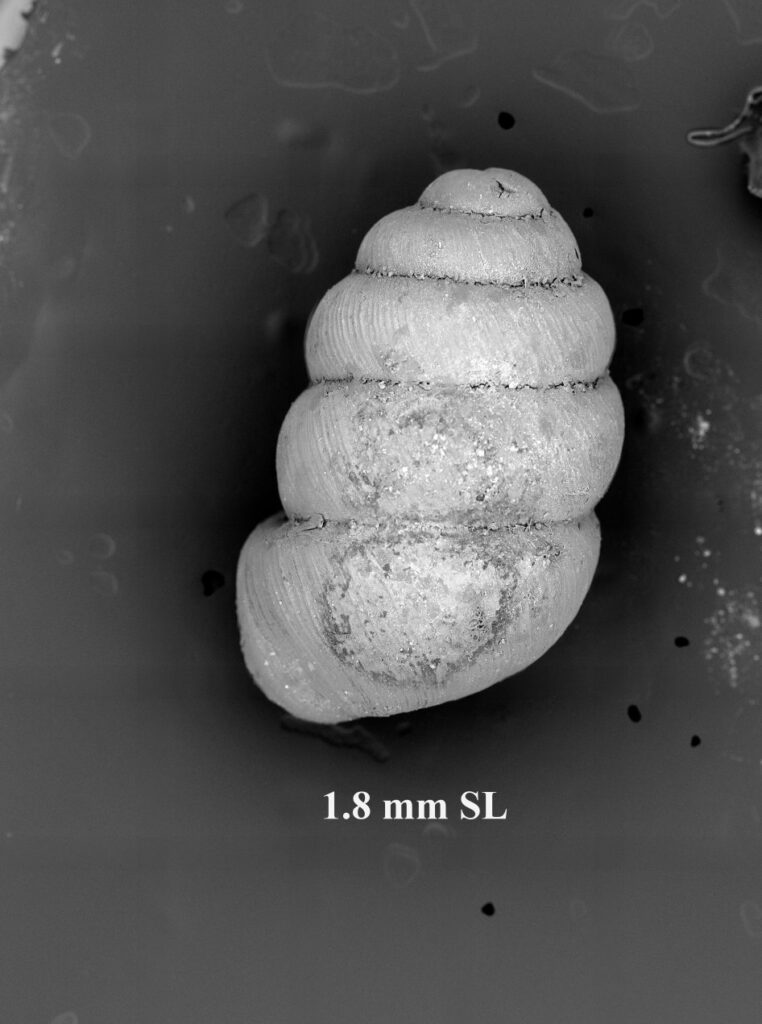
Vertigo gouldii is perhaps the most commonly encountered Vertigo in Virginia. It has a delicate, brownish, pupa-shaped shell with five “teeth” in the aperture. It shares with Vertigo bollesiana and Vertigo cristata a striate shell surface. It differs from V. bollesiana by having stronger striae and by lacking a deep depression on the outer shell surface over the palatal lamellae.
This species differs from V. cristata by having coarser and more irregular striae, by lacking a sharp crest, and by possessing a basal lamella. Additionally, the parietal lamella in V. gouldii is pointed at the upper palatal lamella. Small shells from the southern Appalachians and Ozarks that have somewhat smoother shells and weaker teeth than typical northeastern USA material have often been misidentified as Vertigo bollesiana (Nekola & Coles, 2010).
Ecology
Individuals are most abundantly encountered in well-decomposed leaf litter on shaded calcareous cliff ledges and bases, and on the top of large rocks. They also occur in lower numbers throughout upland and lowland forest, and may be occasionally seen crawling on cliff faces (Nekola & Coles, 2010).
Taxonomy
Synonyms for this animal’s name include Pupa gouldii and Vertigo gouldi.
Distribution
Vertigo gouldii ranges across east-central North America from the Ozarks and northwestern Minnesota, east across southern Ontario and Quebec to northern Maine, and south to the outer coastal plain of North Carolina, and the mountains of northern Alabama.
In Virginia, this species is currently reported only from the western mountains. However, given its presence on the North Carolina coast, it may be expected in calcareous habitats throughout the state.
Conservation
NatureServe Global Rank: G5
NatureServe State Rank: S3
