Image Usage Information
Family: Vertiginidae
Common name: Malleated Vertigo
Described by: Coles and Nekola, 2007
Identification
Height: ~1.9 mm
Width: ~1.0 mm
Whorls: 5
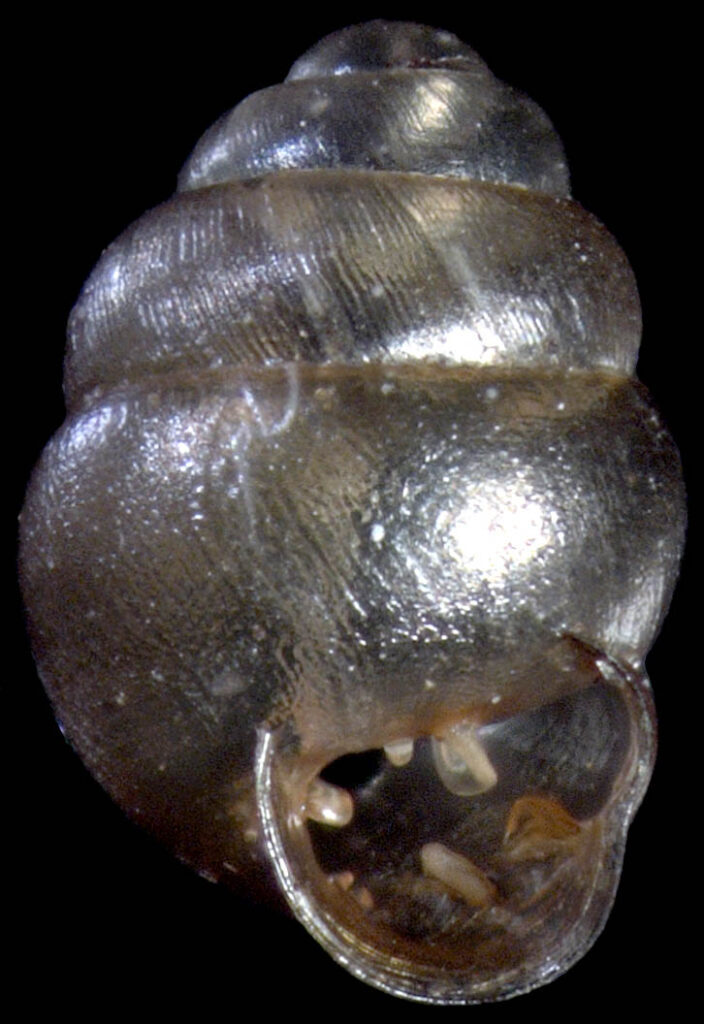
Vertigo malleata is easily distinguished from all other North American pupillid land snails by its pustulose (warty) shell surface along with the presence of an infraparietal lamella in the absence of an angular lamella.
Ecology
Vertigo malleata is an obligatory acidophile (Nekola, 2010) that lives only in highly acid habitats. It is primarily found in humid accumulations of ericaceous shrub and pine leaf litter in mesic to wet base-poor habitats along the eastern seaboard. These include longleaf pine forest and savanna, bay and Atlantic white cedar forest, heaths, pocosins, and other acid peatlands (Nekola & Coles, 2010). Populations on these sites may be very dense, with over 2,000 individuals per square meter occurring in some places (Coles & Nekola, 2007).
Taxonomy
This species has no synonyms.
Distribution
This species ranges along the Atlantic coastal plain in North America from southern Maine south to northern Florida and west to Mobile Bay (Coles & Nekola, 2007).
Vertigo malleata is not yet been reported from Virginia. However, given its abundant occurrence in the pine barrens of New Jersey and the pocosins of the Albemarle-Pamlico Peninsula in adjacent North Carolina, it should occur in the state. It most likely will be found in pocosins near the Great Dismal Swamp or wet heath-dominated shrublands in the counties east of the Chesapeake Bay.
Like Vertigo alabamensis, this species appears to be intolerant of fire management, and will be limited to sites that are spared this management practice (Coles & Nekola, 2007).
Conservation
NatureServe Global Rank: G5
NatureServe State Rank: none
