Image Usage Information
Family: Vertiginidae
Common name: none
Described by: Van Devender, 1979
Identification
Height:~2.1 mm
Width: ~1.1 mm
Whorls: 5
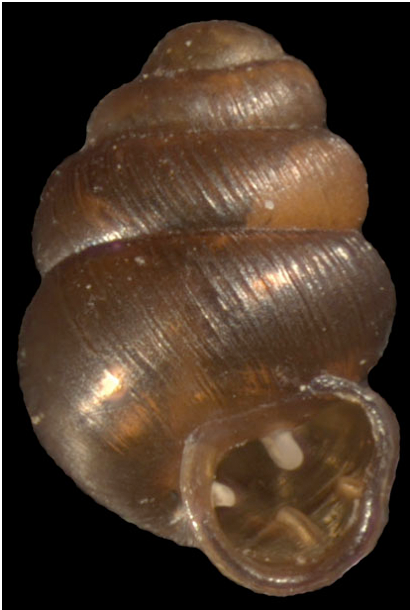
Vertigo meramecensis is unique among North American land snails in possessing a conical shell that tapers all the way to the apex with strong, irregular striae and a dark cinnamon-brown shell. It also possesses only four apertural lamellae and lacks a basal lamella. Additionally, the parietal lamella points towards the lower palatal. It is most similar in appearance to V. cristata but differs from that species in its strongly conical, red-brown shell and coarse, irregular striae. While it commonly occurs with V. gouldii, it is easily distinguished from it by its larger shell volume, conical shape, and absence of a basal lamella.
Ecology
Throughout its range, Vertigo meramecensis is strictly confined to mesic, vertical limestone cliff faces which are often profusely covered in mosses and lichens. This is the only eastern North American Vertigo species that is strictly arboreal in nature. As a result it is one of the easiest of our Vertigo species to observe in the field, with adults being attached or foraging in full view on open rocks and not buried in leaf litter as is characteristic of most other species in the genus.
Cliff-dwelling has also led to a unique adaptation in this animal (Nekola, unpublished data): because it will almost certainly die if it falls from its vertical habitat, individuals attach themselves to the rock face by a dry mucus thread. If dislodged, they fall only to the end of this thread, and are then able to crawl back to the cliff face.
Taxonomy
Genetic analysis (Nekola, unpublished data) shows that eastern populations, while they certainly represent V. meramecensis, are slightly distinct from western populations. There are no synonyms for this species’ name.
Distribution
Vertigo meramecensis was originally described from the Meramec River in Missouri (van Devender 1979). It was subsequently found in a narrow band cutting across the Missouri Ozarks into northern Arkansas, as well as the upper Mississippi Valley in northeastern Iowa, southeastern Minnesota, and northwestern Illinois (Frest & Fay 1981, Hubricht 1985, Nekola & Coles 2010).
In 2012 it was found 300 miles to the east in the Bluegrass region of northern Kentucky (Lori Schroeder, personal communication), and in 2013 it was found another 400 miles east in the Ridge and Valley of west-central Virginia.
While presently only known in Virginia from sites along the Maury River in Rockbridge County, it may occur elsewhere in the western counties where rivers and streams have cut into limestone bedrock.
Conservation
Global Rank: G2/G3
State Rank: not yet ranked
