• Skip to primary navigation
  • Skip to main content
  • Skip to primary sidebar

Carnegie Museum of Natural History

One of the Four Carnegie Museums of Pittsburgh

  • Visit
    • Buy Tickets
    • Visitor Information
    • Exhibitions
    • Events
    • Dining at the Museum
    • Celebrate at the Museum
    • Powdermill Nature Reserve
    • Event Venue Rental
  • Learn
    • Field Trips
    • Educator Information
    • Programs at the Museum
    • Bring the Museum to You
    • Guided Programs FAQ
    • Programs Online
    • Climate and Rural Systems Partnership
  • Research
    • Scientific Sections
    • Science Stories
    • Science Videos
    • Senior Science & Research Staff
    • Museum Library
    • Science Seminars
    • Scientific Publications
    • Specimen and Artifact Identification
  • About
    • Mission & Commitments
    • Directors Team
    • Museum History
  • Tickets
  • Give
  • Shop

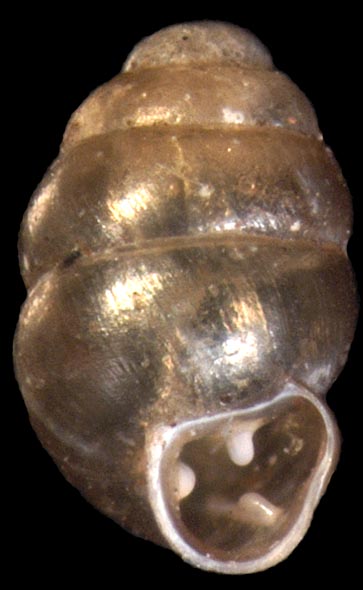
Vertigo parvula

Image Usage Information

  • Jeff Nekola
  • All rights reserved

Family: Vertiginidae

Common name: none

Described by: Sterki, 1890

Identification

Height: ~1.5 mm
Width: ~0.8 mm
Whorls: 4-5

Vertigo parvula is recognized from all other regional pupillid land snails by its very small size (1.5 mm tall or less), ovate shape, smooth shell surface, shallow suture, and peg-shaped columellar lamella. Vertigo tridentata is larger and usually possesses an upper palatal lamella, while Vertigo oscariana has a sheet-like columellar lamella and a shell widest in the middle.

Ecology

Individuals occur in accumulations of well-decomposed leaf litter in base-rich
cove forests, rock outcrops, and talus slopes at mid-to-low elevations in the central Appalachians and adjacent Piedmont (Nekola & Coles, 2010).

Taxonomy

This species has no synonyms.

Distribution

Vertigo parvula possesses one of the most restricted ranges of any North American pupillid land snail, ranging only from northeastern Tennessee and adjacent North Carolina through northern Virginia, with an outlying occurrence being reported from northeastern Ohio. Virginia represents the center of range for this species, with the great majority of known stations being restricted to the state.

Conservation

NatureServe Global Rank: G3
NatureServe State Rank: SU
Virginia’s wildlife action plan: Tier III

sidebar

About

  • Mission & Commitments
  • Directors Team
  • Museum History

Get Involved

  • Volunteer
  • Membership
  • Carnegie Discoverers
  • Donate
  • Employment
  • Events

Bring a Group

  • Groups of 10 or More
  • Birthday Parties at the Museum
  • Field Trips

Powdermill

  • Powdermill Nature Reserve
  • Powdermill Field Trips
  • Powdermill Staff
  • Research at Powdermill

More Information

  • Image Permission Requests
  • Science Stories
  • Accessibility
  • Shopping Cart
  • Contact
  • Visitor Policies
One of the Four Carnegie Museums | © Carnegie Institute | Privacy Policy | Terms of Use | Accessibility
Rad works here logo