• Skip to primary navigation
  • Skip to main content
  • Skip to primary sidebar

Carnegie Museum of Natural History

One of the Four Carnegie Museums of Pittsburgh

  • Visit
    • Buy Tickets
    • Visitor Information
    • Exhibitions
    • Events
    • Dining at the Museum
    • Celebrate at the Museum
    • Powdermill Nature Reserve
    • Event Venue Rental
  • Learn
    • Field Trips
    • Educator Information
    • Programs at the Museum
    • Bring the Museum to You
    • Guided Programs FAQ
    • Programs Online
    • Climate and Rural Systems Partnership
  • Research
    • Scientific Sections
    • Science Stories
    • Science Videos
    • Senior Science & Research Staff
    • Museum Library
    • Science Seminars
    • Scientific Publications
    • Specimen and Artifact Identification
  • About
    • Mission & Commitments
    • Directors Team
    • Museum History
  • Tickets
  • Give
  • Shop

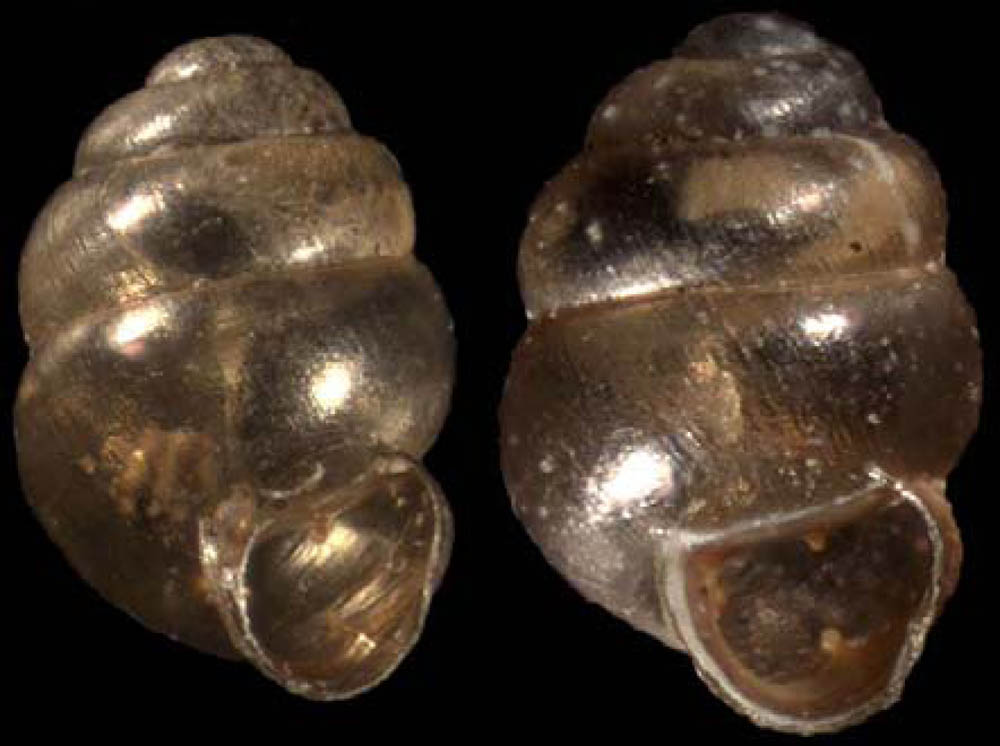
Vertigo perryi

Image Usage Information

  • Jeff Nekola
  • All rights reserved

Family: Vertiginidae

Common name: none

Described by: Sterki, 1905

Identification

Height: 1.5-1.9 mm
Width: 1.0-1.1 mm
Whorls: 5

Within the subgenus Alaea, Vertigo perryi shares with boreal North American V. ventricosa and northeast Asian V. kurilensis a small shell with irregular, weak striae and ovate-conical shape. It consistently differs from V. ventricosa shells in its more ovate shape, grayer olive-yellow color, silky luster from the presence of weak malleation and fine spiral lines on the shell surface, weaker lamellae development and a dark coloration of the apertural margin. These features remain constant across its range.

Ecology

Vertigo perryi is limited to moderately to highly acidic forested to open wetlands (Coles and Nekola, 2004; Nekola, 2008; Nekola and Coles, 2010). It can be abundant in dead leaf accumulations adjacent to sedge tussocks and may also ascend into living vegetation. Type Locality: Warwick, Rhode Island, U.S.A.

Taxonomy

This species has no synonyms.

Distribution

While ranging in North America from northern Wisconsin to Newfoundland, V. perryi is most commonly encountered from areas bordering the Gulf of Maine and Cape Cod wetlands (Coles and Nekola, 2004; Nekola and Coles, 2010). While not yet reported from the southern Canadian Maritime provinces, it is to be expected from New Brunswick and southern Nova Scotia.

Conservation

NatureServe Global Rank: G3/G4, Vulnerable to Apparently Secure.

sidebar

About

  • Mission & Commitments
  • Directors Team
  • Museum History

Get Involved

  • Volunteer
  • Membership
  • Carnegie Discoverers
  • Donate
  • Employment
  • Events

Bring a Group

  • Groups of 10 or More
  • Birthday Parties at the Museum
  • Field Trips

Powdermill

  • Powdermill Nature Reserve
  • Powdermill Field Trips
  • Powdermill Staff
  • Research at Powdermill

More Information

  • Image Permission Requests
  • Science Stories
  • Accessibility
  • Shopping Cart
  • Contact
  • Visitor Policies
One of the Four Carnegie Museums | © Carnegie Institute | Privacy Policy | Terms of Use | Accessibility
Rad works here logo