

Image Usage Information
Family: Vertiginidae
Common name: Pygmy Vertigo
Described by: Draparnaud, 1801
Identification
Height: ~2.0 mm
Width: ~1.1 mm
Whorls: 5
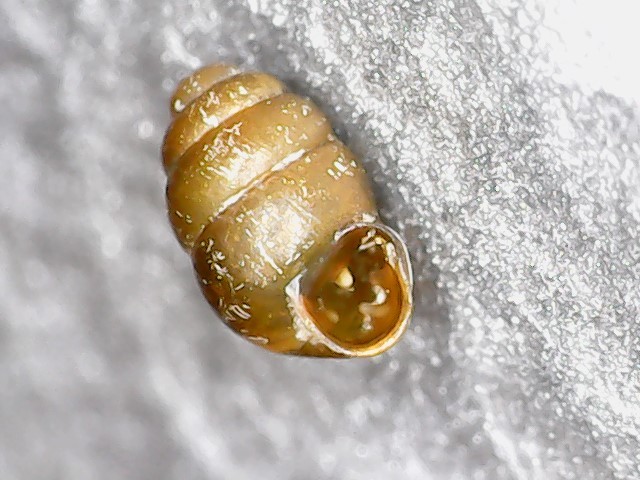
Vertigo pygmaea is most easily separated from other pupillid land snails in the region by its ~2 mm height, silky shell luster, and presence of a white callus that fills the prominent crest on the palatal wall of the aperture.
Ecology
Individuals occur in graminoid thatch and leaf litter accumulations in a variety of anthropogenically disturbed grasslands including roadsides, old fields, yards, and abandoned quarries. It may also occur in more undisturbed habitats such as upland forest, bedrock cliffs, tallgrass prairie, sedge meadows, and acid bogs.
Taxonomy
Synonyms for this animal’s name include Pupa pygmaea and Vertigo callosa.
Distribution
In North America, Vertigo pygmaea ranges from northwestern Minnesota and northeastern Iowa east through southern Ontario to northern Maine, and south to northern Indiana and Ohio and along the Appalachians to east-central Tennessee (Nekola & Coles, 2010). This species also occurs across western Eurasia from Scandinavia, the British Isles and the Iberian Peninsula to the Altai Mountains in south-central Siberia.
Because no authenticated fossils of this species exist from sediments pre-dating European colonization of eastern North America, it seems very likely that Vertigo pygmaea is not a native North American animal (Nekola & Coles, 2010).
In Virginia this species is currently reported only from calcareous districts in the western mountains and from the greater Washington, D.C. metroplex.
Conservation
NatureServe Global Rank: G5
NatureServe State Rank: S2/S4 (introduced)
