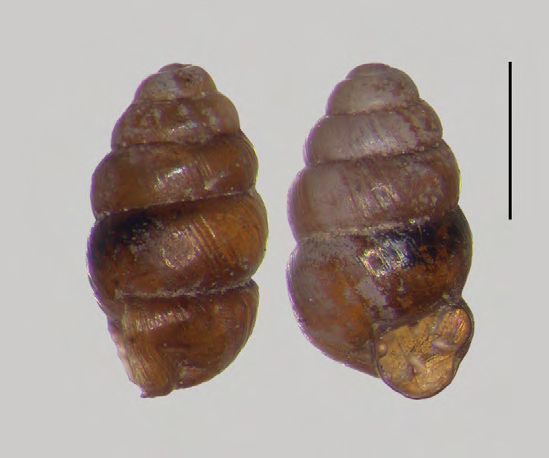
Image Usage Information
Family: Vertiginidae
Common name: none
Described by: E.S. Morse, 1865
Identification
Height: ~1.9 mm
Width: ~1.1 mm
Whorls: 4-5
This species is most similar to Vertigo elatior with which it shares a shiny red-brown shell with no more than five apertural lamellae. While distinguishing these two species can be quite challenging, V. elatior possesses a taller and somewhat more conical upper half of the shell, whereas V. ventricosa is more ovate in outline. The apertural lamellae and sinulus are also more weakly developed in V. ventricosa. Vertigo ventricosa shells are also usually quite transparent, making it easy to see the central column through the shell.
Vertigo ventricosa also appears almost identical to Vertigo idahoensis from the Rockies, although this latter species is reported to have a deeper suture (Pilsbry 1948). Immature V. elatior shells have been commonly misidentified as V. ventricosa across eastern North America (Nekola & Coles, 2010).
Ecology
Individuals occur in accumulations of humid, well-decomposed grass and broadleaf plant litter, in moderately to highly acidic wooded or open wetlands. It is especially found lowland northern white cedar and red maple forest, sedge meadows, Sphagnum peatlands, and poor fens.
Taxonomy
Synonyms for this animal’s name include Isthimia ventricosa, Vertigo approximans.
Distribution
Vertigo ventricosa is restricted to northeastern North America, where it ranges from the Laurentian Shield and Newfoundland south to eastern Ontario and the mountains of West Virginia. Although reported from as far west as central Iowa (Hubricht, 1985), all such reports appear to represent misidentified V. elatior (Nekola & Coles, 2010).
Although this species is reported for the state by Hubricht (1985) and there is also a putative specimen at the Carnegie Museum of Natural History, these are probably in error. In other words, it is not yet correctly reported from Virginia. However, given its presence in acid, high elevation wetlands in the adjacent Dolly Sods area of eastern West Virginia, it is conceivable that populations may also occur in acidic, high elevation wetlands in the northern mountains.
Conservation
NatureServe Global Rank: G5
NatureServe State Rank: S1S3
Virginia’s wildlife action plan: Tier III
