• Skip to primary navigation
  • Skip to main content
  • Skip to primary sidebar

Carnegie Museum of Natural History

One of the Four Carnegie Museums of Pittsburgh

  • Visit
    • Buy Tickets
    • Visitor Information
    • Exhibitions
    • Events
    • Dining at the Museum
    • Celebrate at the Museum
    • Powdermill Nature Reserve
    • Event Venue Rental
  • Learn
    • Field Trips
    • Educator Information
    • Programs at the Museum
    • Bring the Museum to You
    • Guided Programs FAQ
    • Programs Online
    • Climate and Rural Systems Partnership
  • Research
    • Scientific Sections
    • Science Stories
    • Science Videos
    • Senior Science & Research Staff
    • Museum Library
    • Science Seminars
    • Scientific Publications
    • Specimen and Artifact Identification
  • About
    • Mission & Commitments
    • Directors Team
    • Museum History
  • Tickets
  • Give
  • Shop

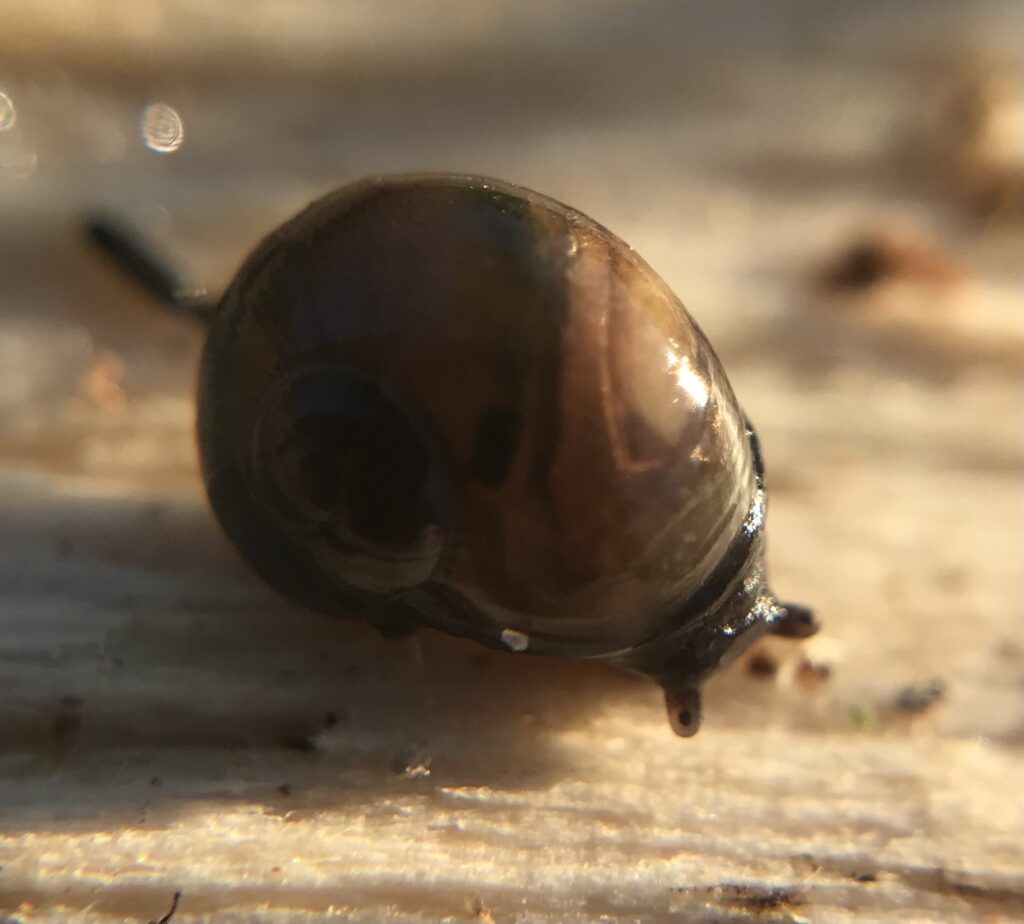
Vitrina angelicae

Image Usage Information

  • Matt Keevi
  • CC BY-NC 4.0 DEED
  • Additional information about this specimen

Family: Vitrinidae

Common name: Eastern glass-snail

Discovery: Beck, 1837

Identification

Small and fragile, the eastern glass-snail is unusual in its shape and habits. A nearly transparent shell, whose body whorl opens widely, seems barely large enough to cover the snail’s soft body as it withdraws. This snail is often found in damp grassy habitats near wetlands, streams and rivers, sometimes beneath wood, or among rocks. They may be found in apparently dry habitats that are wet during other parts of the year.

The shell of the eastern glass-snail is 6mm wide and 4.5mm tall, described by Gould (in Pilsbry, 1946) as “globose-discoid” with the last whorl “much expanded.” The shell is shiny, thin and fragile, and is clear or pale green. The umbilicus is tiny.

Ecology

The eastern glass-snail seems contrary in its habits—it is a northern species that is only active and breeding late in the year, rather than in the warmer months as most land snails. It is apparently an annual, not found alive in spring and summer. George Clapp reported that this species was among river drift along the Ohio River near Pittsburgh, and large numbers were seen in October and November when the temperature was between 1.7º and 7.2ºC (35º and 45 ºF; (in Pilsbry, 1946). Clapp observed them laying eggs in bunches of six or eight beneath wood debris.

Taxonomy

This species has no known synonyms.

Distribution

This animal is distributed in Europe, Canada, and the northern United States to the Midwest. In Pennsylvania it is found in the north and west (Hubricht, 1985).

Conservation

sidebar

About

  • Mission & Commitments
  • Directors Team
  • Museum History

Get Involved

  • Volunteer
  • Membership
  • Carnegie Discoverers
  • Donate
  • Employment
  • Events

Bring a Group

  • Groups of 10 or More
  • Birthday Parties at the Museum
  • Field Trips

Powdermill

  • Powdermill Nature Reserve
  • Powdermill Field Trips
  • Powdermill Staff
  • Research at Powdermill

More Information

  • Image Permission Requests
  • Science Stories
  • Accessibility
  • Shopping Cart
  • Contact
  • Visitor Policies
One of the Four Carnegie Museums | © Carnegie Institute | Privacy Policy | Terms of Use | Accessibility
Rad works here logo