

Image Usage Information
Family: Polygyridae
Common name: Striped Whitelip
Discovery: Say, 1821
Identification
Width: 14.5-32 mm
Height: 17-20 mm
Whorls: 5.5-6
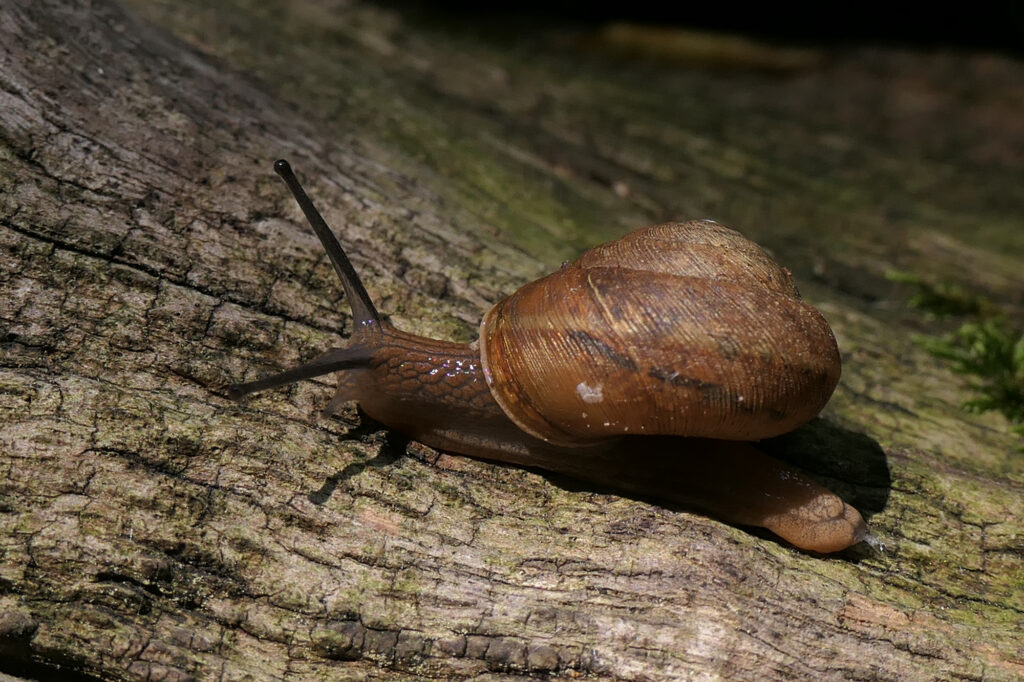
The glossy, thin shellof Webbhelix multilineata is heliciform, the lip is thin and reflected. The shell is imperforate and there are no denticles in the aperture. The color is ivory to olive buff with multiple dark reddish-brown bands that vary in width. Transverse striae are well-developed and impressed spiral striae are present.
Ecology
A species of low damp habitats including floodplains, bogs, marshes, and margins of lakes and ponds, it also occurs on forested islands in the Ohio River (e.g. Taylor and Counts, 1976). Webbhelix multilineata is common west of the Ohio River but quite restricted in the Northeast region. At a wetland in the central Appalachian Mountains this snail dwells among speckled alder and sedge hummocks eating decaying skunk cabbage leaves (Hotopp, pers. obs.). Active snails that sense disturbances may rapidly withdraw, falling from low plants. Many overwinter in dense vegetation at the water’s edge.
The parasite Panopistus pricei has been documented using the kidneys and ureter of W. multilineata as a microhabitat (Barger, 2011). Shrews and deer mice that routinely feed on this species can become infected by this parasite.
Taxonomy
The numerous synonyms include Triodopsis multilineata, Polygyra multilineata altonensis, Mesodon multilineata var. alba and var. unicolor, Helix multilineata var. rubra, Helix multilineata var. alba, Polygyra multilineata, Mesodon multilineata, and Helix multilineata.
Distribution
In the Northeast, this species is known from only a handful of sites in New York, Pennsylvania, Maryland and West Virginia, though it is more common in the upper Midwest.
Conservation
NatureServe Rank: G5.
NatureServe State Ranks: West Virginia, S1; Pennsylvania, S1; Maryland, S1; New York, Not ranked. Webbhelix multilineata is globally secure but quite rare in the Northeast.
