
Image Usage Information
Family: Gastrodontidae
Common name: Black Gloss
Discovery: Müller, 1774
Identification
Width: 6-8 mm
Height: 3.6-4 mm
Whorls: 4.5-5
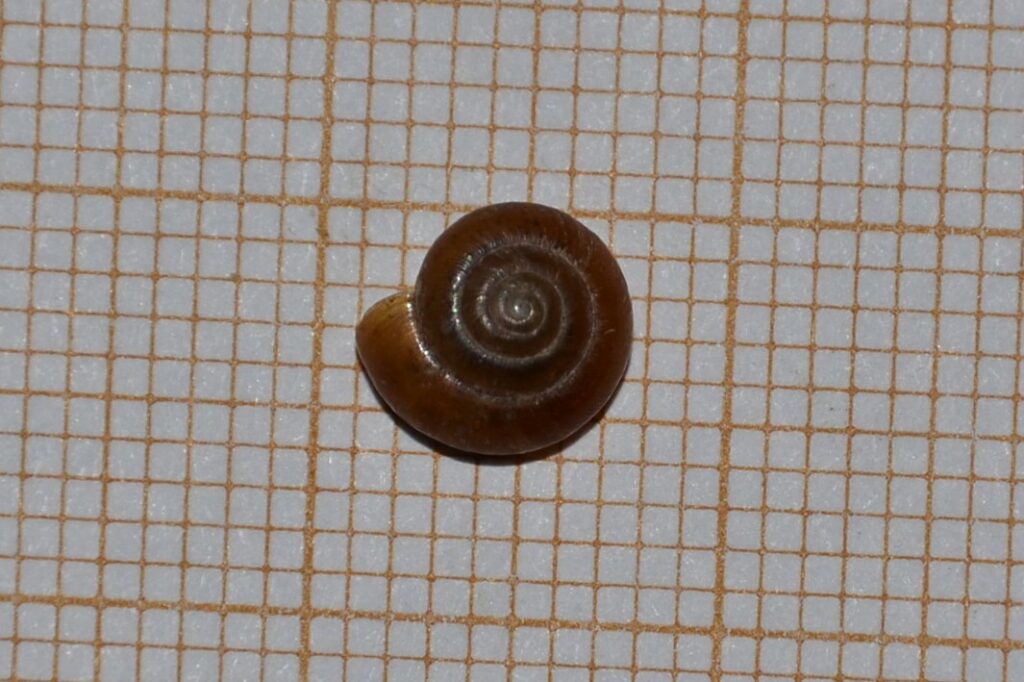
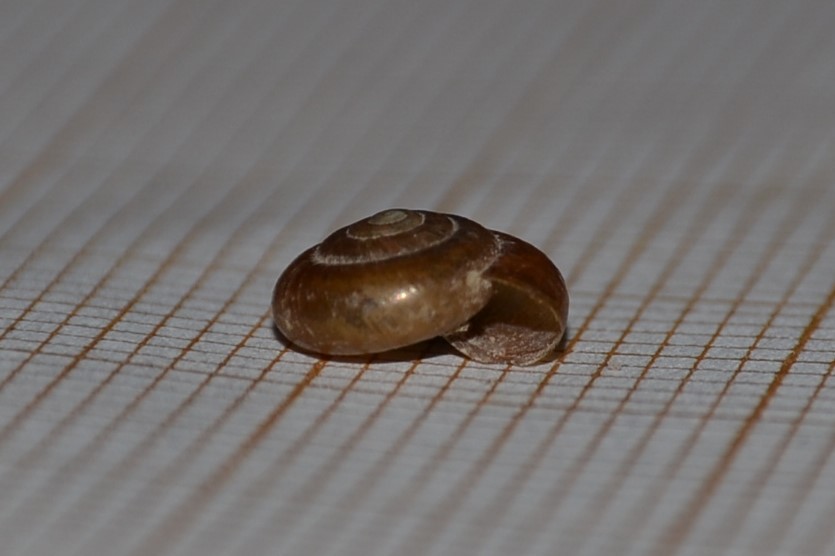
The heliciform shell of Zonitoides nitidus is deep yellowish-brown and glossy, semi-transparent, with well-impressed sutures. The shell is umbilicate, with a simple, thin peristome and lunate aperture lacking teeth at any stage of growth. The embryonic whorl is smooth with the other whorls having finely, weakly marked transverse striae. Spiral striae are not present. The shell is a bit bigger and rounder with a larger aperture than its close relative Z. arboreus. The live animal’s body is black, making the shells of live specimens appear quite dark. There is a characteristic muted-orange spot on the mantle near the lip of the shell.
Ecology
This somewhat amphibious species is generally found on floodplains, streamsides, and in wetlands. In Maine it was present in a variety of wetlands, from acid bog to rich shrub swamp (Nekola, 2008). Its distribution can be quite patchy. Zonitoides nitidus feeds upon rotting vegetation, fungi and fruit (Müller, 1774, in AnimalBase, 2017). In Europe it may lay up to 30 eggs (Gassies, 1849 in AnimalBase, 2017).
Taxonomy
Originally described as Helix nitida by Müller in 1774, Binney later named it Zonites nitidus in 1878. In 1905, Dall gave it the present name of Zonitoides nitidus. Helix hydrophyla and H. hydrophila were synonymized with Z. nitidus by Pilsbry (1946).
Distribution
Zonitoides nitidus is Holarctic, distributed in the higher latitudes of the northern hemisphere. In North America, Z. nitidus has been documented in Canada, Alaska, and as far west as California, Utah, British Columbia, and Washington. In the Northeastern United States, Z. nitidus is found from northern West Virginia and Maryland north to Maine.
Conservation
NatureServe Rank: G5, Apparently secure. This species is widespread, albeit patchily distributed, in most of the Northeast Region.
