by John Wible
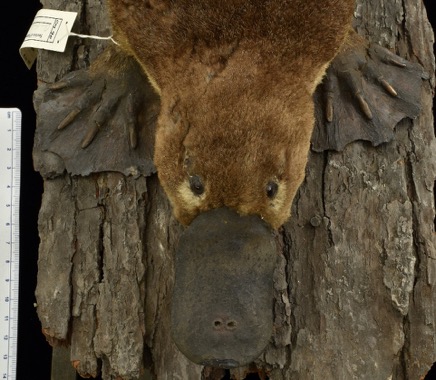
The duck-billed platypus, Ornithorhynchus anatinus, is no doubt one of the world’s oddest mammals, with a suite of adaptations to its life in streams in eastern Australia and Tasmania. Its suede-like bill is packed with electro- and mechanoreceptors, which help the platypus find small invertebrates and fish in murky waters. It has webbed forefeet and hind feet and a hairy, beaver-shaped tail, all great for swimming and diving, and a lush, thick coat for insulation on cold mornings.
As with other mammals, the female platypus produces milk to nurture its young. However, its young are hatched from leathery eggs! Along with the echidna or spiny anteater from Australia and New Guinea, the platypus is one of the two types of living monotremes or egg-laying mammals. This is in contrast to the other groups of extant mammals, marsupials, and placentals, which have live births.
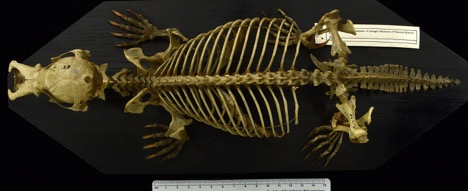
Along with egg-laying, the skeleton of the platypus is a throwback to its mammal-like reptile origin. The bones in its arms and legs, the humerus and femur, are set perpendicular to the trunk, giving the platypus a sprawling posture and a waddling gait on land. Marsupials and placentals have more upright postures with less waddling.
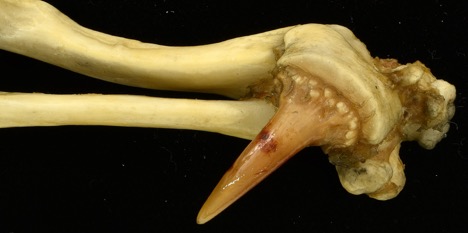
But where is the venom? If you look closely at the ankle of the male platypus, you will see a deadly looking weapon made of keratin, just like your fingernails. This tarsal spur sticks out from the body and sits on a small, flat bone—the os calcaris. The spur is hollow and connected to a gland below the knee that produces venom during the platypus breeding season. Because
of this seasonal activity, the venom is thought to be used in male-male competition for females.
For humans that make the mistake of picking up male platypuses at the wrong time of year, the venom is not deadly, but it is excruciatingly painful. One unfortunate soldier said it is worse than shrapnel! A small remnant of the spur is retained in juvenile female platypuses for only a few months after hatching, and the supporting bone, the os calcaris, without a spur occurs in the echidna. In recent years, tarsal spurs and support bones have been found in the fossil record for numerous groups of extinct primitive mammals that lived during the Age of Dinosaurs. Rather than being unique to the male platypus, venom manufactured in the leg may have been a widespread component of early mammalian weaponry for survival in the hostile Mesozoic landscape. Why this apparatus was lost in early marsupials and placentals is a mystery. One group, the bats, have reinvented a tarsal spur, where it is used in support of the wing membrane.
John Wible, PhD, is the curator of the Section of Mammals at Carnegie Museum of Natural History. John’s research is focused on the tree of life of mammals, understanding the evolutionary relationships between living and extinct taxa, and how the mammalian fauna on Earth got to be the way it is today. He uses his expertise on the anatomy of living mammals to reconstruct the lifeways of extinct mammals. John lives with his wife and two sons in a house full of cats and rabbits in Ross Township.
