by Pat McShea
When a fellow educator shared news about successful freshwater mussel propagation efforts at a Pennsylvania Fish and Boat Commission facility in Erie County, I headed online to learn details. On the webpage for the Union City Aquatic Conservation Center, I learned how two species, known commonly as the fatmucket and the plain pocketbook, had been reared in great enough numbers, and to an advanced enough stage, to initiate re-stocking efforts in waters they formerly occupied. In pursuit of a Museum connection to this positive ecological news, I asked Curator Tim Pearce if he could show me some specific freshwater mussel shells in the Carnegie Museum of Natural History Section of Mollusks.
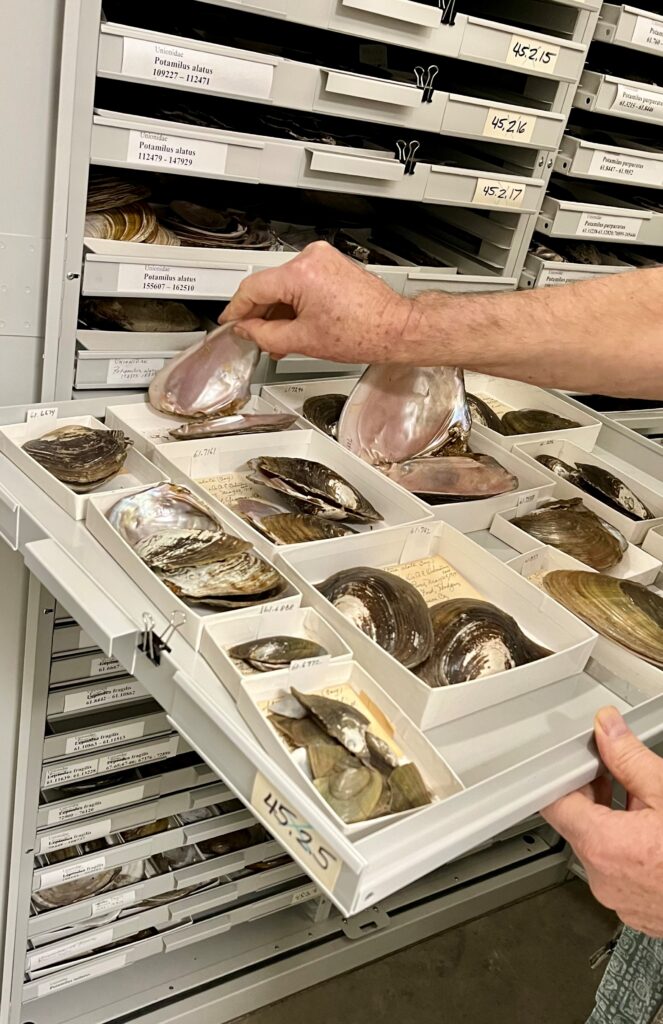
“Imagine the challenge of restoring absent species to parts of their historic range!” This thought recurred continually during a subsequent Section of Mollusks visit as Tim patiently opened drawer after drawer containing freshwater mussel shells. We were looking for shells representing dozens of native species collected in western Pennsylvania more than a hundred years ago by Dr. Arnold E. Ortmann, the European born and trained scientist who served as the Section’s Curator between 1903 and 1927.
At the time, Ortmann was widely recognized as a leading authority for the study of what are scientifically termed, the Unionidae, a large family of freshwater mussels whose global distribution includes some 300 North American species, 127 of which have been documented within the Ohio River Watershed. A century after Ortmann’s collecting efforts, the overall status for what he occasionally termed “river clams” is precarious due to industrial pollution, dredging, siltation, the impoundment of flowing waters, and the introduction of invasive species. Nationally, 38 species are presumed extinct, 70 are listed by the U.S. Fish and Wildlife Service as endangered or threatened, and numerous species are candidates for future listing.
In the open museum cabinets, the specimens Tim pointed out ranged in size from the width of a finger to the spread of a hand. Shell color seemed more limited. The convex shell exteriors were textured by parallel striations of narrow annual growth rings, and most fit on a color spectrum between mustard yellow and darkest green. The concave shell interiors were uniformly smooth and luminous. White was the predominant base color, with shades of pink and purple as visually striking exceptions.
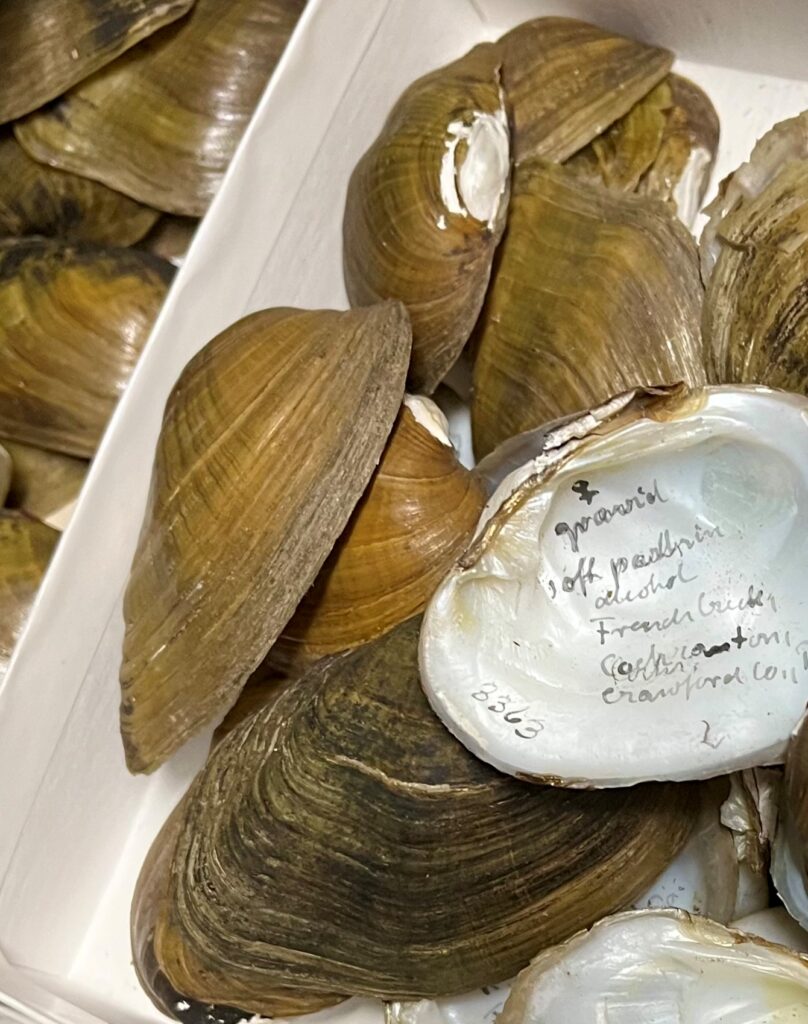
Handwritten locality information, often in neat cursive script, was inked on the pearly interiors of some shells. The resulting silent roll call, French Creek, Mahoning River, Blacklegs Creek, Monongahela River, conjured fleeting mind’s eye images of unique water-centered regional landscapes. The visions tremendously increased my admiration for Ortmann’s fieldwork. During a time of unprecedented and unregulated industrial growth, he travelled hundreds of miles within western Pennsylvania while collecting voucher specimens to document species diversity and population status.
In a 1909 publication titled “The Destruction of Fresh-Water Fauna in Western Pennsylvania,” Ortmann charted the water quality of some 80 western Pennsylvania streams and rivers based upon his firsthand evaluation of each during the previous five years. The 20-page report, published in the Proceedings of the American Philosophical Society, addressed overall stream health, rather than just mussel threats. Still, early in the work, Ortmann made a strong case for using freshwater mussels as the most reliable indicator of a stream’s health.
Being rather sedentary, living on the bottom of the rivers, breathing water, they are easily influenced by the deterioration of the water. Of all the more important groups of our fresh-water fauna, they die first, and after they have been exterminated, it is exceedingly difficult to restock the stream on account of the complex life history of the young mussels.
On a simple map of Pennsylvania’s 25 westernmost counties, the report’s only illustration, the winding course of the waterways Ortmann visited appear traced in red or blue. “Red,” an adjacent key explains, indicates “waters in good condition,” while “Blue” indicates “waters unfit for life.” In a summary statement Ortmann endorses his binary color evaluation as the best means for conveying alarm:
I think a glance upon the map accompanying this paper will tell more than any words possibly could.
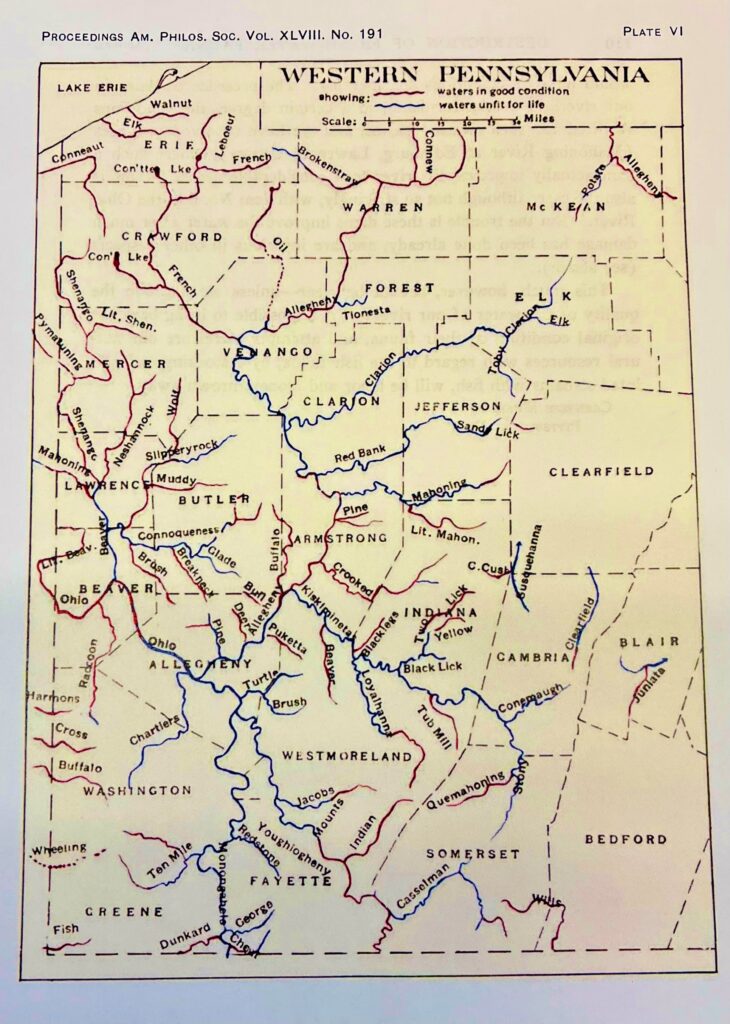
For contemporary readers, a glance at the 117-year-old map immediately raises questions about what has changed since. Fortunately, some hopeful field research based answers to such questions are available through a comprehensive online resource. The Pennsylvania Freshwater Mussel Conservation Plan is an interactive digital archive created in 2024 by the Western Pennsylvania Conservancy along with multiple organizations and government agencies, including the Pennsylvania Fish and Boat Commission, as collaborative partners. More than a glance at the Plan is strongly recommended, however, because in addition to more detailed survey maps covering every Pennsylvania watershed, the archive includes background information explaining mussel anatomy, the critical role fish play in mussel reproduction, and how the filter feeding of a large mussel colony can improve a stream’s water quality. Where the Conservation Plan presents situations in and along rivers and streams in western Pennsylvania, you can assume Dr. Ortmann’s fieldwork contributed information, and shells in the Carnegie Museum of Natural History collections continue to serve as physical, verifiable data points.
Pat McShea is Educator Emeritus at Carnegie Museum of Natural History