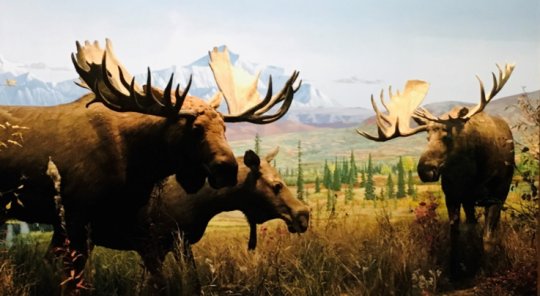
Names create a dilemma for museum educators. During some guided tours, when students are provided with the name of a creature, their observations of the animal’s physical characteristics abruptly end.
As a remedy to this situation, some teachers challenge their students to fill a notecard, page, or computer screen with words describing, but never naming, the subject under study.
At Carnegie Museum of Natural History, the dioramas within the Hall of North American Wildlife and Hall of African Wildlife are particularly well-suited for such exercises.
With practice, effort, and encouragement, student generated works can become much more than disconnected lists of adjectives. Consider, by way of a polished professional, and completely subjective example, writer Trudy Dittmar’s description of the head of a creature whose iconic whole-body outline is embedded in the minds of many people from glimpsed silhouettes on moose crossing signs along north woods highways:
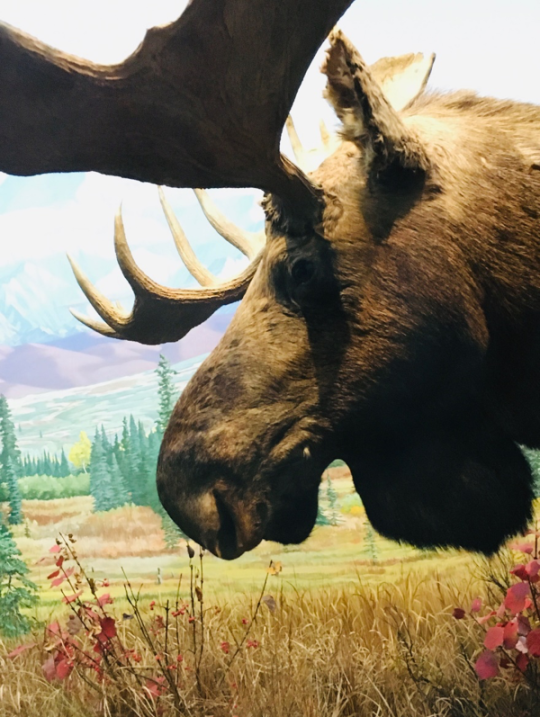
The nose end of his face looks too big for the rest of it – his face is nose-heavy, wide and huge-nostrilled, finished off below with pendulous upper lip – and against the bigness of the nose end of the face, the smallness of his eyes way up back off the muzzle is unsettling. He looks disproportioned and ungainly, a ragtag mix of a lot of things, none of them fully realized – the head an early attempt at something equine;
From: “The Moose,” in Fauna and Flora, Earth and Sky, by Trudy Dittmar, University of Iowa Press 2003
Patrick McShea works in the Education and Visitor Experience department of Carnegie Museum of Natural History. Museum employees are encouraged to blog about their unique experiences and knowledge gained from working at the museum.
