by Molly Carter
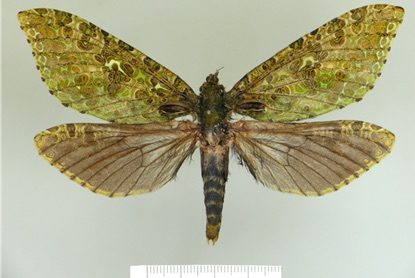
It is big, green, and was recently seen by people for the first time ever. The newly discovered Peruvian Viridigigas ciseskii is a neotropical ghost moth found in the Andes Mountains and is the first of its kind to be officially categorized.
John Rawlins, curator of the Section of Invertebrate Zoology at Carnegie Museum of Natural History, and John Grehan, a research associate, helped describe the new species and published their findings in the Annals of the Carnegie.
This green giant is so distinct, its wider evolutionary position has not been determined and a new genus, Viridigigas, has been created as it is unlike anything entomologists have observed before. Two unique individuals, a male and female, have been described and are the only ones to be collected thus far.
A monster among ghost moths, the Viridigigas ciseskii has a 12 cm wingspan and a combination of features that are not seen in any other ghost moths of the Amazon or the world. Perhaps most striking, the moth’s wings are olive green and overlaid with swirls of irregular dark circular spots, enclosed in a series of fine lines. Other tropical ghost moths have predominantly brown wings, and not one has been documented with any type of circular pattern.
Beyond its coloring, this new species also has unusual characteristics not typically found in ghost moths. The male features a large oval scent gland at the base of his forewing and the moth’s hind legs have long scent scales. While other moths do have similar traits, they are uncommon and shared only with an obscure, small gray moth found in central Chile and a large moth whose habitat is on the islands of Fiji.
While it seems hard to believe that a moth this big remained hidden from human eyes for so long, many ghost moths go unnoticed. The caterpillars burrow in the ground or inside stems, and the non-feeding moths do not often come to light. Because these moths are often ghost-like and hard to come across, it is not yet known if the new species is rare or simply elusive.
