I recently returned from three weeks’ vacation on New Zealand’s South Island. I had expected to see bazillions of sheep (I heard there were 7 sheep for every person in New Zealand), but I found that New Zealand is characterized by birds and ferns (and although we saw lots of sheep, many farmers are turning to dairy). In this post, I’ll touch on the birds of New Zealand.
Before humans arrived, the only land mammals on New Zealand were two species of bats and a now-extinct mouse. That left birds to radiate into numerous niches, and without ground-based predators, many birds became flightless and fearless. (The fearsome Haast eagle, with a wingspan up to 3 m or 10 ft, hunted from the air, but is now extinct.)
42% of the bird species have become extinct since year 1300. New Zealand was colonized by humans comparatively recently: Polynesians, who became the Maori people, arrived about year 1300 AD and brought the Polynesian rat, or kiore, which started to harm ground-nesting birds, and the Maori wiped out the large, herbivorous moa birds (evidently, they were tasty). Europeans colonized in the 1800s and brought mammals that further devastated the bird fauna: Norway rats, cats, and stoats (relatives of weasels).
The New Zealand Department of Conservation traps and poisons the mammals, which helps some birds recover. Mammal lovers who oppose the control efforts don’t offer an alternate plan, but without control, even more birds would now be extinct. There is a move toward complete eradication of the introduced mammalian predators by 2050.
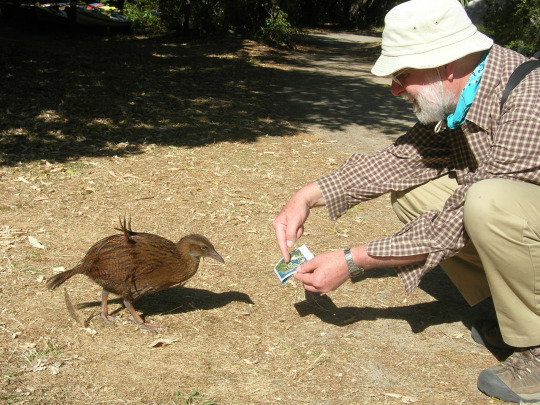
One of the widespread and friendly flightless birds is the weka. It is a member of the rail family and is roughly the size of a chicken. I tried to show one weka how to read a map, but I think it had trouble understanding my U.S. accent (see photo).
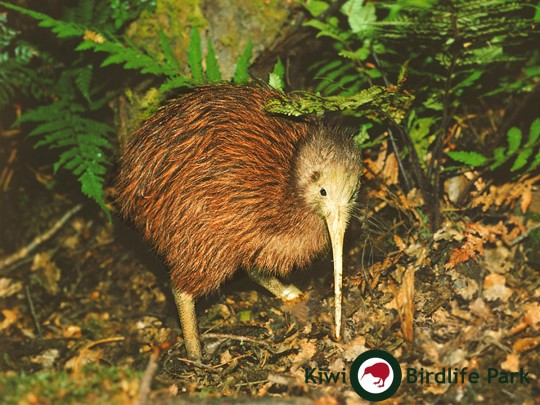
Thanks to conservation efforts, five species of kiwi birds still live in New Zealand. They are primarily nocturnal, and we were fortunate to see some at Kiwi Birdlife Park (see photo). The mother kiwi lays an unusually large egg that is about a quarter of her mass (I imagine her saying ouch at egg laying). Recent DNA evidence suggests the kiwi is more closely related to the (extinct) elephant bird of Madagascar than to the (extinct) moa of New Zealand. I believe the large size of the kiwi’s egg relative to its body size could be from evolution shrinking the adult size faster than it shrank the egg size. Kiwis have a very long proboscis, and the Maori name for one of the kiwi species translates to weka with a walking stick. Kiwis are the only bird with nostrils at the end of its proboscis. Given that bill length is measured from the nostrils to the tip, despite its prodigious nasal protuberance, technically the kiwi has the shortest bill of any bird!
Timothy A. Pearce is Curator of Collections, Section of Mollusks at Carnegie Museum of Natural History. Museum employees are encouraged to blog about their unique experiences and knowledge gained from working at the museum.
