By Anna Weber
Did you know that the ever-popular Dippy the Dinosaur and the American state may or may not share a birthday of sorts? That’s right: though Diplodocus carnegii lived hundreds of millions of years ago, Dippy the fossil was unearthed in Sheep Creek, Wyoming on one of the first days of July 1899. But how did Dippy end up in Pittsburgh, and why was this species named after Andrew Carnegie?
One hundred years ago, if you were a steel magnate, you were also a collector and an investor. You collected or invested in art, real estate and houses, cars, or perhaps even dinosaurs. The expedition that unearthed Dippy was funded by Carnegie, and paleontologist John Bell Hatcher named the new species in honor of the investor himself. When King Edward VII of England expressed an interest to Carnegie in acquiring a replica for what was then called the British Museum of Natural History in London, so launched a business of replicating Dippy the more-than-80-foot dinosaur for museums worldwide.
Why had Carnegie been so interested in getting his hands on his very own dinosaur? Forever interested in evolution and Darwin, Carnegie wanted to continue learning about the natural world and provide this education to the greater Pittsburgh community in order to help all of us better understand our own evolution as humans. In addition, sharing the knowledge derived from the digs, as well as sharing the literal skeletons and fossils, helped foster better diplomacy between the US and other nations.
Carnegie’s dino fervor fueled a facet of the Carnegie Museum of Natural History for which it is still known. Today, Pittsburgh has one of the largest dinosaur collections in the United States, including the holotype of the T. Rex, meaning the first fossil of the world’s most famous dinosaur. As a nod to the museum’s renown, in the movie Silence of the Lambs, Clarice Starling (played by Jodie Foster) walks past a T. Rex skeleton when she visits an etymologist in order to identify the moth.
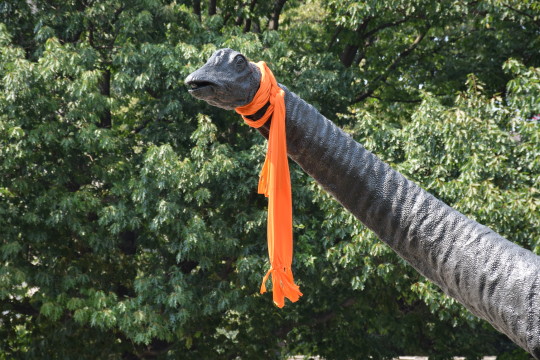
As you may have noticed, lawns, squares, courtyards, and foyers around the city are graced with statues of T. Rexes, Triceratopses, and Stegosauruses in homage to the Carnegie Museum’s collection. Walk the Burgh and Bike the Burgh’s downtown tours introduce walkers to several of these statues: a T. Rex wearing paintings of excavations, a Stegosaurus made of glass, and a Triceratops in the shape of a Heinz Ketchup bottle. Bike the Burgh also has a tour called “From Oakland to East Liberty: Land of Barons and Bankers,” which explores the “city beautiful” architecture of Oakland, including that of the Carnegie Museum itself. And on Walk the Burgh’s “Discover Oakland” tour, we’ll teach you more about Carnegie, the museums, and Diplodocus carnegii. If you come along, we can wave hello to the Dippy statue near Schenley Plaza as we bike or walk by.
Check out more facts about Dippy and our other dinosaurs on the Carnegie Museum of Natural History’s website, and check out more details about Walk the Burgh and Bike the Burgh’s tours at their sites, too.
Anna Weber is the Marketing and Outreach Coordinator for Bike the Burgh and Walk the Burgh Tours. She is working towards an MFA in creative nonfiction at Pitt.
