Build a Bug Hotel Challenge!
This week, we’re learning about arthropods (insects, arachnids, crustaceans, and myriapods) and the many different habitats and ecological roles they occupy! Here are some fun facts about some of the most populous critters on the planet:
- According to our friends at the Smithsonian, scientists estimate that there are currently 10 quintillion individual insects alive at one time (that’s 10,000,000,000,000,000,000)!
- There are over 13 million insect specimens in Carnegie Museum of Natural History’s collection!
- Many of the collected insects at our museum belong to the Order Lepidoptera (butterflies and moths) and Coleoptera (beetles).
- For entomologists (scientists who study insects), the term “bug” specifically refers to insects in the order Hemiptera. An example would be a stink bug.
We know that observing arthropods (including insects!) in the wild is key to understanding them, so let’s build a habitat for these small animals to make it easier for us to observe them!
Using recycled and natural items found in your home and around your yard, build a comfy bug hotel. Find a safe spot to place your hotel, and journal about its new tenants. Below, you will find some helpful material suggestions, but remember to always check with a grown-up before getting started.
Kids: be sure to get permission from a grown-up before using any materials (especially scissors)!
Suggested Materials
General Materials
Bug Hotel Materials
Here are some suggestions but you can be creative and use whatever materials that you find around your house. Check with a grown-up before using anything:
Journal Materials
Hear from one of our Entomologists, Catherine Giles
Step One: Build A Bug Hotel
Remember to check with an adult before using any materials.
- Think about the kinds of insects or spiders you typically near your household. What kinds of things do you think would they find useful or comfy in your bug hotel?
- Gather the materials you want to use to build your bug hotel. See the suggested materials checklist for some options.
- You may need to use scissors, tape, or glue to help construct your bug hotel.
- Think about what natural materials you can use to put inside your bug hotel.
- Think about how you can decorate your bug hotel.
- Think about how you can use your materials. Preplan! Get a pencil and piece of paper to draw how you want your bug hotel to look. Think about how you want to use the materials you gathered. Consider how critters will get in and out of the hotel.
- Now that you have a design plan, build your bug hotel!
- Find a safe spot outside you home to place your bug hotel.
- Remember: it’s okay if the hotel gets a little damp from the rain. Some critters love damp spaces!
- Remember: avoid windy locations—we don’t want your bug hotel to fly away
- With your grown-up’s permission, you may check your hotel daily to see what critters come to visit!

Step Two: Become a Backyard Biologist
Biologists are scientists that study living creatures and their natural habitats! They keep details records of their discoveries. A journal is one way you can keep track of your own discoveries!
- Create your own journal to record your observations using the suggested materials. Get creative!
- Decide how big you want your journal to be. You can use full-sized paper or use scissors to cut the pages down to size.
- Construction paper works well as a front cover, but it is okay if you don’t have any or want to use something different.
- Think about how you will hold your journal together and how you can add more pages later, if you want. Some suggestions include staples, string, or brass fasteners. Check with your grown-up before using these materials.
- Now that you have constructed your own scientific journal, feel free to decorate the covers.
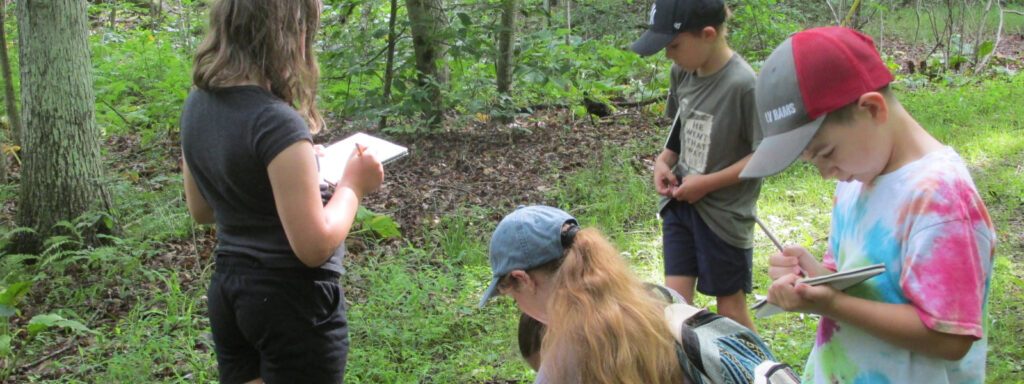
- Visit your bug hotel as often as you like (with your grown-up’s permission) and record as much information as you can. This can include:
- Drawings or written descriptions of your bug hotel’s guests
- How many animals are in your hotel at the time of your observation
- The scientific names of the critters you find; for example, Is your visitor an arthropod? Is it an insect, arachnid, myriapod, or a mystery?
- Remember: if you have a magnifying glass, it may help you see the small details on the critters.
Vocabulary
- Arachnid– an arachnid is an arthropod with eight legs and two main body regions. (Example: spider)
- Arthropod– an arthropod is an invertebrate (no backbone) creature with an exoskeleton, segmented body, and jointed appendages.
- Crustacean– an arthropod with a segmented body with one or two pairs of legs on each segment and a pair of antennae. Many are aquatic, but some live on the land. (Example: crayfish)
- Entomologist– a scientist who studies insects
- Insect– an arthropod with three body segments (head, thorax, and abdomen), six legs, and one or two pairs of wings. (Example: grasshopper)
- Myriapod– an arthropod with many segments and legs on nearly all of the segments. (Example: millipede)