• Skip to primary navigation
  • Skip to main content
  • Skip to primary sidebar

Carnegie Museum of Natural History

One of the Four Carnegie Museums of Pittsburgh

  • Visit
    • Buy Tickets
    • Visitor Information
    • Exhibitions
    • Events
    • Dining at the Museum
    • Celebrate at the Museum
    • Powdermill Nature Reserve
    • Event Venue Rental
  • Learn
    • Field Trips
    • Educator Information
    • Programs at the Museum
    • Bring the Museum to You
    • Guided Programs FAQ
    • Programs Online
    • Climate and Rural Systems Partnership
  • Research
    • Scientific Sections
    • Science Stories
    • Science Videos
    • Senior Science & Research Staff
    • Museum Library
    • Science Seminars
    • Scientific Publications
    • Specimen and Artifact Identification
  • About
    • Mission & Commitments
    • Directors Team
    • Museum History
  • Tickets
  • Give
  • Shop

September 27, 2018

For more information, contact:
Erin Southerland
Carnegie Museums of Pittsburgh
412.353.4818 (office)
SoutherlandE@CarnegieMNH.org

Avian Researchers Awarded Funds to Study Species of Greatest Conservation Need in the Mid-Atlantic Region

Researchers Will Use Nanotags and MOTUS Stations to Study These Species

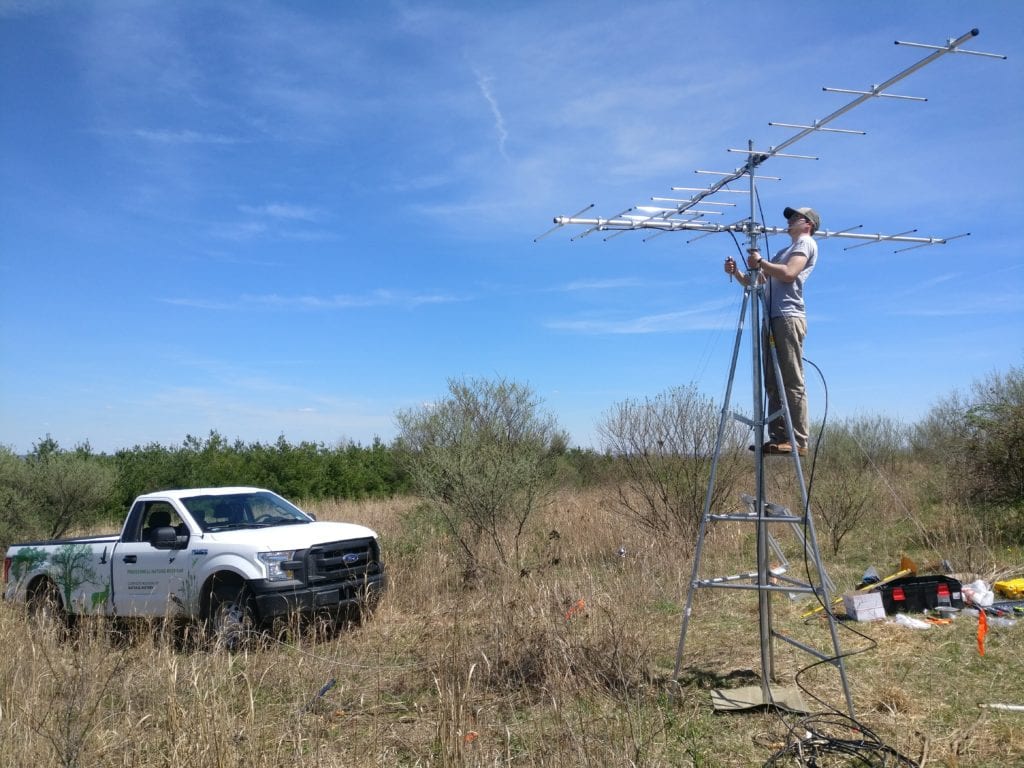
Luke DeGroote in the field at a MOTUS station.

Avian researchers at the Carnegie Museum of Natural History’s Powdermill Nature Reserve have received funding from the U.S. Fish and Wildlife Service of approximately $200,000 for the grant proposal “Overcoming Geographic and Temporal Barriers to Identifying Landscape-scale Habitat Use of Multiple SGCN in the Mid-Atlantic Region Using Nanotag Technology.”

The grant also funds the placement of nanotags on several Species of Greatest Conservation Need (SGCN). Nanotags are digitally coded radio transmitters the size of a bean that are detected by a Motus station when an animal passes within nine miles. Together nanotags and Motus stations have been used to uncover remarkable migratory journeys such as a Gray-cheeked Thrush’s 46-hour, 2200-mile, non-stop flight from Colombia to Ontario.

“The eight species targeted for conservation action in this grant are of particularly grave concern, and the information we gain about them will help us better conserve them and the landscapes they need. But the expanded Motus network this grant provides will allow conservation agencies and researchers to learn about dozens of other declining and imperiled species of birds, bats and migratory insects that travel through the East, about whose movements we know little or nothing,” said author and researcher Scott Weidensaul, one of the founders of the Northeast Motus Collaboration.

DeGroote and his team will be placing nanotags on two SGCN, the American Woodcock and Wood Thrush. The nanotags and Motus stations will help researchers determine the effect of bird collisions with windows on behavior and long-term survival. It is estimated that 600 million birds die every year from collisions in the US alone.

“Many of us have seen a bird hit a window and later fly off, but we have no idea what the long-term repercussions of that collision are,” says Luke DeGroote, “Using this newly available technology, we’ll be able to determine, for the first time, if we’re underestimating the threat windows pose to birds.”

These funds are part of a larger allocation of funds by the Department of the Interior through the State Wildlife Service Grants Program and Tribal Wildlife Grant Program, which awards funds to Native American Tribes and State Wildlife Grants.

Carnegie Museum of Natural History, one of the four Carnegie Museums of Pittsburgh, is among the top natural history museums in the country. It maintains, preserves, and interprets an extraordinary collection of millions of objects and scientific specimens used to broaden understanding of evolution, conservation, and biodiversity. Carnegie Museum of Natural History generates new scientific knowledge, advances science literacy, and inspires visitors of all ages to become passionate about science, nature, and world cultures. More information is available by calling 412.622.3131 or by visiting the website, www.carnegiemnh.org.

sidebar

About

  • Mission & Commitments
  • Directors Team
  • Museum History

Get Involved

  • Volunteer
  • Membership
  • Carnegie Discoverers
  • Donate
  • Employment
  • Events

Bring a Group

  • Groups of 10 or More
  • Birthday Parties at the Museum
  • Field Trips

Powdermill

  • Powdermill Nature Reserve
  • Powdermill Field Trips
  • Powdermill Staff
  • Research at Powdermill

More Information

  • Image Permission Requests
  • Science Stories
  • Accessibility
  • Shopping Cart
  • Contact
  • Visitor Policies
One of the Four Carnegie Museums | © Carnegie Institute | Privacy Policy | Terms of Use | Accessibility
Rad works here logo