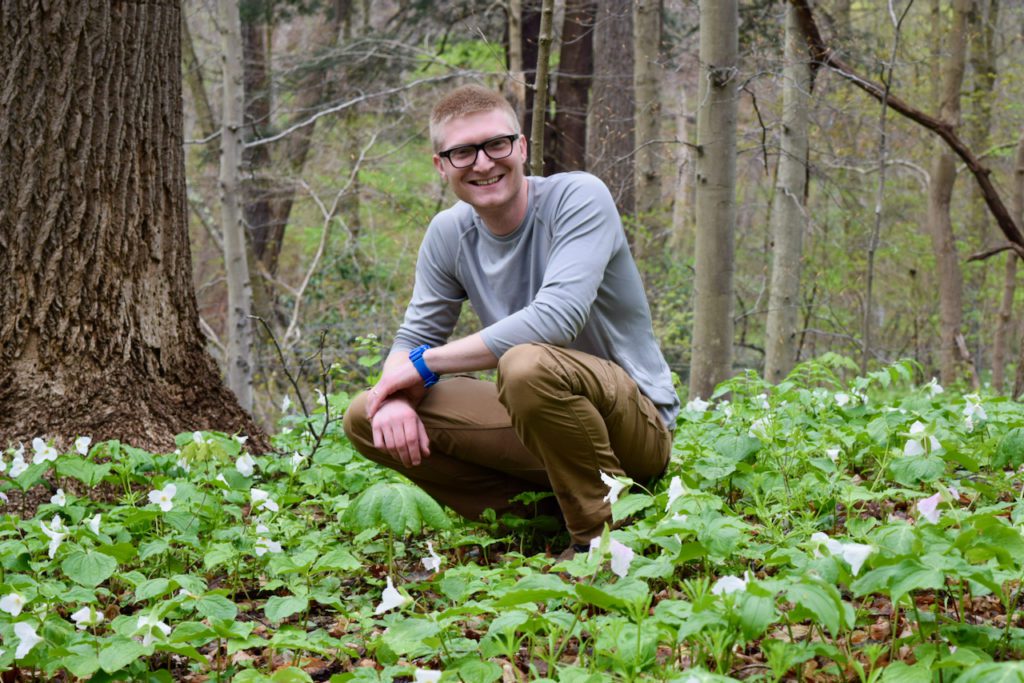
Pittsburgh, PA—Carnegie Museum of Natural History announces a National Science Foundation award of $645,767 for a three-year collaborative research project undertaken by the museum, the University of Pittsburgh, and Boston University to study the phenological mismatches between trees and wildflowers mediated by climate change and invasive plants. Carnegie Museum of Natural History will receive $198,178 for the project.
The research team includes Mason Heberling, Assistant Curator of Botany at Carnegie Museum of Natural History; Richard Primack, Professor of Biology at Boston University; and Sara Kuebbing, Assistant Professor of Biological Sciences at the University of Pittsburgh. The study expands the scope of a previous collaboration that cited observations recorded by Henry David Thoreau to shed insight on the effects of climate change on the seasonal timing of flowering and leaf outs of wildflowers.
Previous research by members of these research groups suggests the timing of leaf out of overstory trees may shift faster than understory wildflowers in response to warmer spring temperatures. Such mismatches in leaf out timing of various plant species might reduce wildflower populations and impact forest diversity. In addition to climate change, non-native shrubs with extended spring and autumn phenologies have increasingly invaded forests and contributed to these mismatches.
Direct measurements of climate-induced phenological mismatches between interacting species are rare, and natural history collections have emerged as critical resources. The project will combine data from these collections, including digitized herbarium specimens from around the world, with field and lab experiments to understand the consequences of global change on forest ecology and wildflower species. Study sites include those managed by Allegheny Land Trust, Audubon Society of Western PA, and Powdermill Nature Reserve, the field station of Carnegie Museum of Natural History.
“Natural history collections have never been more relevant,” said Dr. Heberling. “They uniquely position us to study these relationships across a century of change and worldwide. Combining museum specimens with new fieldwork, we are poised to better understand the past and predict future impacts to forests.”
The study exemplifies the museum’s commitment to major pillars outlined in its 2020-2022 strategic plan: a focus on world-class ecological research and public awareness of the Anthropocene, the proposed name of the current geological epoch of profound human impact on the planet.
The project includes coordination with the museum’s public-facing and educational channels, including social media, public lectures, on-site museum activities, and workshops for K-12 educators integrating forest monitoring and local examples of climate change into school curricula.
“This work epitomizes our mission as a forum for understanding our rapidly changing world,” said Steve Tonsor, Daniel G. and Carole L. Kamin Interim Director of Carnegie Museum of Natural History. “It focuses on the intersection of ecology and the Anthropocene and delivers these findings not only to experts in the scientific community, but also to educators and to our museum public at large. For public engagement on climate change, it is especially important that we study systems like this in our own backyards. Congratulations to Mason and his colleagues for launching this vital and timely project.”
Since 2015, Carnegie Museum of Natural History has been awarded $2.5 million in National Science Foundation Funds for projects including the Climate and Rural Systems Partnership, STEM education programs, and the preservation of the herpetology collection.
The National Science Foundation is an independent federal agency that promotes the progress of science by funding scientific research and education. Funds from federal agencies like the National Science Foundation support initiatives, exhibitions, educational programs, and research at all four Carnegie Museums of Pittsburgh and further Carnegie Museums’ mission of making arts, sciences, and humanities accessible to all.
