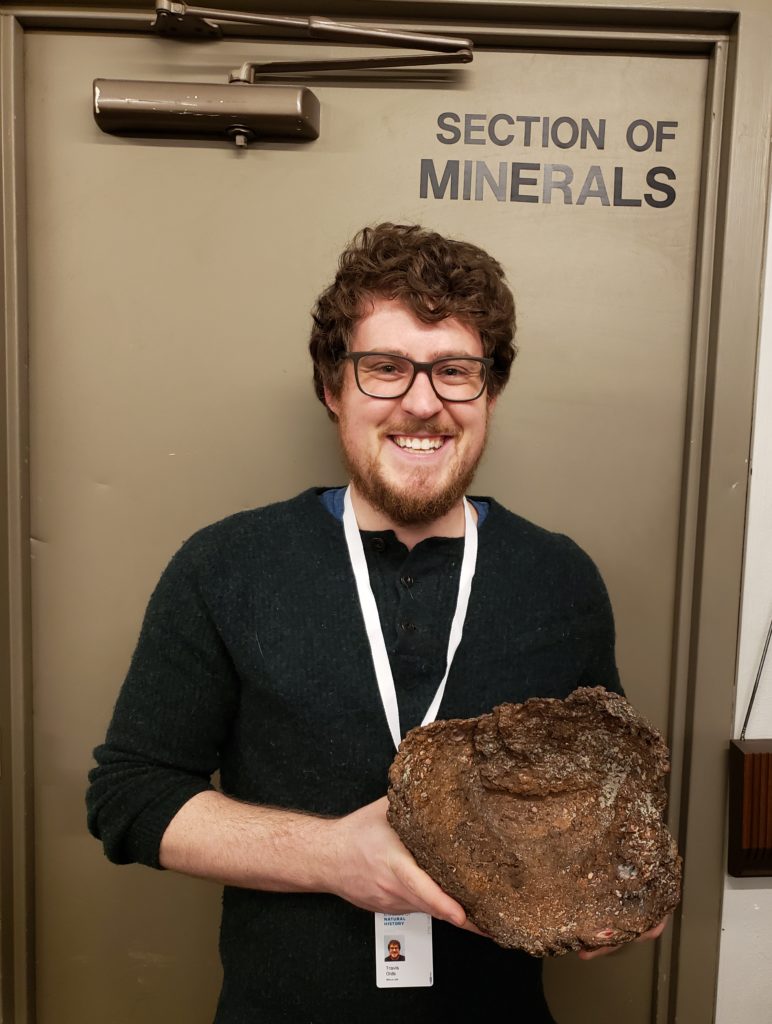
Pittsburgh, PA — Following an international search, Carnegie Museum of Natural History welcomes Dr. Travis Olds as the new assistant curator of the internationally renowned minerals collection. Olds officially started at the museum on December 30, 2019 and is already at work. Among Olds’ first duties will be the presentation of the Carnegie Mineralogical Award at the Tucson Gem and Mineral Show on February 15, 2020.
Olds joins the museum from Washington State University, where he was a post-doctoral research associate who led research efforts for the Actinide Ceramic Materials Laboratory. Prior to that, he completed his PhD at the University of Notre Dame studying the mineralogy and crystal chemistry of uranium. To date, Olds has discovered or been involved in the description of 19 new minerals recognized by the International Mineralogical Association Commission on New Minerals, Nomenclature and Classification.
“Many of the new minerals contain uranium, and they are helping us to better understand the nuclear fuel cycle, from mining of ore to remediation of the mine and disposal of used nuclear fuel,” says Olds. “Another example of our new finds is hydroxyl pyromorphite, a mineral that helps to keep lead out of drinking water.”
Olds’ research interests align with the museum’s Anthropocene initiative, the study of our current geological epoch in which humans have profound planetary impact. He aims to uncover a deeper understanding of the interactions between minerals and humans and how researchers can use knowledge of mineral structures to create better materials and processes for environmental and technological benefit.
“We’re thrilled to welcome Travis to our distinguished team of researchers,” said Steve Tonsor, Daniel G. and Carole L. Kamin Interim Director of Carnegie Museum of Natural History. “Our mineral collection is among the world’s best, and our institution’s scientific work in this field enjoys a celebrated legacy. Travis, whose work zeroes in on the intersections of humans and minerals, positions us to build on this legacy and achieve new relevance.”
“Mineralogy and minerals are a crucial facet to everything we do, especially in the fields of technology, environmental science, and medicine,” says Olds.
Carnegie Museum of Natural History received funding support for the search from the Hillman Foundation, Inc.
ABOUT THE SECTION OF MINERALS
The Section of Minerals at Carnegie Museum of Natural History includes more than 30,000 specimens, with over 1,300 on display in Hillman Hall of Minerals and Gems. Acquisitions include an outstanding suite of minerals from the former Soviet Union, a historically important suite of nearly 5,000 Pennsylvania minerals formerly owned by the Academy of Natural Sciences in Philadelphia, and more than 2,700 Pennsylvania minerals acquired from the Bryon Brookmyer collection. Overall, approximately one third of the minerals in the collection are from Pennsylvania, and it is the most comprehensive Pennsylvania collection in the world. The section also houses a gem collection of about 2,000 pieces and a collection of meteorites.
Hillman Hall of Minerals and Gems opened in September 1980 after a decade of planning and exhibit-quality specimen acquisition made possible by the generosity of Henry L. Hillman and The Hillman Foundation Inc. The Hillman Foundation later established an endowment for Hillman Hall of Minerals and Gems to provide for continuing improvement of and operating support for the mineral program. This contribution also provided funding for a mineral conservation and preservation laboratory and a permanent curatorial position.
ABOUT THE CARNEGIE MINERALOGICAL AWARD
The Carnegie Mineralogical Award honors outstanding individuals or groups whose contributions in mineralogical preservation, conservation, and education match the ideals advanced in Carnegie Museum of Natural History Hillman Hall of Minerals and Gems. Established in 1987 through the generosity of The Hillman Foundation Inc., the award consists of a bronze medallion, a certificate of recognition, and a $3,000 cash prize. The award is presented each February during the Tucson Gem and Mineral Show.
