Researchers Discover New Species of Sail-Backed Mammal Forerunner that Reveals Earliest Indications of Herbivory in Fossil Record
Melanedaphodon hovaneci Named in Honor of Pittsburgh-Area Native A. George Hovanec
FOR IMMEDIATE RELEASE
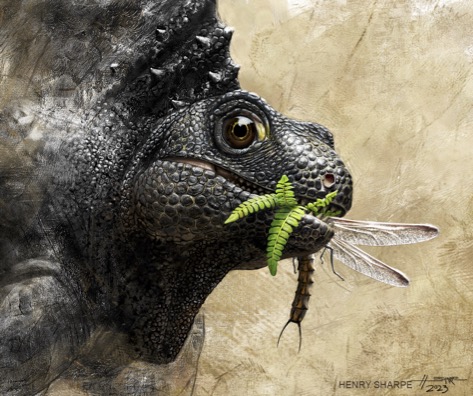
Pittsburgh, PA, April 5, 2023 — In a study published in the journal Scientific Reports, researchers from the Smithsonian’s National Museum of Natural History, Carnegie Museum of Natural History, and Harvard University’s Museum of Comparative Zoology announce the discovery of Melanedaphodon hovaneci, the earliest known edaphosaurid synapsid, ancient precursors of mammals recognized in popular culture and science textbooks for the spine-supported sails along their backs. The study also provides clues about how and when herbivores first appeared on the evolutionary scene.
The study analyzed two fossils recovered from cannel coal in eastern Ohio dating to the Moscovian Age (315.2 to 307 million years ago) of the Carboniferous Period. Using micro CT scanning, the team described the new species, highlighting similarities between it and later edaphosaurids that occurred roughly 300–272 million years ago.
Anatomical data provided by the new fossils yields insights about how herbivorous behavior first arose among land animals. With its large, bulbous, and cusped marginal teeth, together with numerous teeth on its palate (i.e., the roof of the mouth), Melanedaphodon differs from all other known species of Edaphosauridae. The presence of such teeth suggests that adaptations for processing tough plant material first appeared among the earliest mammal precursors. The researchers propose that durophagy—feeding on organisms with hard shells or exoskeletons—eventually enabled the eating of plants.
“This is such an exciting find,” said Amy Henrici, one of the authors and Collection Manager of Vertebrate Paleontology at Carnegie Museum of Natural History. “We now have a much better understanding of how terrestrial animals first adapted as plant eaters, which had a profound impact on global ecosystems.”
The team named Melanedaphodon hovaneci in honor of the late A. George Hovanec, a native of West Mifflin, Pennsylvania whose financial contributions made the study possible. Mr. Hovanec passed away in January of 2023. “We’re so honored to celebrate George with the naming of Melanedaphodon hovaneci,” said Henrici. “His generous support throughout the years was vital to so much of our work. I think he would be thrilled.”
In addition to Henrici, the research team includes lead author Arjan Mann and colleague Hans-Dieter Sues of the Department of Paleobiology, National Museum of Natural History and Stephanie Pierce of the Museum of Comparative Zoology and Department of Organismic and Evolutionary Biology, Harvard University.
