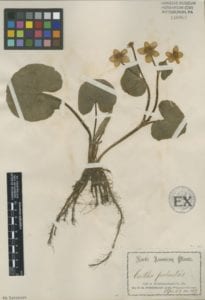
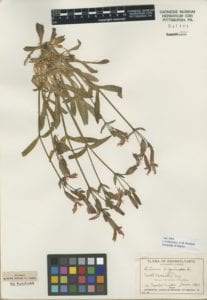
Carnegie Museum Herbarium specimens: (left) the oldest Allegheny County specimen collected in 1869 (right) Caltha palustris collected in 1874
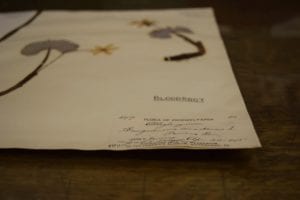
Sanguinaria canadensis specimen collected in 1905
Botanists from Carnegie Museum of Natural History (Pittsburgh, PA) received funding from the US National Science Foundation (NSF) totaling $173,614 to partner with the ongoing Mid-Atlantic Megalopolis (MAM) Project. Along with students and volunteers, Mason Heberling, Postdoctoral Research Fellow, and Bonnie Isaac, Collection Manager, of the Botany Department will be working with the team to digitize nearly 190,000 plant specimens in the museum’s collection to better understand plant life in urban environments. This three-year project begins August 1, 2018.
Carnegie Museum’s Herbarium (CM) is the major botanical facility in the Upper Ohio Valley region and ranks among the top 25 herbaria in North America. In addition to large holdings from the region dating back to the 1800s, the more than 540,000 vascular plant specimens include worldwide geographic and taxonomic representation.
The Mid-Atlantic Megalopolis (MAM) Project includes specimens from 13 institutions in Pennsylvania, New York, New Jersey, Delaware, Maryland, and District of Columbia. According to the MAM Project website, “The data mobilized in this effort will help us achieve a better scientific understanding of living urban systems, a critical need for urban planners, restoration ecologists, environmental engineers, (landscape) architects, and conservationists engaged in creating more sustainable and better designed cities, including the constructed and restored natural environments of our urban areas.”
The initial MAM Project’s focus was on the densely-populated urban corridor from Washington, D.C. to New York City. This funding to the Carnegie Museum of Natural history substantially expands the project’s scope by adding the unique industrial and environmental history of the Greater Pittsburgh Region. The addition of the Carnegie Museum Herbarium will increase the number of digitized specimens in the MAM Project by more than 25% (nearly 190,000 plant specimens).
A digital herbarium will be publicly available online, making plant specimens in the Carnegie Museum of Natural History, and the information within, accessible to researchers worldwide. Along with high-resolution images for nearly 190,000 plant specimens at the Carnegie Museum of Natural History, the project will mobilize additional data, including who collected the specimen, where it was collected it (including GPS coordinates), when it was collected, and more.
The project also funds activities that enhance the ongoing Anthropocene initiatives at the Carnegie Museum of Natural History, including programs in invasive species management, education of nature in the city, and museum exhibition. Taken together, this project will improve scientific and public understanding of urban environments, highlighting sustainability and the future of this increasingly common biome in the current era of environmental change.
