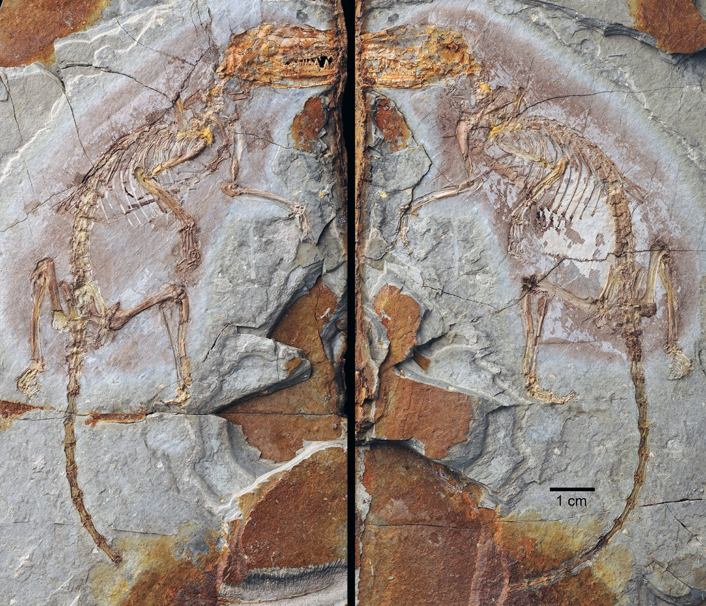
An international team including scientists from Carnegie Museum of Natural History and Indiana University of Pennsylvania have announced a 126 million year old fossil in the placental mammal lineage. This new fossil, named Ambolestes zhoui, was found in Inner Mongolia, northeastern China, in rocks also known for their spectacular feathered dinosaurs. Placental mammals, including humans, comprise most of the 5,500 species of living mammals. The other types are marsupials and monotremes. Within the placental lineage, only a handful of fossils of a similar or older age have been found. Ambolestes zhoui is without a doubt the most complete of these earliest members of the placental lineage.
As with other fossils from Inner Mongolia, Ambolestes zhoui was discovered by splitting rocks, resulting in a specimen cleaved in two halves. Putting these halves back together, nearly every bone in the body is preserved, including some bones that have never been found in any mammal from the Age of Dinosaurs. Perhaps the most remarkable preservation concerns the complete hyoid apparatus, a string of delicate bones suspended from the base of the skull that provide attachment area for muscles of the tongue and neck. Humans have a single, U-shaped hyoid bone, but that of Ambolestes zhoui was more elaborate, composed of seven separate bones, as in some living mammals, such as squirrels.
“The hyoid is one of the least understood elements of the mammalian skeleton,” according to Carnegie Museum of Natural History Curator of Mammals John Wible, an author on the study. “Its form across living mammals is amazingly diverse and we have little understanding why.” Wible hopes that the discovery of the hyoid apparatus in such an early placental relative will spark interest by researchers working on swallowing, mastication, and vocalization to provide evidence about the hyoid’s role in these critical functions so integral to being a mammal.
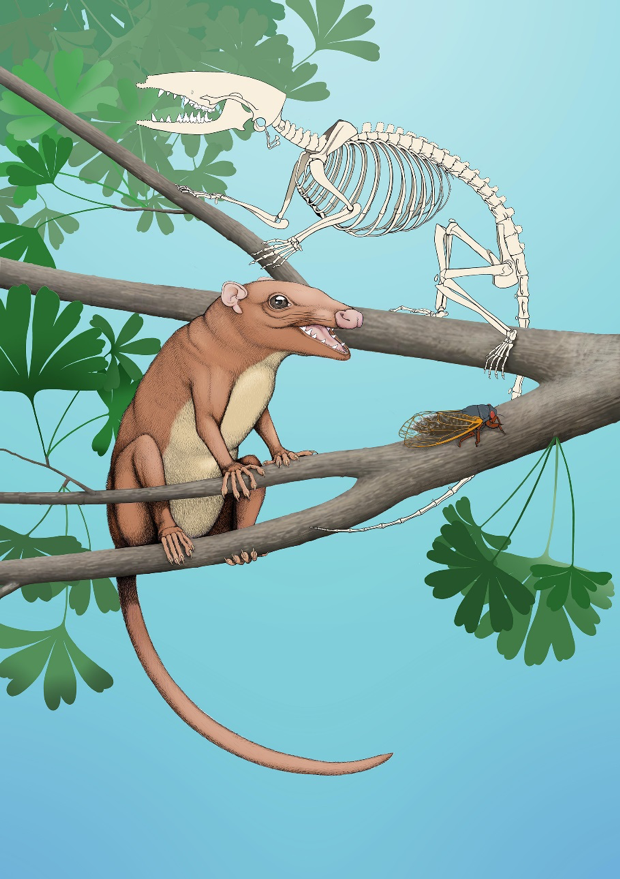
The nearly complete skeleton of Ambolestes zhoui, roughly 10 inches in length (25 centimeters), allowed Carnegie Museum scientific illustrator Paul Bowden to make a detailed reconstruction of how this animal looked. The bones of its hand point to it being an adept climber and its teeth to an insectivorous diet. Consequently, Ambolestes zhoui is reconstructed in a gingko tree hungrily eyeing a cicada; both the tree and the insect are also present in the same fossil formation in Inner Mongolia. Co-author Dr. Shundong Bi of Indiana University of Pennsylvania said “because this new animal is so complete, it affords an amazing window on the early evolution and lifestyle of the mammal group that would become dominant after the demise of the dinosaurs 66 million years ago.”
CONTACT INFORMATION FOR RESEARCH TEAM
John Wible, Carnegie Museum of Natural History: 412.606.2708, wiblej@carnegiemuseums.org
