by Patrick McShea
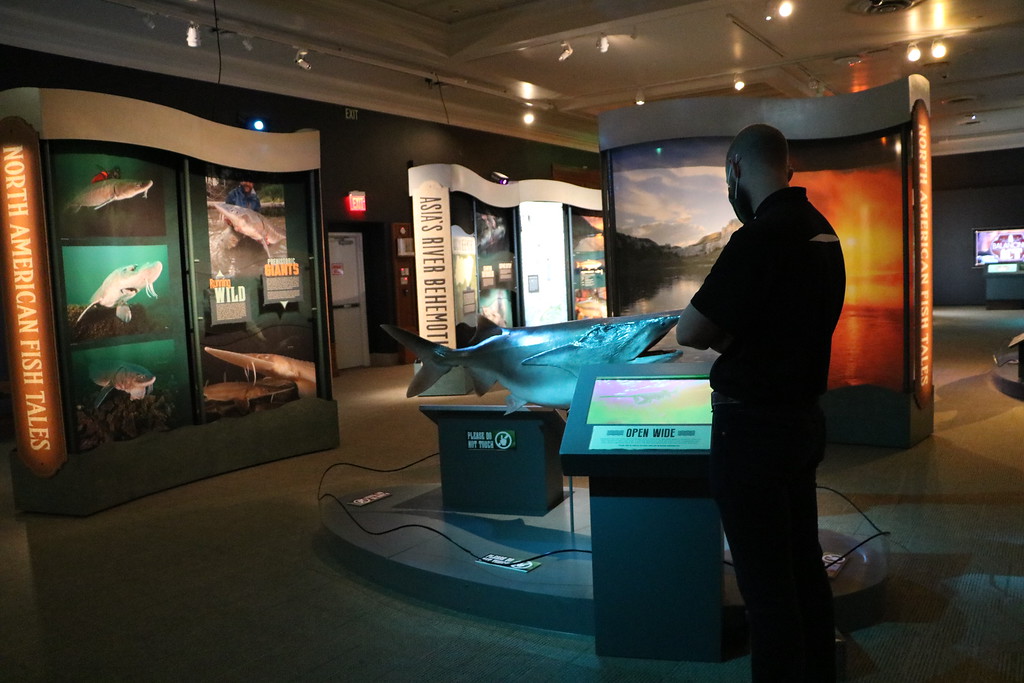
The world’s big river systems are a sub-topic of Monster Fish: In Search of the Last River Giants, an exhibition developed and traveled by National Geographic Museum, and now on view in the R.P. Simmons Family Gallery.
Species featured in the exhibition as life-size replicas continue to inhabit portions of the Mekong, Amazon, Ganges, Murray, and Mississippi River systems. Text panels, maps, and in-the-field video testimony by National Geographic Explorer Dr. Zeb Hogan repeatedly present the current state of these enormous finned residents as a measure of each freshwater network’s ecological health.
The message is certainly locally relevant. The Ohio River, which forms in Pittsburgh at the confluence of the Allegheny and Monongahela Rivers, drains the massive eastern flank of the Mississippi River Watershed. Visitors to Monster Fish from western Pennsylvania, northern West Virginia, or eastern Ohio will naturally wonder about the largest fish in our region’s flowing waters. Addressing such curiosity is second nature for Ryan Argo, a Technical Programs Manager for the Ohio River Valley Sanitation Corporation, a multi-state agency widely known in abbreviated form as ORSANCO.
The 73-year-old organization works with member states on water quality improvements in the Ohio River Basin to ensure the river system can be a resource for drinking water, industrial supplies, and recreation, as well as habitat for a healthy and diverse aquatic wildlife community. Ryan’s work involves regular surveys of fish and aquatic invertebrate populations along the whole 981-mile length of the Ohio River as well as lower portions of significant tributaries.
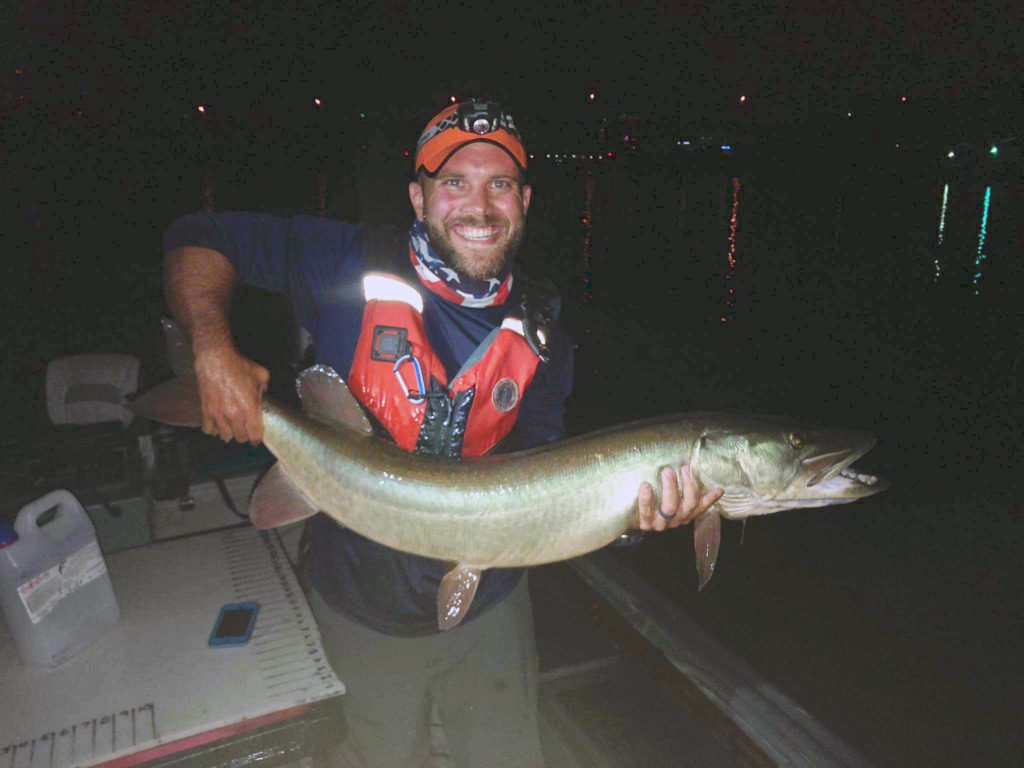
Speaking recently from ORSANCO’s Cincinnati headquarters, Ryan began a big fish conversation with a Pittsburgh reference. “During a survey on the lower Allegheny a couple years ago, we came upon a 50-inch-long muskellunge at a place well within sight of Downtown buildings. In that part of the river system, muskellunge are the top predator, and this one was waiting along shore in what seemed barely six inches of water to ambush its next meal.” That next meal could have been any one of a long list of fish species. Surveys document more than 120 species of fish in the Ohio River, a handful of which can approach monster standards in size.
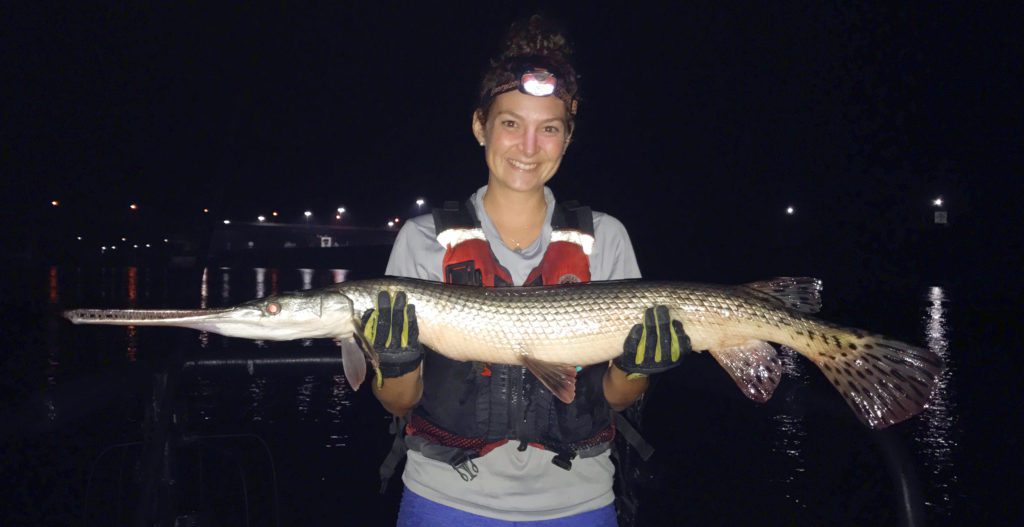
In addition to muskellunge, Ryan mentions American Paddlefish, Flathead and Blue Catfish, and a species of sucker known as Black Buffalo as Ohio River fish with potential to grow particularly large and can exceed 50 pounds. “Perhaps Long-nosed Gar should also be considered. They’re thin bodied, completely without bulk, but a twenty-pound gar can be a fish more than four feet long.”
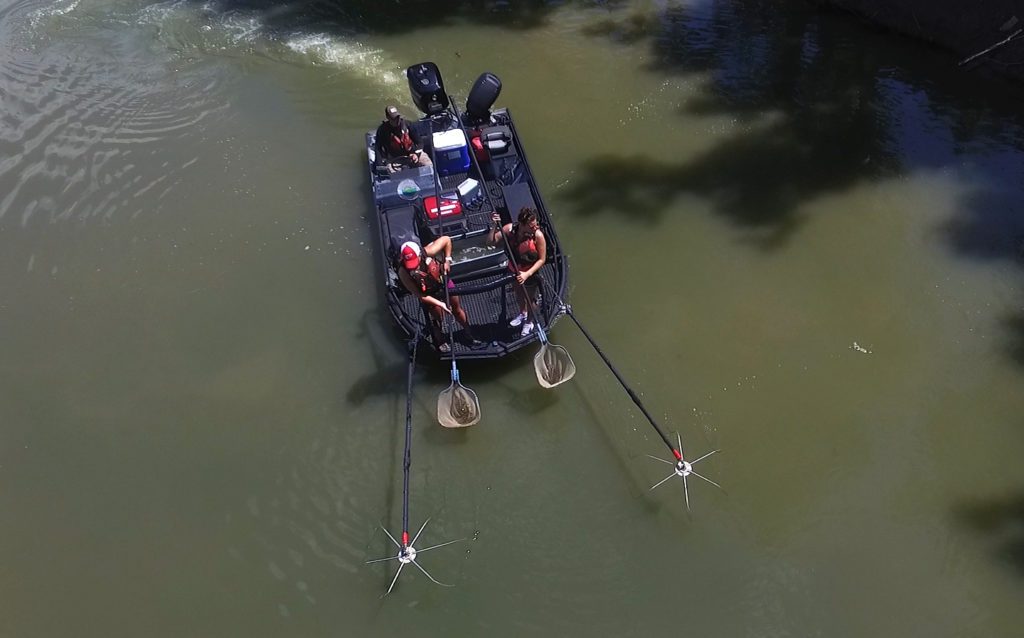
Ryan qualified his species selection by explaining that ORSANCO survey techniques generally involve near shore electrofishing, a practice that employs a weak direct electrical current to temporarily immobilize fish for easy capture. “Our surveys look at the entirety of fishery by sampling similar lengths of shoreline throughout the river system. The work documents not just species diversity, but also biomass. Species like paddlefish that tend to remain out in the main flow of the river don’t show-up much, so their presence is accounted for in other survey methods. The ongoing examination of the fish community tells us about the system’s health, and this information is shared with state and federal agencies.”
In explaining how much the river has changed from the time when its fish and freshwater mollusks were a vital food resource for the Native Peoples who lived along its banks, Ryan cites the Ohio’s binary geologic structure as important baseline information. “There’s the cool water, high gradient, upper river that’s draining a portion of the Appalachians. Then there’s the warm water, low gradient, lower river that wanders across glaciated terrain. Same river, but for fish, different habitat.”
Active management of both sections for navigation, which began in the 1820’s with a federally-funded snag removal, eventually produced the current system of 20 locks and dams that create a dependable main channel for commercial and recreational watercraft. “We know fish can move through,” Ryan explains, “but continuing discussions are important, especially as more dam sites become hydro-electricity generators. We want our native fish populations to be as robust as possible, and that means discussions about how locks operate, and how hydro plants operate.”
After summarizing the Ohio River as a “large robust biologic system” that is always facing new emerging issues, Ryan concluded the conversation with an account of a big fish observation worthy of those Dr. Zeb Hogan shares in multiple Monster Fish videos.
“Along the lower Ohio River there are some places where the remnants of old wicket dams still cling to the shore. During periods of high water, when these anchor points are submerged, the water flow over them creates an enormous standing wave, perhaps six feet high. Amidst this churning water I’ve seen big paddle fish and gar moving with ease, the way those species have been doing for thousands of years.”
Patrick McShea works in the Education and Visitor Experience department of Carnegie Museum of Natural History. Museum employees are encouraged to blog about their unique experiences and knowledge gained from working at the museum.
Related Content
Educator Spotlight: Christian Shane
Carnegie Museum of Natural History Blog Citation Information
Blog author:Publication date:
