• Skip to primary navigation
  • Skip to main content
  • Skip to primary sidebar

Carnegie Museum of Natural History

One of the Four Carnegie Museums of Pittsburgh

  • Visit
    • Buy Tickets
    • Visitor Information
    • Exhibitions
    • Events
    • Dining at the Museum
    • Celebrate at the Museum
    • Powdermill Nature Reserve
    • Event Venue Rental
    • Gift Cards
  • Learn
    • Field Trips
    • Educator Information
    • Programs at the Museum
    • Bring the Museum to You
    • Guided Programs FAQ
    • Programs Online
    • Climate and Rural Systems Partnership
  • Research
    • Scientific Sections
    • Science Stories
    • Science Videos
    • Senior Science & Research Staff
    • Museum Library
    • Science Seminars
    • Scientific Publications
    • Specimen and Artifact Identification
  • About
    • Mission & Commitments
    • Directors Team
    • Museum History
  • Tickets
  • Give
  • Shop

Consulting Center

Center for Biodiversity and Ecosystem Services
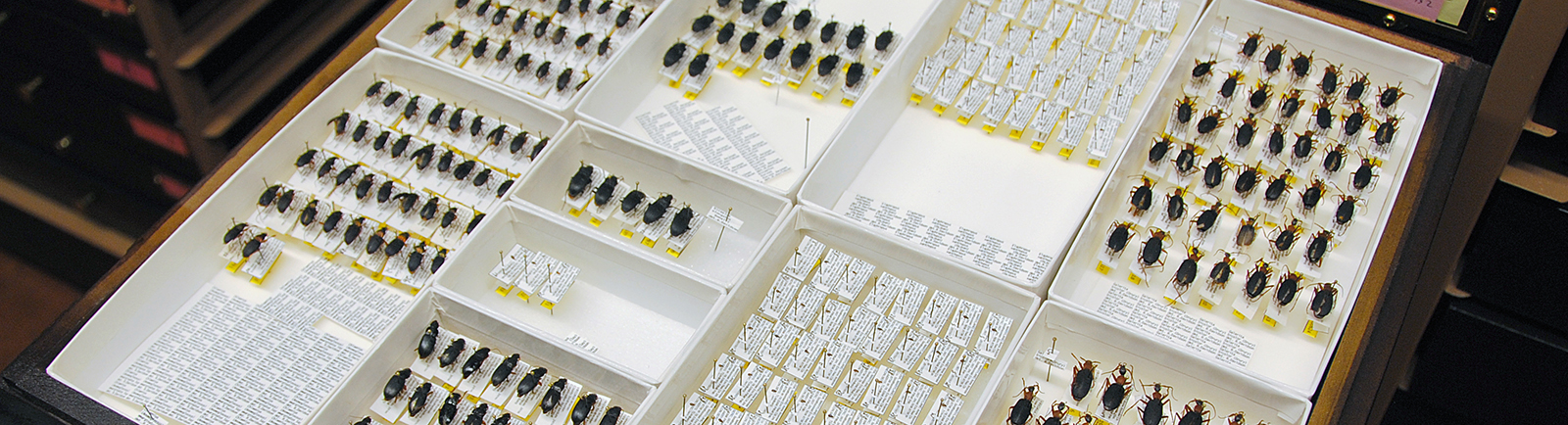
beetles in a specimen drawer

Overview

The Carnegie Consulting Center serves as an independent, objective provider of scientific information for public and private sector projects. The museum leverages its expert scientific staff and vast collection of specimens to provide biodiversity services in five broad categories: 1) geographic information systems; 2) aquatic ecology; 3) terrestrial ecology; 4) population genetics; and 5) museum expertise. In addition to the scientific staff and collections, the museum is equipped with the scientific equipment (e.g., microscopes, alcohol, field guides, molecular tools, software) needed to carry out these projects. The center provides an administrative structure for all applied research projects within the museum and raises the visibility of these projects within the scientific and local community.

The museum’s resources and respected reputation make it an attractive option for government organizations and non-profits that are in the market for environmental consulting services. Please fill out the form below to contact us if you are interested in engaging our services on a project.
Contact

[gravityform id="13" title="false" description="false"]

Potential Service Areas

  • Geographic Information Systems
    • Incorporation of field collected data into a GIS
    • Investigate ecological conditions by combining multiple layers of data in GIS
    • Develop GIS applications for site evaluation, modeling, and management
    • Coordinate GIS with other kinds of information (LIDAR, etc.)
    • Training in use of Unmanned Aerial Vehicles (drones) in asset management
  • Aquatic Ecology
    • Macroinvertebrate sampling and identification
    • Establish baseline conditions and/or restoration targets for streams
    • Our staff are trained in EPA Rapid Bioassessment protocols, PA DEP Technical Guidance protocol and have strong taxonomic expertise
  • Terrestrial Ecology
    • Species identification and inventory
      • Plants
      • Insects
      • Snails
      • Birds
      • Amphibians and Reptiles
      • Mammals
    • Species monitoring
      • Tracking introduction and spread of invasive species
      • Monitoring of threatened and endangered native species
  • Population Genetics
    • Identify new species and delineate species boundaries using molecular techniques
    • Assess the status of a population by quantifying genetic diversity
  • Community Ecology
  • Museum Expertise
    • Consultation on wildlife trafficking issues
      • Our staff have CITES training and direct experience w/ CITES issues
    • Serve as expert witness in court cases

Select Current Projects

Invasive insect detection

The USDA Animal and Plant Health Inspection Service (APHIS)/Plant Protection and Quarantine (PPQ), USDA Forest Service, and various state departments of agriculture contract with the Section of Invertebrate Zoology to detect invasive woodboring beetles and other insect pests. These contracts span 24 projects involving 17 states, ranging from Maine to Georgia and Texas to California. An average of 6,000 raw samples are processed annually by Invertebrate Zoology’s Biodiversity Services Facility (BSF), containing from dozens to thousands of specimens each.

Current taxonomic focus is on bark beetles (Scolytinae) and longhorned beetles (Cerambycidae) which are primary pests in both hardwoods and conifers. As woodborers, these insects are persistently being introduced into the US through international commercial activities. Submitted samples are screened, specimens identified and the results reported to the clients through a dedicated web portal. Select specimens are prepared, data-based and added to the CMNH collection to expand its coverage as an identification resource and to provide materials for other research such as revisionary, faunal, evolutionary, or ecological studies.

Ground beetle monitoring

The National Ecological Observatory Network (NEON), one of the largest National Science Foundation-funded projects ever, is a continent-wide facility which “gathers and synthesizes data on the impacts of climate change, land use change and invasive species on natural resources and biodiversity.”  Sampling began in 2013, and by 2018 all 81 field sites will be operational with sites chosen throughout the US to reflect all major habitats. Monitoring includes plants, soil microbes, small mammals, mosquitoes, birds, ground beetles, ticks, soils, and climatic conditions.

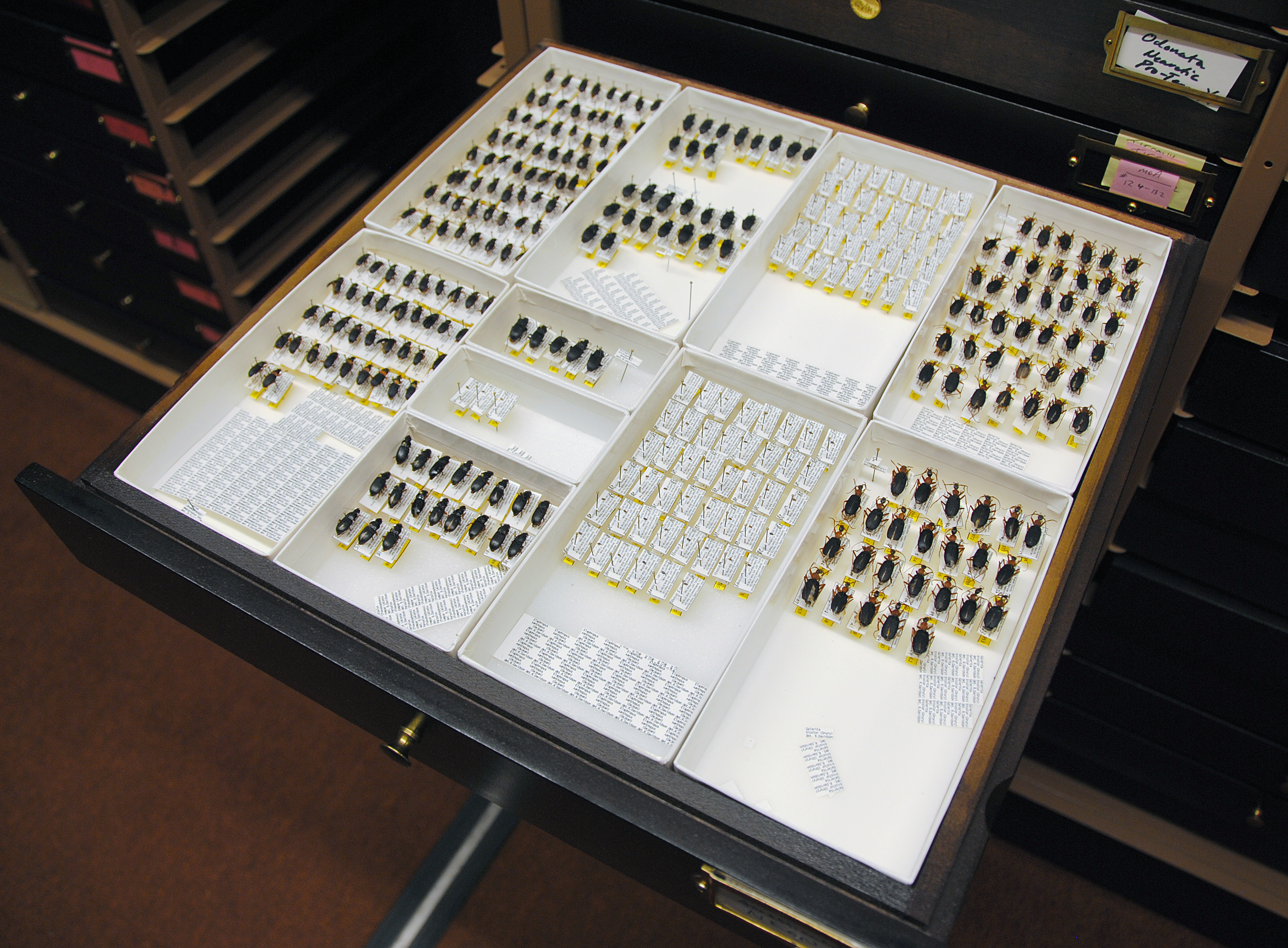
With support from NEON, the Section of Invertebrate Zoology plays a key role in the ground beetle monitoring project. The section has a ground beetle expert on staff, and therefore a very large and diverse collection of ground beetles - one of the two or three best in the New World. The section receives the beetle samples, performs the identifications, records the data, returns a small synoptic set to NEON, and reports on new or important species. The remainder of the material is accessioned into the collection, where it is available for loan and further study by scientists worldwide.

ground beetles
beetles collected in the field
Tim sampling fallen leaves

Tim finding snails on Santa Rosa Island. (Photo: June 16, 2016, Charles Drost.)

USGS Land Snails Survey

The Section of Mollusks is currently supported by the United States Geological Survey to survey land snails of the California Channel Islands as well as coastal National Parks on the adjacent mainland. About 75% of the land snail species are endemic to one or more of the islands. Our recent work on San Clemente Island has doubled the number of land snail species known from that island, with similar increases on other islands we have surveyed; some unusual finds may represent entirely new species. Research also indicates marked differences in species composition between the northern and southern islands. Islands from which non-native mammals were removed longest ago have best recovery of native vegetation and better populations of land snails and slugs.

WRCP Buffalo Nut Plant Conservation

With support from the Pennsylvania Dept. of Conservation and Natural Resources’s Wild Resource Conservation Program, Powdermill Nature Reserve is examining declining populations of the buffalo nut plant (Pyrularia pubera). While this small forest tree was once reported to be common in western Pennsylvania, it is now listed as rare. Remaining populations are threatened by deer browse and a lack of sexual reproduction, which can reduce genetic diversity. Scientists at Powdermill are working to characterize the genetic diversity and reproductive biology of buffalo nut to establish best practices for conservation of this species.

sidebar

About

  • Mission & Commitments
  • Directors Team
  • Museum History

Get Involved

  • Volunteer
  • Membership
  • Carnegie Discoverers
  • Donate
  • Employment
  • Events

Bring a Group

  • Groups of 10 or More
  • Birthday Parties at the Museum
  • Field Trips

Powdermill

  • Powdermill Nature Reserve
  • Powdermill Field Trips
  • Powdermill Staff
  • Research at Powdermill

More Information

  • Image Permission Requests
  • Science Stories
  • Accessibility
  • Shopping Cart
  • Contact
  • Visitor Policies
One of the Four Carnegie Museums | © Carnegie Institute | Privacy Policy | Terms of Use | Accessibility
Rad works here logo
