by Ruth Fauman-Fichman
In the Section of Collection Care and Conservation at the Carnegie Museum of Natural History there are thousands of artifacts that silently scream for treatment. They wait patiently for their turn to be noticed. Some have been waiting for close to a hundred years, having gathered dirt and soot from their years ago acquisition by the museum. If it weren’t for Conservator Gretchen Anderson’s dogged dedication, many would still be waiting. They all harbor secrets, some easier to figure out than others. Many came to the museum long ago with limited information about themselves, tucked into dark corners.
At the “Annex” (the informal name for the O’Neill Research Center) one afternoon I found myself sitting in front of a sawhorse covered over with degrading plastic. I had seen and moved around four of these sawhorses over the last year, always hearing from Ms. Anderson: “we can’t deal with these yet, but soon!” Now, as a result of a successful grant proposal to the National Endowment for the Humanities to upgrade the storage capabilities of the Anthropology holdings, I would finally be able to inspect and conduct a light cleaning of the contents underneath.
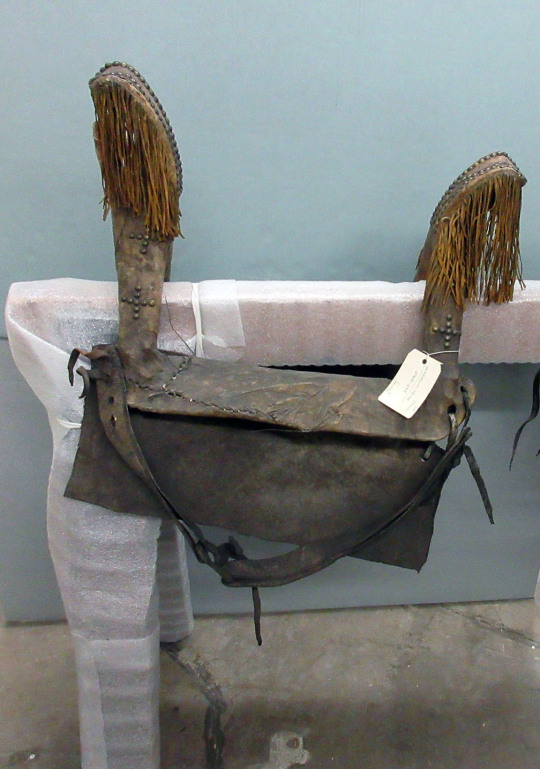
With its non-archival plastic cover now discarded, the sawhorse hid a soot-black North American Indian woman’s saddle. What an ugly disappointment, I initially thought. What was it made of? Animal, vegetable, mineral? The only way to know was to carefully begin, using soft brushes. Almost immediately a surprise surfaced. This saddle was not just some indistinct blob! It was made of a combination of wood, antler, leather, brass ornaments and COLOR!
Brushing the top of the front tasseled pommel suddenly revealed intentional red ochre staining around the decoratively placed brass studs embedded in a cross pattern. Further careful cleaning changed the grey suede tassels to a luminous mustard-color. The same was revealed on the back pommel. Suddenly this non-descript saddle had personality and power! No longer disappointing, the rest of the six hours I spent cleaning this piece made me feel connected to the person who might have used it.
I carefully cleaned the rest of the piece over several sessions with soot sponges. The seat and pommels were made of wood and antler, covered in leather sewn together with sinew. I noticed the tanned leather thongs used to tie each piece of the saddle together and attach to leather cinches placed around the belly of the small pony or horse. The thongs were degrading practically to a powder with even limited handling from what Anderson and Collections Manager Deborah Harding called “red rot.” The woman who sat on this pony or horse shielded her thighs from being rubbed raw by rectangular pieces of leather attached to the saddle body with leather thongs. The “leathered” side of the rectangular piece rested against the pony and the suede side against the rider. Careful cleaning on the suede side revealed red stains. Red ochre? Horse blood? Something else?
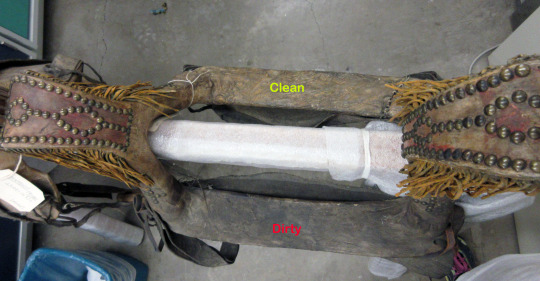
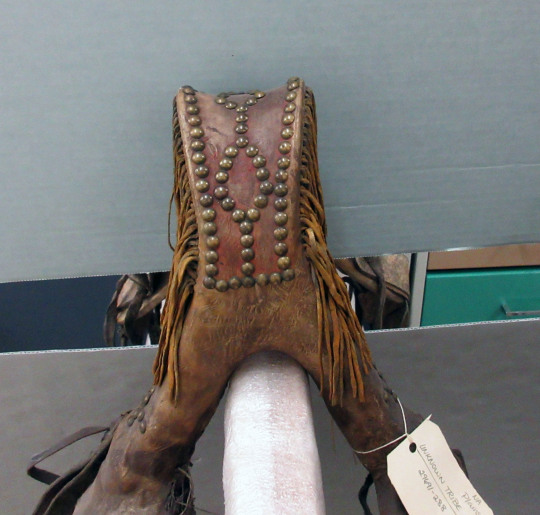
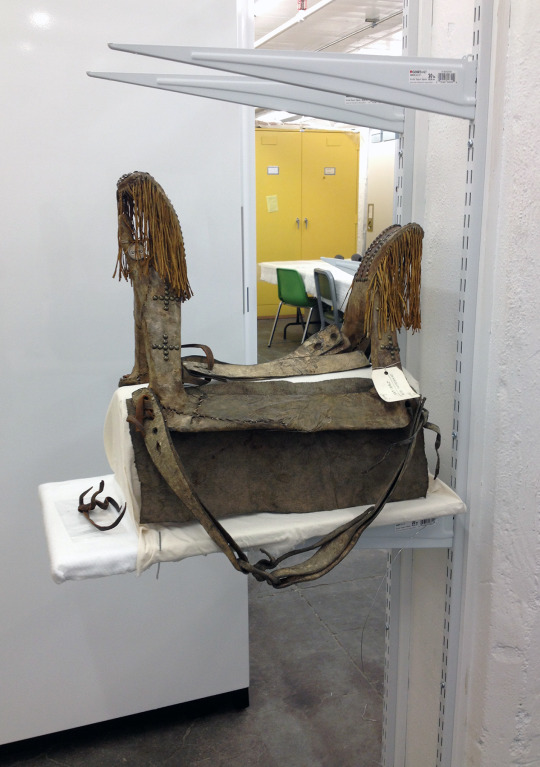
While there is little information in the accession record to tell us anything about the original owner of this saddle, from cleaning it carefully I was able to determine that this saddle was well used. It was a privilege to handle it and let it speak to me for a little while. In its cleaner state, it now rests on a horse-like bed of archival materials that will not further degrade its fragile materials and I will be making a cover for it and its three other saddle companions in the near future.
Ruth Fauman-Fichman is a volunteer at the Carnegie Museum of Natural History.
