by Timothy A. Pearce
We humans like to think we are special among all creatures. To support that notion, we claim unique traits such as language, tool use, consciousness, etc. Oops, all of those traits have now been shown to occur in other species. Do not fear, though, for I have found a trait that seems to be unique to humans: a fondness for 90 degree angles (aka right angles). You heard it here first! I don’t know where on the evolutionary lineage to modern humans we acquired this fondness for right angles, but evidence of this fondness is all around us in the modern built environment.
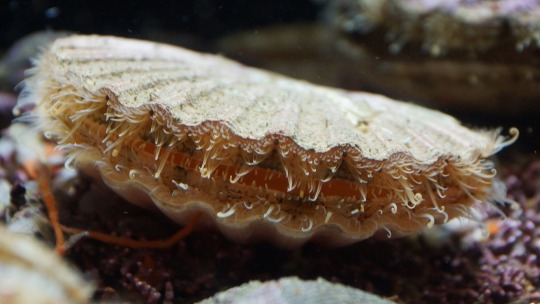
What does fondness for right angles have to do with scallop eyes? First let me tell you about the amazing eyes of scallops. They have up to 200 eyes along the mantle margin, and those eyes contain concave mirrors. Instead of being similar to cameras (as our, and most, eyes are), scallop eyes are similar to reflecting telescopes, and each eye has two retinas so they can see clearly in both narrow and peripheral views at the same time.
New research published this week in Science (and described in the New York Times ) demonstrates that the concave mirror of each scallop eye is tiled with more than 100,000 square mirror tiles. Did you get that? They are squares! Outside of the human built environment, right angles are scarce. So to find squares in the eyes of scallops is remarkable. The properties of the tiles making up the mirror has implications for the scallop’s ability to see in the particular wavelengths of light in its surroundings and can inspire improved human optical devices. Future studies will have to examine why a scallop needs to have such amazing vision. But for now, I am amazed to know that scallop eyes contain square mirrors.
Timothy A. Pearce, PhD, is the head of the mollusks section at Carnegie Museum of Natural History. Museum employees are encouraged to blog about their unique experiences and knowledge gained from working at the museum.
