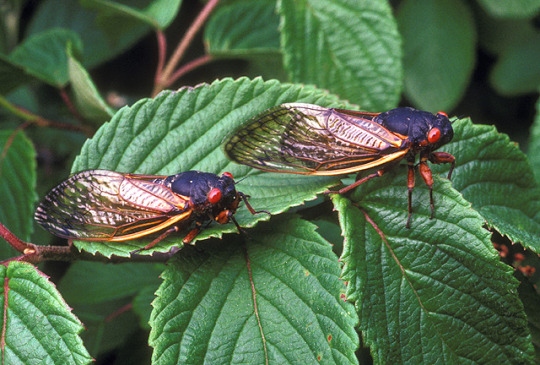
There are different broods of periodical cicadas. Any given brood has adults emerging only once in 17 years and has a defined range of occurrence. The brood we will see in Allegheny County this year (2019) is Brood VIII. It is a brood with a relatively small distribution, occurring mainly in eastern Ohio, the panhandle of West Virginia, and about a dozen counties in southwestern and western Pennsylvania.
Adults will emerge in a couple of months (mid-May, but with climate change issues this is becoming less predictable; when the subsurface soil reaches 64 degrees Fahrenheit, emergence will begin), females will lay eggs, nymphs will hatch 6-10 weeks thereafter, and those nymphs will drop to the ground, burrow into the ground below deciduous trees, tap into the roots to syphon the plant juices, and remain underground for the next 17 years. The adults of this brood will not be seen for 17 years, emerging again in 2036.
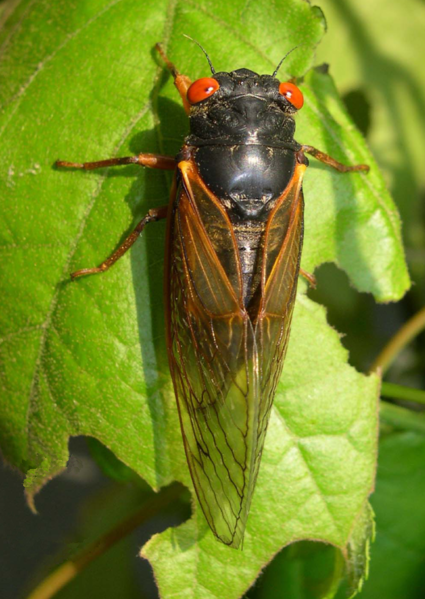
Photo from Wikimedia Commons.
Currently there are 12 broods of 17-year cicadas, each with a different aggregate distribution. This means that in a 17-year period, adults will be emerging somewhere in 12 different years. Some of these have a very small distribution; some have huge distributions. For example, Brood X is nicknamed the Great Eastern Brood because it ranges from New York to Georgia, and west to Michigan. Brood X occurs over much of Pennsylvania, though not here in the southwest corner. Its adults will emerge again in 2021 (and then 2038, etc.), but they are not related to or derived from the ones we will see this year. In a way, you can think of them as different clans or tribes that can’t interbreed or interact with one another because the adults are not in the same areas at the same time.
Of the 12 broods, 8 of them occur in Pennsylvania as a whole, though mostly to the east. Here in the southwest, we get only 3 broods. This means here in southwestern Pennsylvania, we will normally see adults emerging during 3 years out of 17. Brood VIII, already mentioned, will be out this year and again in 2036. Brood VII we saw here last year (2018), and it will be out again in 2035. Both of these have been found in Allegheny County. Brood V, last seen in 2016 and due again in 2033, has not officially been recorded from Allegheny County, but since it is known from nearby Greene, Washington, Westmoreland, and Fayette Counties, it is most likely here.
And, to be clear: there are other kinds of cicadas that come out every year. These are usually called Annual Cicadas. They don’t aggregate in big swarms, so there is just one here, one there. Nymphs are underground only a year or two, so there are adults every year. And they are active later in the season, mostly July-September rather than May-June. These are the solitary ones you hear singing in a tree in late summer.
Bob Davidson is Collection Manager of Invertebrate Zoology at Carnegie Museum of Natural History. Museum employees are encouraged to blog about their unique experiences and knowledge gained from working at the museum.
