by Patrick McShea
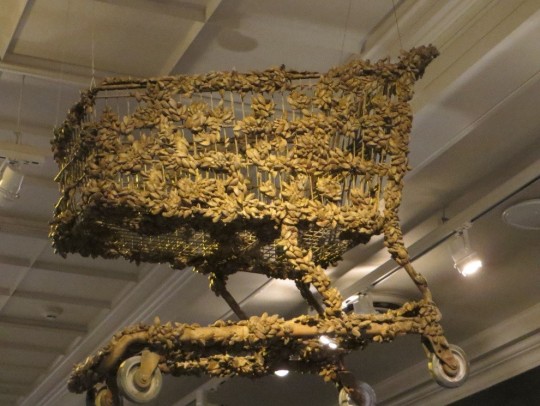
The shell-encrusted shopping cart in We Are Nature would get lots of visitor attention even if it weren’t suspended from the ceiling. Hundreds of zebra mussels coat the familiar contraption, creating an eerily appropriate symbol for human-altered natural systems: An empty icon of consumer culture armored by hitchhiking organisms of global trade.
Zebra mussels, a freshwater species native to the Caspian Sea and Black Sea, were unwittingly introduced into the Great Lakes during the 1980s via ballast water dumped by ocean-crossing cargo ships. The creature’s rapid dispersal since then has been attributed to the passive drifting of tiny larvae and the ability of mature zebra mussels to attach to boats moving between the lakes and adjacent river systems.
As invaders, zebra mussels have profound effects on ecosystems. They feed by filtering tiny organisms from the water, and by sheer numbers can out-compete fish larvae and native mussel species dependent on the same food source. Zebra mussels attach to any submerged hard surface. Their profusion attracts attention when it results in clogged water in-take pipes, but not necessarily when thousands of the striped fingernail-sized creatures occupy physical positions atop existing beds of native freshwater mussels.
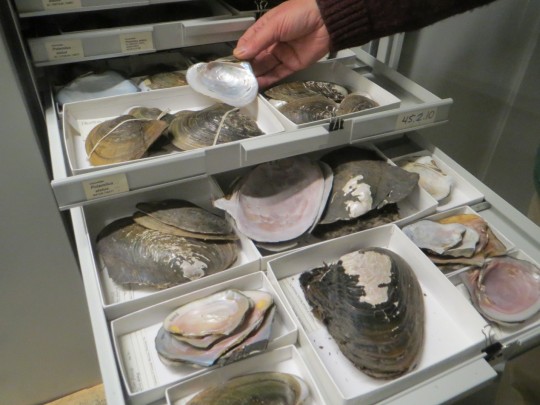
At Carnegie Museum of Natural History, concern for the health of our region’s diverse population of native freshwater mussels has a long history. In 1909, Arnold Ortmann, then Curator of Invertebrate Zoology, termed the disappearance of mussel species “the first sign of pollution of a dangerous character in a stream.” His observation was based upon biological surveys in rivers and streams throughout Western Pennsylvania, fieldwork performed during a time of rapid industrialization that garnered the museum an irreplaceable collection of local mussel shells.
Patrick McShea works in the Education and Visitor Experience department of Carnegie Museum of Natural History. Museum employees are encouraged to blog about their unique experiences of working at the museum.
