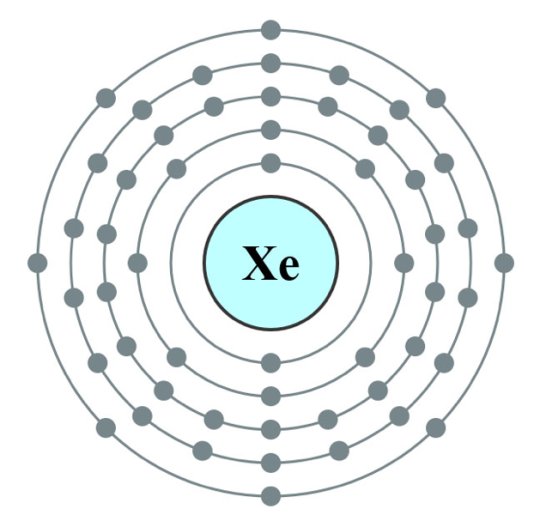
Xenon-124, one of the radioactive noble gases, has an extremely long half-life. The half-life of xenon-124, one isotope of xenon, was recently measured to be a trillion times longer than the age of the universe! This is the slowest process ever measured by direct observation. You might well ask who measured such a slow process. Was it a scientist who thought watching paint dry or snail migrations were too exciting? In fact, the half-life was determined as a by-product of the search for dark matter. The XENON1T dark-matter detector in Italy, containing 3.2 metric tonnes of liquid xenon, detected energy release from the decay of 126 xenon-124 atoms over a year, which allowed Aprile et al. (2019) to calculate the half-life.
Speaking of radioactive decay, within the last decade, researchers have reported that the radioactive decay constant (the rate at which a radioactive element decays, thought to be constant – that’s how atomic clocks keep perfect time) is not constant! Certain radioactive elements decay faster when closer to the sun (Jenkins et al. 2012), leading some to speculate that neutrinos could explain the changed decay rate. (Counterintuitively, earth is closer to the sun during northern hemisphere winter.) Neutrinos are tiny particles, abundantly produced by the sun, that interact with essentially nothing and about 100 trillion pass through your body every second). Maybe a particle that doesn’t interact with anything can change something that never changes!
This correlation of neutrinos and radioactive decay rates makes me wonder whether every instance of radioactive decay might result from interaction with a neutrino. Neutrinos are abundant and some elements decay in less than a second, other rates are much longer. If neutrinos influence radioactive decay, perhaps some atoms are easier to hit in just the right way for decay to happen. If so, then I wonder why Xenon-124 is so slow to decay; is its nucleus harder for a neutrino to hit just right? It turns out that the decay of xenon-124 is unusual because it results from two-neutrino double electron capture, which means two electrons from the atom combine with two protons in the same atom, releasing two neutrinos. If neutrinos have an influence, perhaps getting two neutrinos to interact simultaneously with a xenon-124 atom in just the right way to cause decay must be a very rare event.
Reference
Aprile, E., Aalbers, J., Agostini, et al. 2019. Observation of two-neutrino double electron capture in 124Xe with XENON1T. Nature, 568(7753): 532-535. doi.org/10.1038/s41586-019-1124-4
Jenkins, J.H., Herminghuysen, K.R., Blue, T.E., et al. 2012. Additional experimental evidence for a solar influence on nuclear decay rates. Astroparticle Physics, 37: 81-88.
Timothy A. Pearce, PhD, is the head of the mollusks section at Carnegie Museum of Natural History. Museum employees are encouraged to blog about their unique experiences and knowledge gained from working at the museum.
