• Skip to primary navigation
  • Skip to main content
  • Skip to primary sidebar

Carnegie Museum of Natural History

One of the Four Carnegie Museums of Pittsburgh

  • Visit
    • Buy Tickets
    • Visitor Information
    • Exhibitions
    • Events
    • Dining at the Museum
    • Celebrate at the Museum
    • Powdermill Nature Reserve
    • Event Venue Rental
  • Learn
    • Field Trips
    • Educator Information
    • Programs at the Museum
    • Bring the Museum to You
    • Guided Programs FAQ
    • Programs Online
    • Climate and Rural Systems Partnership
  • Research
    • Scientific Sections
    • Science Stories
    • Science Videos
    • Senior Science & Research Staff
    • Museum Library
    • Science Seminars
    • Scientific Publications
    • Specimen and Artifact Identification
  • About
    • Mission & Commitments
    • Directors Team
    • Museum History
  • Tickets
  • Give
  • Shop

Smoke Scenery

by Pat McShea

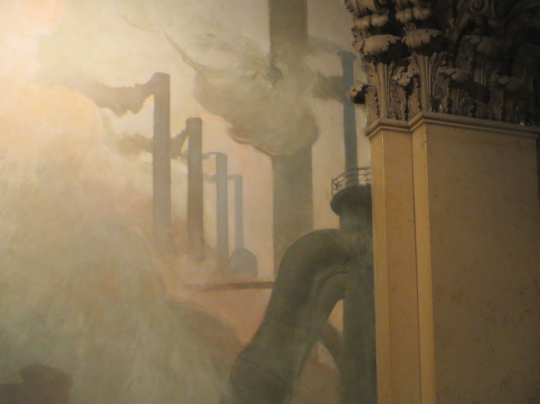
Detail from The Apotheosis of Pittsburgh mural by John White Alexander

A museum educator from Norway offered a novel way to interpret We Are Nature: Living in the Anthropocene. “This should be part of the story.” explained Bergsveinn Thorssonas he gestured at century-old steel industry scenes depicted in second-floor portions of the multi-level grand staircase mural painted by John White Alexander.

Thorsson, a PhD student who is studying how museums present current environmental issues, was fascinated by the smoky scenes and their marble pillar frames. “Owning our industrial history is important to understanding our current situation.” he added before conceding that he didn’t have advice for accomplishing such a task.
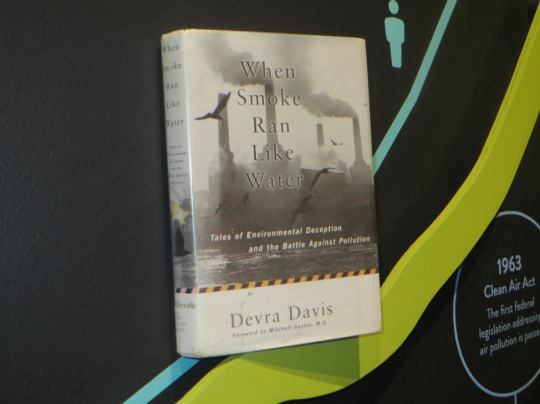
A copy of When Smoke Ran Like Waterpositioned at the 1948 mark on the population and atmospheric carbon level graph in We Are Nature
A copy of When Smoke Ran Like Water positioned at the 1948 mark on the population and atmospheric carbon level graph in We Are Nature

Since 2002, an excellent book-form model of industrial acknowledgement has existed in When Smoke Ran Like Water, by Donora, Pennsylvania native Devra Davis. The book, which Davis summarizes as an argument for “a fundamentally new way of thinking about health and the environment,” begins with a recounting of the most significant air pollution disaster in the United States – the build-up in Donora, some 25 miles southeast of Pittsburgh, during a five-day period in late October 1948, of a toxic fog of steel and zinc industry emissions that resulted in 20 deaths and 600 hospitalizations.

In Davis’s account, family histories, with all their hopes, accomplishments, and compromises, are central to the tragedy. A quote from her mother captures a common attitude toward the smoky scenery: “Look, today they might call it pollution. Back then it was just a living.”

Patrick McShea works in the Education and Visitor Experience department of Carnegie Museum of Natural History. Museum employees are encouraged to blog about their unique experiences and knowledge gained from working at the museum.

sidebar

About

  • Mission & Commitments
  • Directors Team
  • Museum History

Get Involved

  • Volunteer
  • Membership
  • Carnegie Discoverers
  • Donate
  • Employment
  • Events

Bring a Group

  • Groups of 10 or More
  • Birthday Parties at the Museum
  • Field Trips

Powdermill

  • Powdermill Nature Reserve
  • Powdermill Field Trips
  • Powdermill Staff
  • Research at Powdermill

More Information

  • Image Permission Requests
  • Science Stories
  • Accessibility
  • Shopping Cart
  • Contact
  • Visitor Policies
One of the Four Carnegie Museums | © Carnegie Institute | Privacy Policy | Terms of Use | Accessibility
Rad works here logo