By Tim Pearce
Only one species of land snail is known to glow in the dark: Quantula striata, albeit very faintly. A glow organ under its chin produces yellow-green light, and the rest of the body glows very faintly. The snail occurs in some areas of Southeast Asia including Malaysia and Singapore. The snail uses the same system to glow as fireflies, two chemicals: luciferase reacts with luciferin to produce light.
Scientific papers, including those by Yata Haneda, have characterized the wavelength of the light, the interval of the flashes, which part of the body glows, and differences in glowing between juvenile and adult snails. However, none of the papers has addressed why the snails glow. Given that light production is energetically costly, there must be some evolutionary advantage to glowing. How does glowing help the snail in its daily life?
There are five known reasons that organisms glow: (1) attract mates (as in fireflies [originally for larval defense, see Branham and Wenzel 2003, Cladistics, 19:1-22]), (2) attract prey (as lures in deep sea fish), (3) attract dispersers (insects attracted to light disperse spores from glowing mushrooms), (4) escape predators (deep sea octopus create glowing clouds and slink away unnoticed), (5) burglar alarm (some ocean microorganisms glow when copepods try to eat them; the glow attracts fish that then eat the copepods).
I speculate that Quantula striata glows to escape predators.
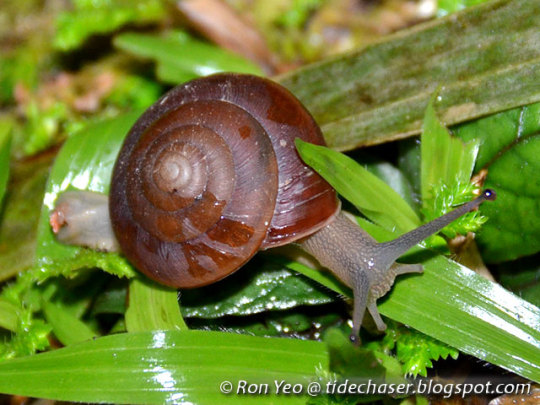
Larval fireflies eat land snails and larval fireflies occur in Southeast Asia where this glow snail lives. Perhaps a glowing snail could fool a hungry firefly larva by falsely conveying that the snail is already occupied, so glowing might ward off an attack by a firefly larva. Thus, the evolutionary advantage is that glowing snails might experience less predation.
One way to test this hypothesis would be to expose glowing and non-glowing snails to larval fireflies to determine which kind of snail gets eaten more. I haven’t tried this experiment yet, because I don’t have glow snails available in my lab.
More speculation: could the genes for the light-producing system have moved from a firefly to this snail? It is a remarkable coincidence that the snail and the fireflies both produce light using the luciferin and luciferase system. What are the chances of that! One possibility is that the genes to produce luciferin and luciferase were somehow transferred from a firefly to an ancestor of the snail, then spread over time throughout the species. While such horizontal gene transfer is thought to be relatively rare, the transfer of genes from one species to another is known in single celled organisms (e.g., the spread of antibiotic resistance among bacteria species), and evidence exists that it has occurred in some multi-cellular organisms.
One way to test whether horizontal gene transfer could explain the luciferin and luciferase lighting system in Quantula striata would be to sequence the DNA of the snail and the DNA of fireflies living in Southeast Asia. If both genes for luciferin and luciferase were transferred from the firefly to the snail, there is a good chance that additional DNA on either side of those two genes was transferred as well. If additional firefly DNA exists near the luciferin and luciferase genes in the snail, that would be strong evidence that the snail’s ability to glow came from a firefly.
It could have happened!
Relevant Snail Joke:
Q: What happened to the glow-snail that lost its glowing organ?
A: It was de-lighted.
Timothy A. Pearce, PhD, is the head of the mollusks section at Carnegie Museum of Natural History. Museum employees are encouraged to blog about their unique experiences and knowledge gained from working at the museum.
