by Patrick McShea
Social Skills Instructor Stacy Smith wanted to convey just how challenging last year’s abrupt shift to remote instruction during the COVID-19 pandemic was for The Children’s Institute of Pittsburgh. An initial challenge she had to solve was how to keep virtual learning engaging.
“Some of our students don’t even like watching TV,” Stacy said.
Not only did in-person collaborations with programs like Museum on the Move at CMNH have to be transformed into a remote experience, but the school day also had to function differently for students with unique needs. The 119-year-old organization serves more than 6,000 children each year at seven campuses across western Pennsylvania, helping to heal, teach, and empower individuals with special physical, social, and emotional needs.
Individualized instruction is the hallmark of Educational Services at The Children’s Institute, a characteristic readily apparent when Stacy recites a typical schedule for a student at the campus in Squirrel Hill.
“Morning groups of around six students last 15 to 30 minutes, and after that they would each have individual teaching sessions. They’d have individual speech, occupational therapy, physical therapy, and social skills or other ancillary classes. We work with some students to master abilities that aren’t even considered in other schools, like the balance required to simply walk in a hallway,” Stacy explained.
Museum on the Move programs provide a field trip-like role amidst such regular instruction, with museum educators using authentic materials to enrich presentations about dinosaurs, fossils, rocks and minerals, insects, and animal adaptations. Stacy cited Quintin Peacock, an educator who recently left the museum to pursue a master’s degree in education, as a particularly skilled in-person presenter in 2019 and early 2020, before the COVID pandemic forced the program into a remote, but still interactive delivery system.
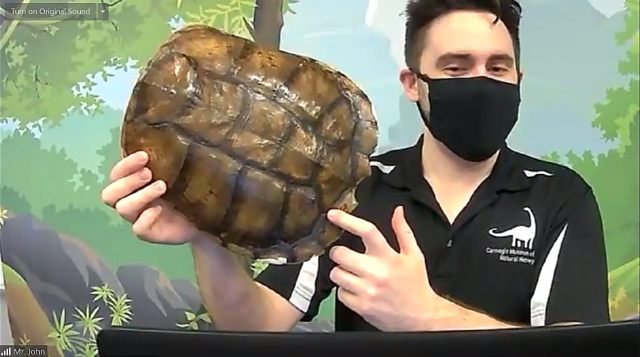
Museum educators John Bitsura and Aaron Young received Stacy’s praise as remote delivery heroes for their dedication to The Children’s Institute’s students and willingness to innovate.
“These guys were the only outside group we had this year and we were very fortunate to have them,” she said.
While some students returned in-person this school year, for the Museum on the Move “field trips” to maintain their effectiveness in a remote format, a familiar teacher needed to be an active visual and vocal participant. Technology and screen-sharing enabled both Stacy and the CMNH team to easily participate in presenting to the students together.
“I’ve always been on with them, and it’s been really nice that they’ve been so welcoming with me being a part of their presentation,” she said.
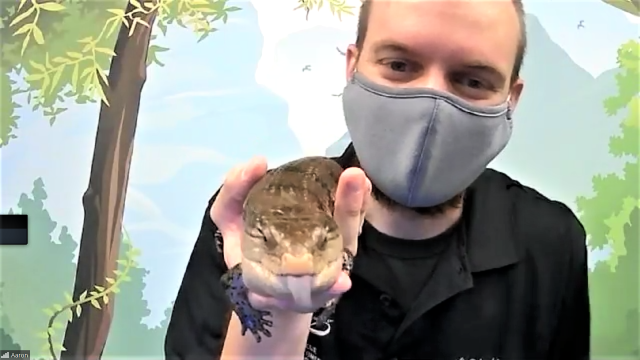
For the museum, the feeling is mutual. Aaron praises the radiant energy Stacy brings to the virtual programs and credits her constructive feedback with their continual improvement. John points to the solving of Zoom problems and a joint performance of a rap song about geology as key pieces of the collaboration. He also summarized this year’s efforts as creating the foundation for a wonderful partnership.
Patrick McShea works in the Education and Visitor Experience department of Carnegie Museum of Natural History. Museum employees are encouraged to blog about their unique experiences and knowledge gained from working at the museum.
Related Content
Water Bears: why my yard is like the moon
Carnegie Museum of Natural History Blog Citation Information
Blog author: McShea, PatrickPublication date: May 10, 2021
