by Asia Ward
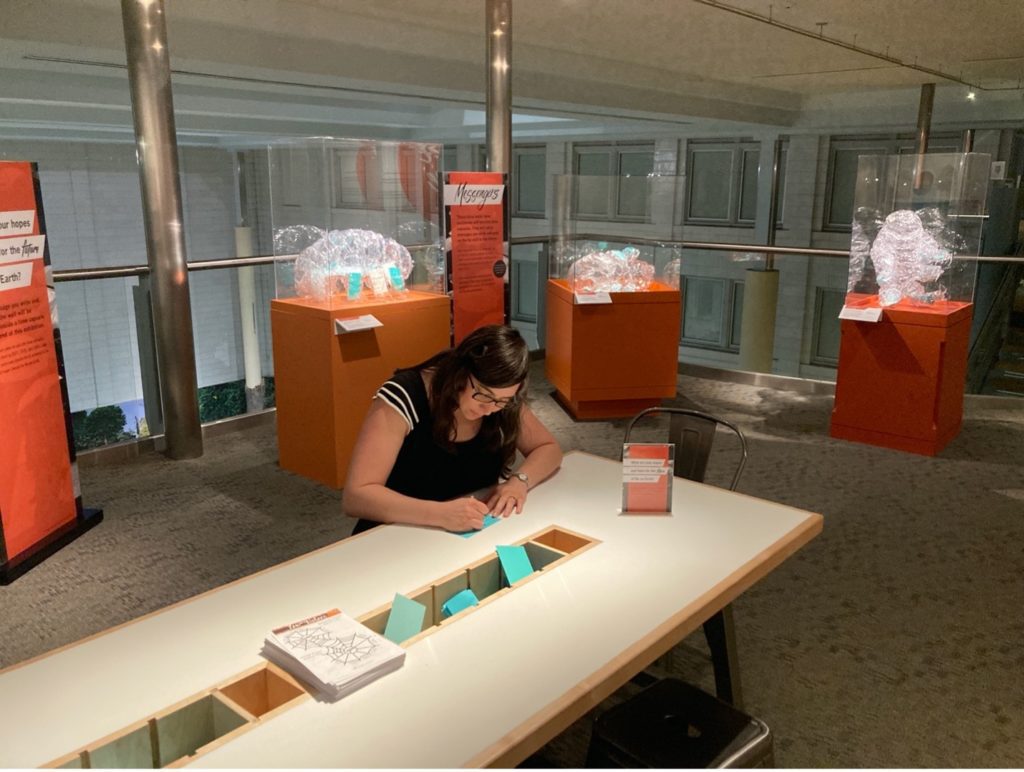
Have you seen the Tardigrade-shaped time capsule installation titled Messengers on the third-floor balcony in the Carnegie Museum of Natural History? I am the artist who fabricated those for the We Are Nature: A New Natural History exhibit experience. My name is Asia Ward, and I’m a social practice and public sculpture artist who is also the Project Manager and Science Communicator for the We Are Nature project.
Sometimes my two careers combine, as occurred during the time capsule interactive art installation. I was invited to contribute an art installation for the exhibition by Nicole Heller, the Associate Curator for Anthropocene Studies, and director of the We Are Nature project.
In my 14-year career as a science communicator for other organizations, I have worked with museums on prototyping interactive exhibits. The experience of contributing an art piece to a project I was also managing allowed me to get supporting departments involved in thinking about what an art installation could be. I generated the ideas for an interactive exhibit, and through group discussions and brainstorming with colleagues in the Education, Exhibition, Anthropology, and Anthropocene Studies departments, the final project concept was shaped. I then went to work sculpting large versions of Tardigrades out of recycled thermal plastic. Three time capsules were created as repositories for visitors’ thoughts about conditions in 2027, 2025, and 2095, years chosen for their potential to be a time of major change for life on Earth.
I created the Tardigrades to be transparent and hollow, with doors for the deposit of visitor messages. The installation runs from November 2021 until November 2022, and so far, out of all the interactive installations I have created, this has proven to be the most successful and the most surprising.
Why Tardigrades?
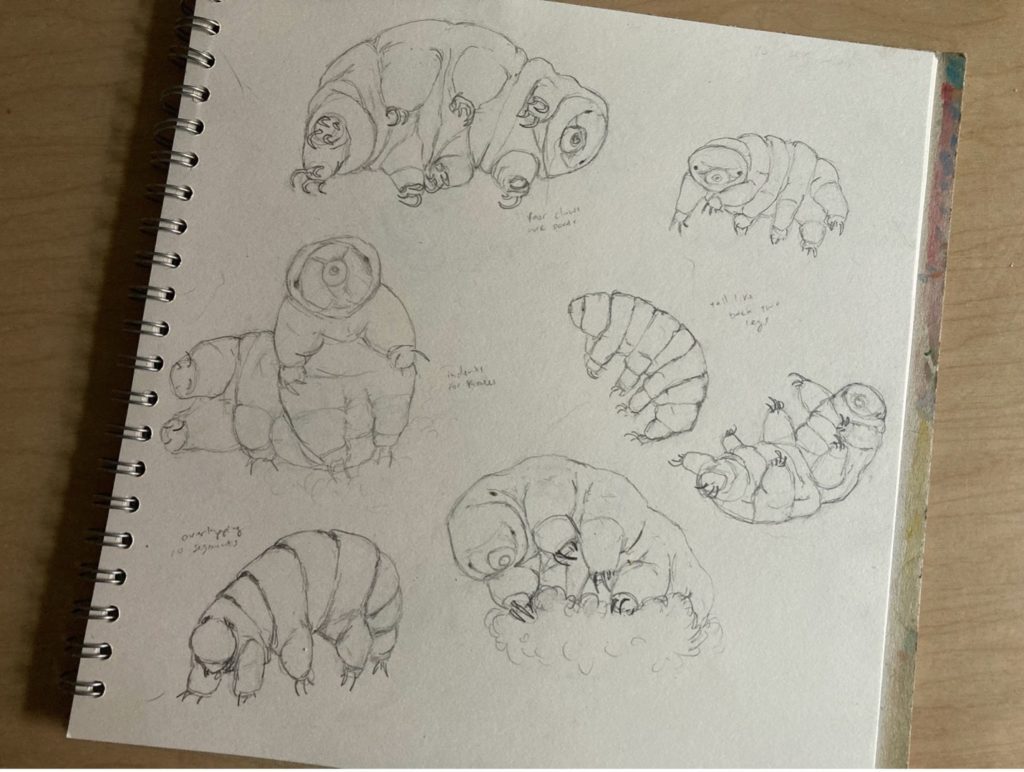
Tardigrades, otherwise known as “Water bears” or “Moss Piglets” because of their 8-legged chubby resemblance of key features on bears or pigs, are well known around the globe for their survival skills. I can’t seem to do research on them without finding some new fantastic feat they’ve conquered, like being frozen for 30 years and brought back to life, or failing to survive impact from a crashed rocket on the moon.
Tardigrades, which compare in size with a tiny rice grain, are microscopic creatures found almost everywhere on Earth, from your backyard to the top of a volcano or the ocean.
I’ve found them by gathering some lichen from my backyard, soaking a section of lichen in water, and then examining the fluid under a microscope, and BAM! There they are, crawling around eating and pooping. I think they’re weirdly cute and very accessible. If you’re interested, there are some instructions online for doing your own research.
I think what’s most inspiring about Tardigrades is how they have evolved to go into what is termed a tun state, becoming a dehydrated looking blob in a state of suspended animation in order to survive harsh environmental change, and then rehydrating when the environment is more to their liking. For these creatures, whose average life span is three to four months for some species, and a little more than 2 years for others, the ability to press “Pause” when things get tough, is unique. From my interpretation, the tardigrade’s time traveling ability makes them perfect messengers for future Earth.
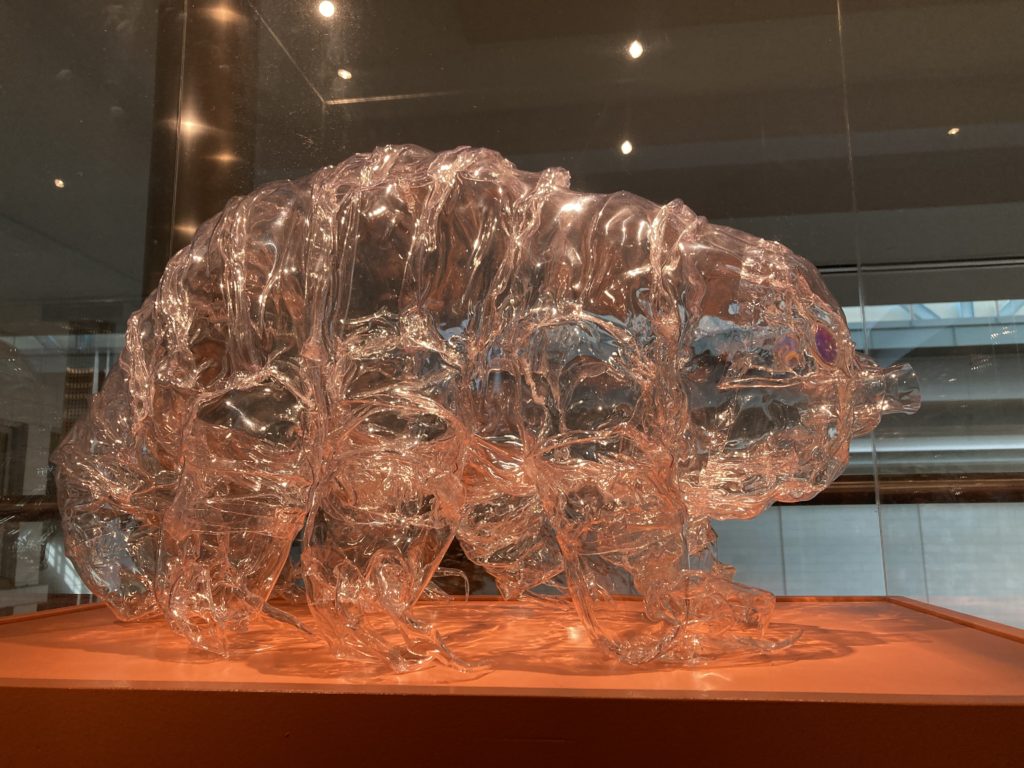
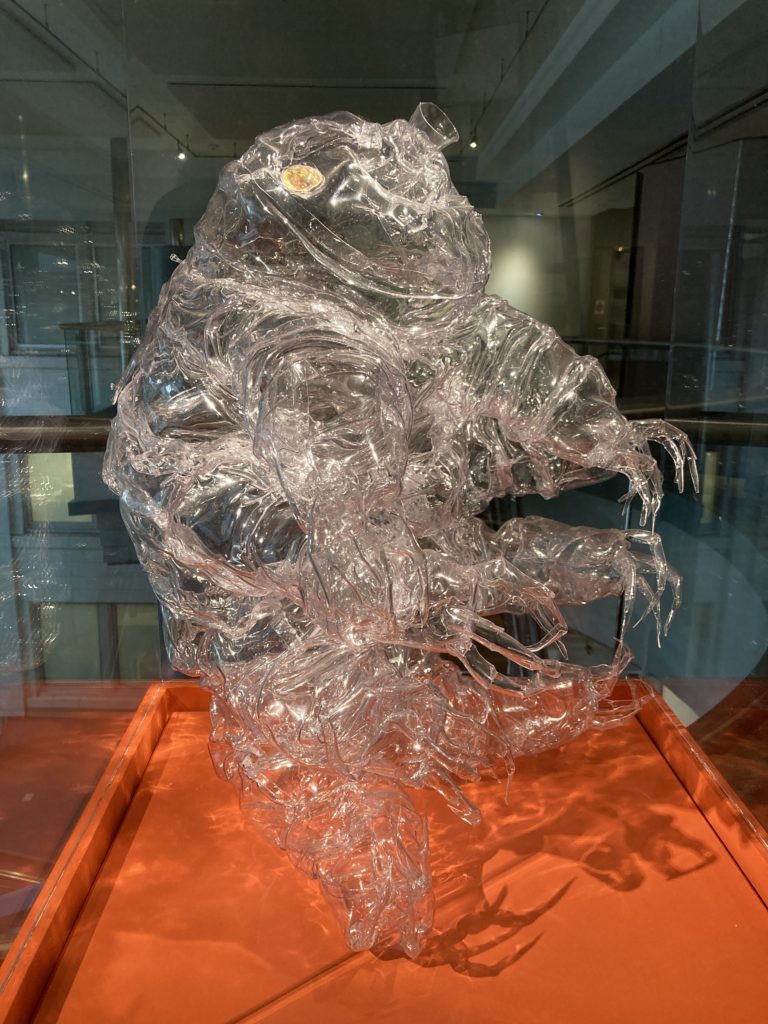
Time Capsules as an Interactive Exhibit to Process the Anthropocene
Before the time capsules were fabricated, the installation required some thought as to how visitors could best approach the time capsules and feel invited to contribute a message for the future. I worked with the Exhibitions staff for a year to prototype different prompts and test their effectiveness on the floor with visitors. In collaborating with different departments, we realized that the Hub, where Messengers is located, should be a space where visitors can process what they’ve learned and express their feelings about the Anthropocene. The term Anthropocene is the name of the proposed current geological epoch when human activities dominate the functioning of the planetary system. This distinct geological time period is what We Are Nature: A New Natural History explores, using new interpretive panels in 15 existing exhibit areas and related art installations as focus points to help visitors learn more about the topic.
The final prompts and labels for the Messengers installation were part of what made it so successful. Every week, we get an average of 200-300 messages, many of them very serious, heartfelt, and earnest. An additional factor in its success is the message wall, where visitors can place their messages under the different year headers. During my observations, most visitors go directly to the message wall, reading from left to right every single message. The visitors might have come into the space because of the shiny and interesting looking Tardigrade sculptures, but they stay in the space and contribute because of the prompts and the messages that others have left.
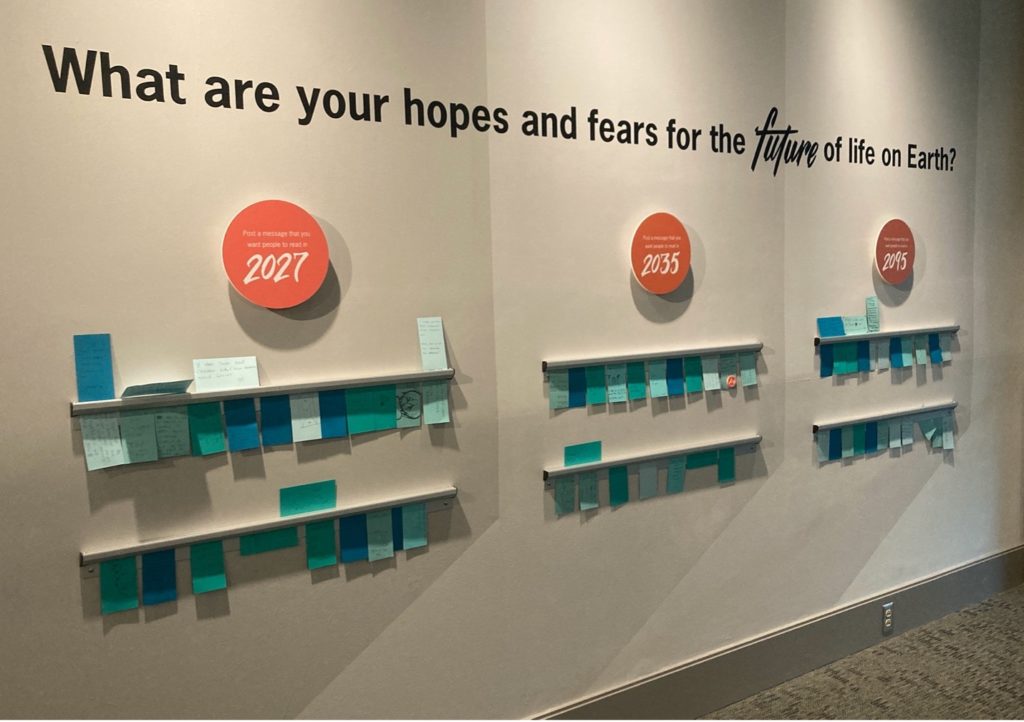
Message wall prompt:
What are your hopes and fears for the future of life on Earth?
Each Tardigrade has a designated year:
- Many climate scientists say we have until 2027 to take bold action to avoid climate disaster. If humans can keep global warming under 1.5°C (2.7° F), we reduce the risk of catastrophic heat and drought, food scarcity, flooding, and more.
- The United States set a goal to have 100% carbon-free energy production by 2035. Achieving this goal will require a major overhaul of the energy system, changing the way we power homes, businesses, and transportation to reduce pollution.
- Seven decades separate use from the 1950s, and seven decades separate us from the 2090s. The 1950s are known as the Great Acceleration. Some researchers look back at those years as a turning point when human activities and population growth became unsustainable, putting all life on Earth at risk.
Visitors’ Feelings About the Future as Part of the Anthropocene Collection
After reading thousands of messages, photographing and scanning them for documentation, some themes have emerged.
2027 is within close reach, and messages intended for this time capsule tend to mention pop culture, current events, or personal daily events, worries, or desires. There are references to Netflix series, The Simpsons, comic book-based movies, shootings, the war in Ukraine, Biden, Trump, current unusual weather, COVID-19, the Roe v. Wade Supreme Court case, hashtags, and social media handles. Additionally, the same hopes and fears as well as advice from the other years are mentioned. 2027 also leans more into the hopeful.
2035 contains more hopeful messages, with down to earth fears listed. In the hopeful range, messages list policy or government changes they would like to see and act towards, environmental and social justice, environmental regulation, being rich and famous, completing college and following their dreams, renewable energy and technology reversing Climate Change, climate disaster averted, no more species going extinct, and some general advice as to ‘be kind, compassionate, loving, accepting’ and to vote a certain way, recycle, pray, ‘believe in God.’ In the fear zone, messages list worry about having kids, kids’ future, escalating tension between countries and continued war, more deadly pandemics, natural environment extracted and wasted, too much government control, not enough regulation, and injustice for those with disabilities, women, and people of color.
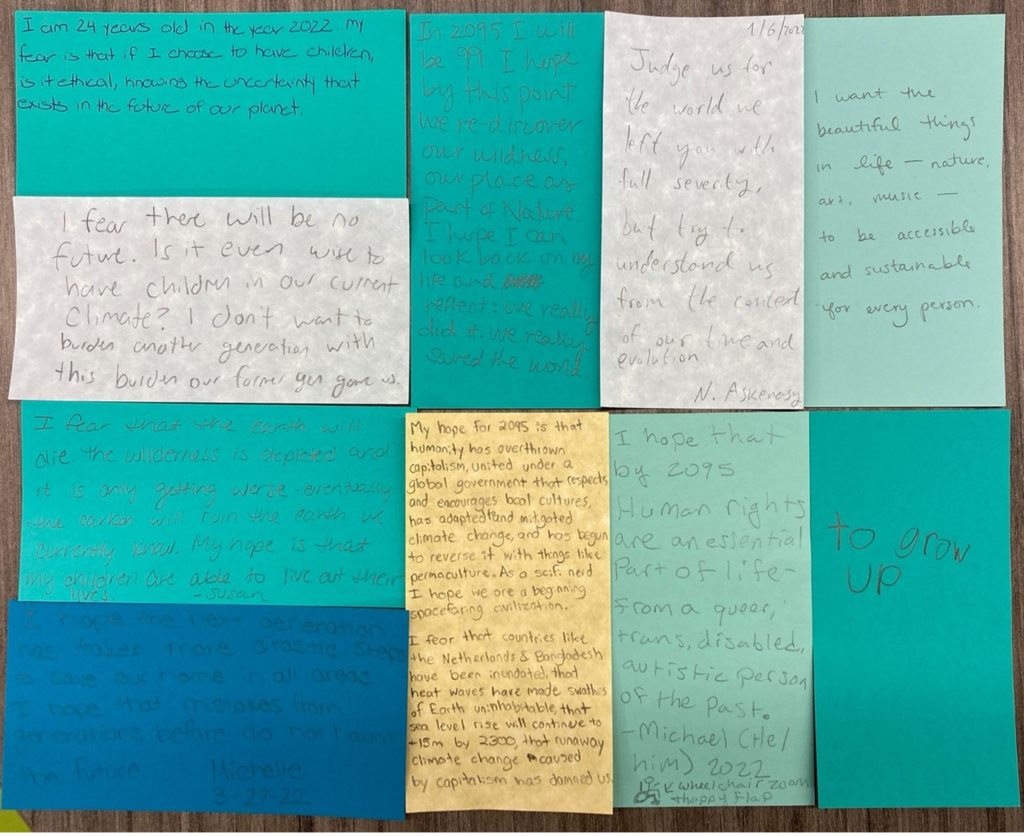
The year with the most messages is 2095. That, for most of us, is far enough in the future where we will be dead, and the following generations will be the ones to read the messages. This batch tends to lead into the fantastical, but perhaps possible? (Dinosaurs coming back, flying cars, interplanetary colonies), the super hopeful (world peace, climate disaster averted, human and non-human rights as norm, world hunger solved) or super fatalistic (humans have killed themselves off with most of the planet’s life, the robots take over Matrix-style, suffocating capitalism or government control, poison by pollution and heightened injustice). There’s also advice about ‘being the change you want to see’ and apologies ‘for screwing you over.’ Personally, I think the reason 2095 has the most messages is because it’s far enough away that it’s easier to remove oneself from the complicated day to day systems we’re involved in (like politics, culture, ethics, and current events), and to see the systems from a bird’s eye view.
What’s incredible about the messages, is that they come from all ages. From misspelled messages from kids just learning how to write and process the world around them, to older generations thinking back on their life and thinking forward for their grandkids.
Observing visitors interacting and reading their messages has been the most rewarding experience I could have asked for as an artist and project manager. Visitors spend so much time there, reading others’ messages, then sitting to write down their thoughts. Families come in and it becomes a family activity, sitting around the table, silent in their writing. I’m glad they feel invited to share their thoughts about the future of life on Earth. I read through every message and prepare them for documentation so they can be included in our collection. There isn’t one reading session where I don’t leave both laughing and crying.
Think about what your life will be like in 5, 13, 73 years.
What are your hopes and fears for the future of life on Earth?
If you would like to contribute to the time capsules, please visit before the We Are Nature: A New Natural History exhibit experience ends in November 2022. The message you write and post to the wall will be sealed inside a time capsule at the end of the exhibition. The capsules and all the messages will be preserved in the museum’s collection and opened in 2027, 2035, and 2095.
Thanks to the Gallery Experience Presenter Staff, the Natural History Interpreters, Events, Visitor Services, Education, Exhibitions, Anthropology, Anthropocene Studies, We Are Nature team, and the volunteers for your help making this installation possible.
Asia Ward is a social practice artist. You can learn more about her work on her website AsiaWard.com.
References
Asia Ward website. Accessed June 2, 2022.
Bordenstein, Sarah. “Tardigrades (Water Bears).” Microbial Life Educational Resources. Accessed June 2, 2022.
https://serc.carleton.edu/microbelife/topics/tardigrade/index.html
Carnegie Museum of Natural History website, Nature Crawl June 10th 2022 registration webpage. Accessed June 2, 2022 https://carnegiemnh.org/event/nature-crawl-21-june/
Carnegie Museum of Natural History website, We Are Nature: A New Natural History webpage. Accessed June 2, 2022. https://carnegiemnh.org/explore/we-are-nature-a-new-natural-history/#:~:text=Carnegie%20Museum%20of%20Natural%20History%20follows%20up%20its%20groundbreaking%202017,time%20to%20our%20own%20times.
Megumu Tsujimoto, Satoshi Imura, Hiroshi Kanda. “Recovery and reproduction of an Antarctic tardigrade retrieved from a moss sample frozen for over 30 years.” Cryobiology. February 2016. Accessed June 2, 2022
https://www.sciencedirect.com/science/article/pii/S0011224015300134
Myriam Richaud, Emilie Le Goff, Chantal Cazevielle, Fumihisa Ono, Yoshihisa Mori, Naurang L. Saini, Pierre Cuq, Stephen Baghdiguian, Nelly Godefroy, Simon Galas. “Ultrastructural analysis of the dehydrated tardigrade Hypsibius exemplaris unveils an anhydrobiotic-specific architecture.” PubMed Central. March 9th, 2020. Accessed June 2, 2022.
https://www.ncbi.nlm.nih.gov/pmc/articles/PMC7062702/
O’Callaghan, Jonathan. “Hardy water bears survive bullet impacts- up to a point.” Science. March 18, 2021. Accessed June 2, 2022.
https://www.science.org/content/article/hardy-water-bears-survive-bullet-impacts-point
Waldman, Ariel. “Tested From Home: How to Find Tardigrades in Your Backyard!” YouTube Adam Savage’s Tested, Accessed June 2, 2022. https://www.youtube.com/watch?v=ccmnSXJG3QE
Wianecki, Shannon. “Hawaii’s mysterious water bears.” BBC, Travel. August 21st, 2016. Accessed June 2, 2022.
https://www.bbc.com/travel/article/20160602-hawaiis-mysterious-water-bears
Wright, Jeremy. “Tardigrada water bears (Also: moss piglets).” Animal Diversity Web. Accessed June 2, 2022.
https://animaldiversity.org/accounts/Tardigrada/#lifespan_longevity
Related Content
Water Bears: Why My Yard is Like the Moon
Carnegie Museum of Natural History Blog Citation Information
Blog author: Ward, AsiaPublication date: July 8, 2022