• Skip to primary navigation
  • Skip to main content
  • Skip to primary sidebar

Carnegie Museum of Natural History

One of the Four Carnegie Museums of Pittsburgh

  • Visit
    • Buy Tickets
    • Visitor Information
    • Exhibitions
    • Events
    • Dining at the Museum
    • Celebrate at the Museum
    • Powdermill Nature Reserve
    • Event Venue Rental
  • Learn
    • Field Trips
    • Educator Information
    • Programs at the Museum
    • Bring the Museum to You
    • Guided Programs FAQ
    • Programs Online
    • Climate and Rural Systems Partnership
  • Research
    • Scientific Sections
    • Science Stories
    • Science Videos
    • Senior Science & Research Staff
    • Museum Library
    • Science Seminars
    • Scientific Publications
    • Specimen and Artifact Identification
  • About
    • Mission & Commitments
    • Directors Team
    • Museum History
  • Tickets
  • Give
  • Shop

Nicole Heller

June 7, 2023 by Noelle Swart

Carnegie Museum of Natural History Presents Chirp, Chitter, Caw: Surrounded by Birdsong

This summer, Carnegie Museum of Natural History invites visitors of all ages to experience the audio exhibition Chirp, Chitter, Caw: Surrounded by Birdsong, created in partnership with artists Chris Hoff and Sam Harnett, founders of The World According to Sound. The new visitor experience runs July 1 through September 4, 2023, in the museum’s iconic Bird Hall and adjoining R.P. Simmons Family Gallery. It is free with museum admission.

Stylized banner that reads "Chirp, Chitter, Caw! Surrounded by Birdsong" Above the words there are speech bubbles with musical notes and various lines. On the right there's a woodpecker taxidermy mount.

Visitors can relax in a listening lounge, mimic unusual bird calls, and stroll down Bird Hall to hear sonic snapshots created by Hoff and Harnett. Featured sounds include the low rumble of the Southern Cassowary, the mimicry of the Superb Lyrebird, and the rhythmic knocks of the Pileated Woodpecker. The experience tunes audiences into the world of birdsong to discover the beauty and complexity of avian communication that surrounds us.

“We were so excited when Chris and Sam approached us about bringing this experience to Pittsburgh,” said Sarah Crawford, the museum’s Director of Exhibitions and Design. “Our audiences love Bird Hall and are always eager for bird programming, whether they’re exploring our displays, following the research and bird banding at our Powdermill Avian Research Center in the Laurel Highlands, or demonstrating their familiarity and passion for the region’s birds on social media. I can’t wait for them to experience the incredible artistry of Chris and Sam. The museum’s birds will never look—or sound—the same.”
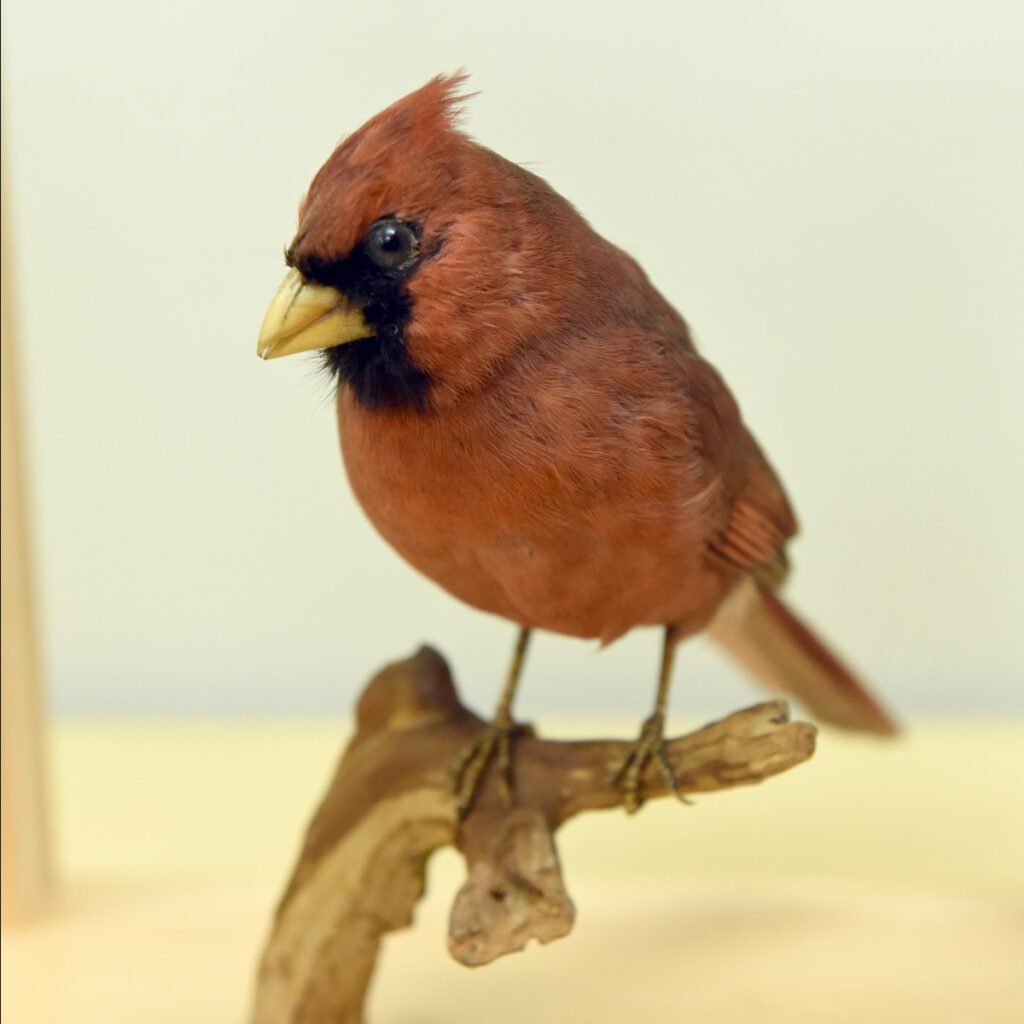
Northern Cardinal taxidermy mount
Northern Cardinal at Carnegie Museum of Natural History. Photo by Matt Unger. 

The exhibition is free with museum admission and runs until September 4, 2023. General museum admission costs $25 for adults, $20 for adults 65 and older, $15 for children aged 3-18 or students with valid student IDs, and $12 after 3 p.m. on weekdays. Admission is free for members and children aged 2 and younger. More information is available at CarnegieMNH.org.

Filed Under: Press Release Tagged With: Anthropocene, Anthropocene Section, Anthropocene Studies, Nicole Heller

April 10, 2023 by Erin Southerland

Researchers Call for New Conservation Paradigm that Embraces Positive Contributions of Land Stewardship

In a new study published by the journal Nature Sustainability, researchers call for a revised conservation paradigm that recognizes human and natural systems as inextricably intertwined and co-evolving and acknowledges the potentially positive roles that people play in generating ecosystem health through land stewardship. The researchers—representing Carnegie Museum of Natural History, Stanford University, and the Santa Cruz Mountains Stewardship Network—argue that revised conservation and sustainability science paradigms are integral to adapting to climate change and other anthropogenic stresses. Current frameworks—while recognizing the damaging impacts of society on nature and the positive contributions of nature to people’s wellbeing—gloss over people’s positive contributions to nature. This ignores the variability, complexity, and mutually constitutive states of culture, society, and ecologies. The researchers collaborated with the Santa Cruz Mountains Stewardship Network (SCMSN), located in a biodiversity “hot spot” and urban population center, as a case study assessment that incorporates land stewardship alongside other ecosystem health metrics and illuminates the challenges and opportunities for similar frameworks. 
 
Historically, people lose access to land when it is set aside for conservation, ceasing land stewardship altogether due to the assumption that human activities can only diminish the biodiversity and health of wildlands. Recently, a return to diverse forms of stewardship—including using fire, harvesting timber, raising animals, and cultivating local food—has earned attention because of the benefits to managing ecosystem health in the face anthropogenic stresses, like invasive species and climate change. For example, in California, low-intensity grazing is useful for reducing invasive plants, while Indigenous cultural burning and restoration forestry are important tools for reducing the impacts of large, severe fires that are increasing with climate change. The researchers concede that challenges lie in identifying appropriate metrics to express stewardship geospatially and study its effects. Land stewardship is relationship-based, place-based, and dynamic. It is not easily classified, mapped, or quantified, and often occurs on private lands or in private contexts that are hard to study. Understanding and embracing the social-ecological complexities of land stewardship will prove critical for the future of conservation science.
 
“The threat and urgency of climate change and biodiversity loss is real, and as a society, we are not going to solve these problems without transformational shifts in our thinking and doing in all fields of practice.” said Dr. Nicole Heller, lead author and Associate Curator of Anthropocene Studies at Carnegie Museum of Natural History.  “For too long, conservation science has promoted a worldview that eschews people from nature, ignoring valuable knowledge and mutually beneficial relationships people have with land and other species. This injustice has especially been the case with Indigenous populations and others with long cultural histories of stewardship in a specific place. The emerging paradigm shift, recognizing the value of land stewardship to ecosystem health, raises many interdisciplinary research questions and indicates an opportunity for more investment in caring for land stewards and land stewardship as part of protecting Nature. Re-thinking people and their possibility to be in good relationships with the land could be a game changer for sustainability.”
 
The study reflects one of Carnegie Museum of Natural History’s strategic commitments: to align research and programming around the “We Are Nature” concept, recognizing that humans are an inextricable part of nature—a powerful yet fragile relationship that has evolved over thousands of years.  The museum debuted the We Are Nature podcast in 2022—the first season of which focused on local and regional climate action, including land stewardship—as a follow-up and companion to We Are Nature visitor experiences in the museum in 2017 and 2021. 
 
In addition to Dr. Heller, the paper’s authors include Dr. Kelly McManus Chauvin, Jasper Ridge Biological Preserve and Department of Biology, Stanford University; Dylan Skybrook, Santa Cruz Mountains Stewardship Network; and Dr. Anthony Barnosky, Jasper Ridge Biological Preserve, Stanford University and Department of Integrative Biology, University of California, Berkley. Additional information about the study and SCMSN, including a conversation with the researchers, is available at Stanford News. 

Filed Under: Press Release Tagged With: Anthropocene, Anthropocene Section, Anthropocene Studies, climate change, Nicole Heller

June 10, 2021 by wpengine

New Anthropocene Publication: Stemming the Tide

by Nicole Heller

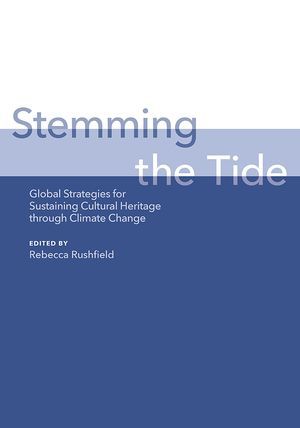
Blue and white cover of a book. Title: Stemming the Tide: Global Strategies for Sustaining Cultural Heritage Through Climate Change. Edited by Rebecca Rushfield.

I am pleased to share this Smithsonian Scholarly Press publication, Stemming the Tide: Global Strategies for Sustaining Cultural Heritage Through Climate Change. The e-book, edited by Rebecca Rushfield, is available online and freely available to read and download. It is the product of an international symposium organized and hosted by the Smithsonian Institution, Washington DC, March 5 – 6, 2020. According to Amber Kerr, Chief of Conservation, Smithsonian American Art Museum “The objective of the symposium was to empower cultural heritage authorities, managers, and advocates to pursue more ambitious engagement with, and collaborative approaches to, the climate crisis,” and “250 registrants and 1,100 live web stream viewers representing 33 states and 25 countries ranging from the United Kingdom, Spain, and Greece to Canada, Mexico, and Trinidad and Tobago” took part.

I was honored to be invited to participate and frame remarks about museums and climate change. Looking back, the symposium was at the beginning of difficult times. The crisis of the coronavirus pandemic was just becoming a known reality. I recall forgoing handshakes and hugs, and instead bumping elbows, with the awesome group of global professionals assembled.

Perhaps for this reason, seeing this volume published now gives me extra pause, and feels especially symbolic of the interconnections between people and planet – past, present and future – and the risks we face in the early 21st century. As Lonnie G. Bunch III, Secretary of the Smithsonian Institution, writes in the forward “This publication invites us to put our heads together and lead the cultural heritage sector in addressing the most pressing issue of our time.”

My chapter, “Museums Facing Climate Change. All Hands On Deck: Moving Past Climate Science and Into Culture,” is about the special opportunity for museums to lead on climate change action and education in their communities, and draws on the good works started at the Carnegie Museum of Natural History with We Are Nature: Living in the Anthropocene and Climate Systems Partnerships. Other chapters explore a wide range of issues. For example, there are chapters on adapting cultural heritage sites and historic buildings to increased risks from extreme weather and sea level rise, ensuring the preservation of collections and archeological sites, supporting resilience of displaced communities, sustaining and respecting Indigenous knowledge and storytelling, as well as tools for mitigating greenhouse gases and improving sustainability practices in collections and exhibition practices.

While intended for a professional audience, I imagine this book will be relevant to anyone concerned about human-caused climate change and interested in the diverse opportunities and challenges it presents. I commend the Smithsonian Institute for leadership in organizing the symposium and publishing this valuable resource. I look forward to using it with my colleagues at the Carnegie Museums and here in Pittsburgh toward pursuing more ambitious engagement and collaborative approaches to the climate crisis.

Read Stemming the Tide: Global Strategies for Sustaining Cultural Heritage Through Climate Change free online.

Nicole Heller is Curator of Anthropocene Studies at the Carnegie Museum of Natural History. Museum employees are encouraged to blog about their unique experiences working at the museum.

Related Content

Warmer Springs and Earlier Birds

Cities Are Not Biological Deserts

Pittsburgh’s Moths Reflect Environmental Impacts of Industry

Carnegie Museum of Natural History Blog Citation Information

Blog author: Heller, Nicole
Publication date: June 10, 2021

Share this post!

  • Share on Twitter Share on Twitter
  • Share on Facebook Share on Facebook
  • Share on Pinterest Share on Pinterest
  • Share on LinkedIn Share on LinkedIn
  • Share on Reddit Share on Reddit
  • Share via Email Share via Email

Share this post!

  • Share on Twitter Share on Twitter
  • Share on Facebook Share on Facebook
  • Share on Pinterest Share on Pinterest
  • Share on LinkedIn Share on LinkedIn
  • Share on Reddit Share on Reddit
  • Share via Email Share via Email

Filed Under: Blog Tagged With: Anthropocene, Anthropocene Studies, Nicole Heller, Science News

April 7, 2021 by wpengine

Cities are Not Biological Deserts

by Nicole Heller

Cities are increasingly important in organizing the experience of people and their interactions with nature. In 1950 there were 2.5 billion people on Earth and 30% lived in cities. Today, there are 7.5 billion people and 55% live in cities. By 2050, there will be an estimated 9.5 billion and 68% will live in cities.

Generally, cities are not good places for other critters to live. The abundance of pavement, buildings, traffic, pollution, pesticides, herbicides, and other hazards make cities really hard places for plants and animals to survive and breed. From a conservation science perspective, cities have long been considered dead spaces, or biological deserts. But more recently researchers are paying more attention to nature in cities. One reason for their interest involves people’s need for nature. Study after study confirms the basic biophilia hypothesis, that people want to associate with nature; they are happier and healthier when they are near plants and animals in their daily lives.

Berlin is recognized as a city that works for people and biodiversity due to its high percentage of green space, variety of habitats, and thoughtful regional planning. Photo by Filipe Varela on Unsplash.

Cities have also drawn the attention of researchers because of some really exciting things are happening within their limits, such as growing populations of peregrine falcons , sightings of rare birds using cities parks during annual migrations, and even discoveries of new species not previously known to science. While cities are overall negative for biodiversity, recent research findings raise important questions: Can human cities be good for non-humans too? Can urban wildlife include a broader spectrum of creatures beyond the common city-adapted species like European sparrows, pigeons, and black rats? What about species special or unique to the regions in which cities are located? How can we make cities work for biodiversity?

A few years ago I posed these questions along with colleagues from the Resilient Landscape program at the San Francisco Estuary Institute. We wanted to learn if there were general lessons that could be distilled from recent and ongoing research projects about what kinds of species can benefit from cities and if so how might city planners utilize this information to prioritize actions that would help cities contribute positively to the resilience of regional biodiversity, or at least do more to diminish the negative impacts.

Earlier this year, some of our findings were published open source in the journal Bioscience, The Biological Deserts Fallacy: Cities in Their Landscapes Contribute More than We Think to Regional Biodiversity, by Erica N Spotswood, Erin E Beller, Robin Grossinger, J Letitia Grenier, Nicole E Heller, Myla F J Aronson.

The study, which includes citations from dozens of regional research projects around the world, identifies five pathways by which cities can help regional biodiversity. “Cities can benefit some species by releasing them from threats in the larger landscape, increasing regional habitat heterogeneity, acting as migratory stopovers, enhancing regional genetic diversity and providing selective forces for species to adapt to future conditions under climate change (e.g., a phenomenon we are calling preadapting species to climate change), and enabling and bolstering public engage­ment and stewardship.”

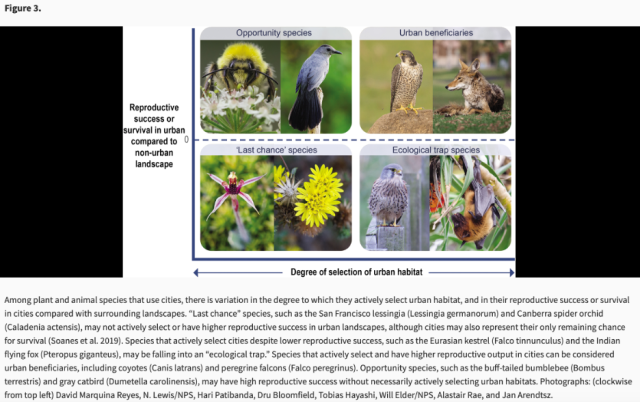
Each of these pathways is described in greater detail in the study. Four categories of species commonly utilize urban habitat, with varying degrees of success, and the study explores examples of how specific species in specific places demonstrate these five pathways.

screen grab of a figure from a paper with birds and flowers

Overall, the role of cities in supporting landscape-scale biodiversity is an understudied area of research. As cities continue to grow in number and size, human populations rise, and climate change continues, paying attention to the experience of other critters, and how we can make space for them to survive and thrive in anthropogenic habitats, will be more important than ever. This research identifies opportunities to reconcile cities with biodiversity. Opportunities exist to learn more about the unique resources that cities can provide, which specific types of species can take advantage of these resources, and how this information can be incorporated into city plans for parks and green spaces. The San Francisco Estuary Institute has begun this applied work in their report Making Nature’s City, which presents a science-based framework for increasing biodiversity in cities.

What excites me are possibilities if we really try. For the most part cities have been developed with little or no concern for biodiversity. Often people think that humans and nature just can’t coexist. What if city planners and conservation professionals start applying these lessons from ecology more broadly and work together with citizens to deliberately steward biodiversity in cities? How abundant and rich with diverse life could cities become? How happy would that make humans? I wonder. And I am hopeful.

If you are interested in urban nature, you can help to measure its diversity by participating in the museum’s upcoming City Nature Challenge. You never know what you may find in our city. Our combined observations, coupled with the museum’s collections and records, will provide important benchmarks to help track how local species are doing as the region keeps growing and changing in the 21st century.

Full Article Citation

The Biological Deserts Fallacy: Cities in Their Landscapes Contribute More than We Think to Regional Biodiversity By ERICA N. SPOTSWOOD , ERIN E. BELLER, ROBIN GROSSINGER, J. LETITIA GRENIER, NICOLE E. HELLER, AND MYLA F. J. ARONSON BioScience, Volume 71, Issue 2, February 2021, Pages 148–160, https://doi.org/10.1093/biosci/biaa155

Nicole Heller is Curator of Anthropocene Studies at the Carnegie Museum of Natural History. Museum employees are encouraged to blog about their unique experiences working at the museum.

Related Content

Teaching About Local Wildlife with the City Nature Challenge

Air Quality and Urban Gardening

Introducing the Anthropocene Living Room

Carnegie Museum of Natural History Blog Citation Information

Blog author: Heller, Nicole
Publication date: April 7, 2021

Share this post!

  • Share on Twitter Share on Twitter
  • Share on Facebook Share on Facebook
  • Share on Pinterest Share on Pinterest
  • Share on LinkedIn Share on LinkedIn
  • Share on Reddit Share on Reddit
  • Share via Email Share via Email

Share this post!

  • Share on Twitter Share on Twitter
  • Share on Facebook Share on Facebook
  • Share on Pinterest Share on Pinterest
  • Share on LinkedIn Share on LinkedIn
  • Share on Reddit Share on Reddit
  • Share via Email Share via Email

Filed Under: Blog Tagged With: Anthropocene, City Nature Challenge, Nicole Heller, Science News, We Are Nature 2

December 15, 2020 by wpengine

New Anthropocene Studies Paper in Curator: The Museum Journal

two hands clasped together and painted to look like the earth

A recent paper in Curator: The Museum Journal sheds light on the particular and growing relevance of natural history museums in sharing information about the Anthropocene, a proposed geological epoch, generally defined by the significant impacts of human activities on the Earth’s systems. In the 18 pages of The Anthropocene in Natural History Museums: A Productive Lens of Engagement, four co-authors use a careful comparison of two recent ground-breaking exhibitions devoted to the topic, one at a small natural history museum in Switzerland, and the other at Carnegie Museum of Natural History (CMNH), to establish how museum spaces as well as the unique materials that museums collect and preserve were effectively used to provide visitors with the means to experience the complexity, uncertainty, and interdisciplinary nature of current work in this relatively new field of study.

The Swiss exhibition, Objectif Terre: Vivre l’Anthropocene (Destination Earth: Living the Anthropocene) which was open during 2016 and 2017 at the Valais Nature Museum in the town of Sion, was the very first natural science exhibition worldwide specifically about the Anthropocene. The CMNH exhibition, We Are Nature: Living in the Anthropocene, which was open in 2017 and 2018, was the first major exhibition in North America to focus on the topic.

The paper also explores ways that the Anthropocene is driving changes in the practice of natural history science. The Anthropocene shows that humans are an integral part of nature, creating a challenge to the nature/human dichotomy that has been a common organizing principal in Western science and cultural worldviews. The authors maintain that recognition and study of ongoing human-induced changes is coupled with responsibility. Clear calls are made for scientists to explode the boundaries between natural science and social sciences, humanities and arts; and to think more critically about cultural assumptions and biases that are limiting scientific understandings and human responses to ecological crises. Analysis of the success of both exhibitions is tempered with advocation for more transdisciplinarity (people from different fields and backgrounds working together) and more attention to humanistic concerns and social equity in natural history museums. The overall conclusion of the peer-reviewed work is that in facing the Anthropocene, natural history museums are more relevant than ever. They have a critical role to play in 21st century education about social-ecological challenges, and in mobilizing community understanding and motivation to act for just sustainability.

The four co-authors came together to collaborate in the context of Gil Oliveira’s 6-month visit to CMNH to intern in the Anthropocene Studies section under the mentorship of Nicole Heller. His internship was part of attaining his Master of Arts in Museum Studies at the University of Neuchâtel. Gil had worked on the exhibition Objectif Terre: Vivre l’Anthropocene at the Valais Nature Museum with Museum Director, Nicolas Kramer.

The Anthropocene in Natural History Museums: A Productive Lens of Engagement in Curator The Museum Journal

GIL OLIVEIRA, ERIC DORFMAN, NICOLAS KRAMAR, CHASE D. MENDENHALL, AND NICOLE E. HELLER

Full Article can be found here, https://onlinelibrary.wiley.com/doi/full/10.1111/cura.12374.

Nicole Heller is Curator of Anthropocene Studies at the Carnegie Museum of Natural History. Museum employees are encouraged to blog about their unique experiences working at the museum.

Related Content

What does it mean to be for a Place?

Women in Science at Carnegie Museum of Natural History

Happy International Peace Day! 

Filed Under: Blog Tagged With: Anthropocene, Anthropocene Living Room, Museum from Home, Nicole Heller, Science News

November 9, 2020 by wpengine

The Surrounding Trees Whispered with Their Leaves

A fictional short story about a new era of inter-being communication and earth healing from past human mistakes.

two children on bicycles riding on a path in the woods

As a transdisciplinary scholar, I am always pushing myself to experiment with new ways of communicating and exploring ideas. This summer, I was invited with my long-term collaborator, Tomas Matza, associate professor of Anthropology at University of Pittsburgh, to contribute to a Post-Covid Fantasies blog series published by the journal American Ethnologist. The prompt was to “propose imagined or speculative future scenarios for how things could be better in a post-covid world than previously.”

Writing this fantasy illustrated to me the power of speculative fiction for confronting the complexity of the Anthropocene. Anthropocene problems – climate change, biodiversity loss, pandemics – are overwhelming. How are we possibly going to solve the myriad of challenges that we all face living on a crowded, hot planet? It’s hard enough these days just to go to the grocery store!  But with speculative fiction – or imagining futures, we can transcend the practical affairs of “real life” and let our minds wander freely. We can explore unthinkable changes and fantastical scenarios.

For me one of the most surprising aspects of the pandemic experience was how it caused society to stop, at least for a while. The sudden downturn in consumerism, production, travel, and consequently large drops in carbon emissions, was remarkable and unprecedented (documented in the scientific literature here and here). It made me wonder…how will society change in the 21st century? How might people in the future look back at the world today and see it from a radically different perspective? What will trigger the changes that result in our society becoming sustainable? Rather than being through incremental policy work and gradual change, perhaps it will come in a most unexpected way – a giant jump forward – caused by interspecies mingling beyond our wildest dreams?

I hope you enjoy our fantasy, and the other contributions in this series. And I encourage you to write your own post-covid fantasy! What do you imagine for the future?

Nicole Heller is Curator of Anthropocene Studies at the Carnegie Museum of Natural History. Museum employees are encouraged to blog about their unique experiences working at the museum.

Related Content

Anthropocene Living Room (Video)

The Inequity of Summer Heat

From the Allegheny to Our Kitchen Sinks

Filed Under: Blog Tagged With: Anthropocene, Anthropocene Living Room, Museum from Home, Nicole Heller, Science News

  • Page 1
  • Page 2
  • Go to Next Page »

sidebar

About

  • Mission & Commitments
  • Directors Team
  • Museum History

Get Involved

  • Volunteer
  • Membership
  • Carnegie Discoverers
  • Donate
  • Employment
  • Events

Bring a Group

  • Groups of 10 or More
  • Birthday Parties at the Museum
  • Field Trips

Powdermill

  • Powdermill Nature Reserve
  • Powdermill Field Trips
  • Powdermill Staff
  • Research at Powdermill

More Information

  • Image Permission Requests
  • Science Stories
  • Accessibility
  • Shopping Cart
  • Contact
  • Visitor Policies
One of the Four Carnegie Museums | © Carnegie Institute | Privacy Policy | Terms of Use | Accessibility
Rad works here logo